


Jimmy Kimmel, formerly host of ABC “Jimmy Kimmel Live!”, found his show abruptly “suspended” (translation: cancelled) after he made a particularly tasteless remark about the assassin who gunned down Charlie Kirk.
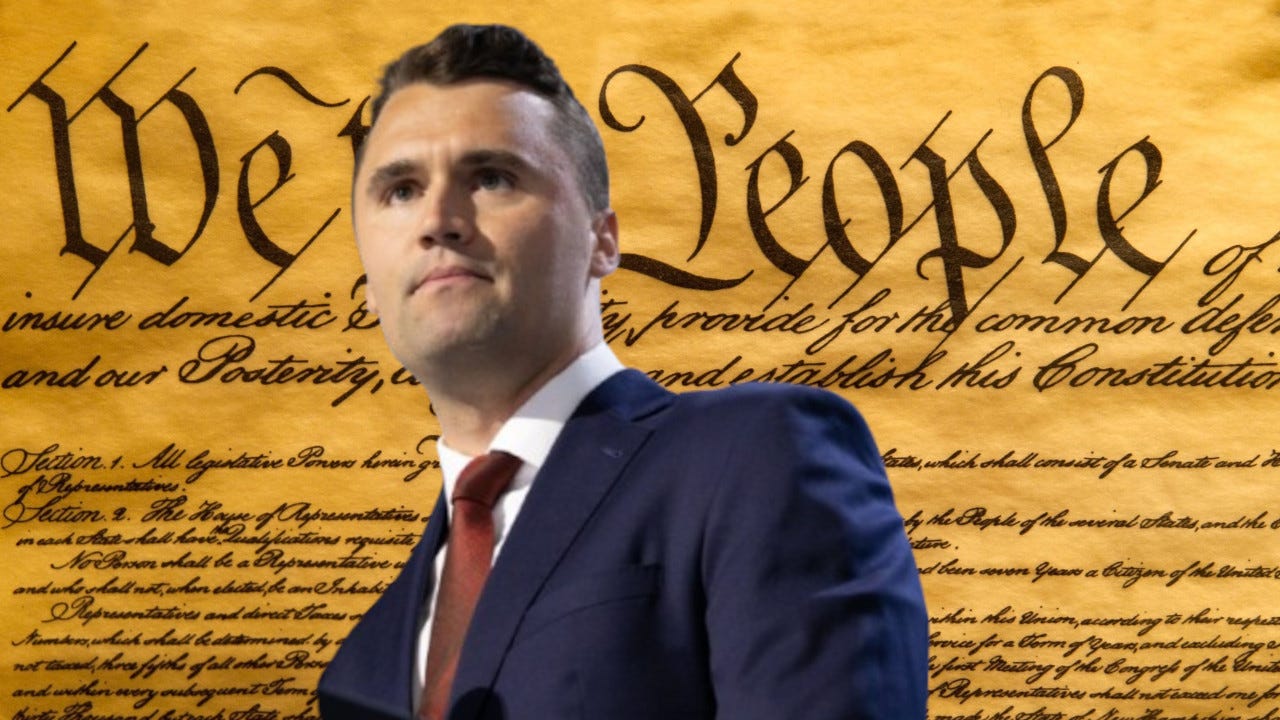
ABC on Wednesday night pulled the “Jimmy Kimmel Live!” late-night show off the air “indefinitely” after controversial comments by its host about the killing of conservative activist Charlie Kirk.
Was this censorship? Judging by the predictable howls of outrage among the corporate media and Democrat elites, cancelling Jimmy Kimmel was an outrageous assault on freedom of speech.
Yet a fuller contemplation of Kimmel’s remarks puts the lie to such claims. While there are aspects of his show’s cancellation which are cause for concern, there are also arguments to be made in favor of imposing sanctions on Kimmel for his remarks.
Contrary to the fulminations of the latest crop of eleventh-hour “free speech advocates”, at no point has America’s First Amendment protections of the freedom of speech ever been interpreted to mean freedom from consequence. The marketplace and private enterprise absolutely can and do impose consequences on people for what they say. The law supports them in this, and the law also supports criminal sanctions if what people say incites others to lawlessness and violence.
Moreover, those same “free speech advocates” have opposed Free Speech for others in the past. Their defense of Free Speech is “speech for me but not for thee.”
Can Free Speech endure in the face of such hypocrisy? Can any defense of Free Speech as a moral imperative prevail once people are unwilling to govern their own speech with principles of honesty, civility, and courtesy towards others?
If we do not have Free Speech for all, we will have Free Speech for none.
Free Speech Is A Moral Imperative
To restate what should always be obvious, yes, Free Speech is a moral imperative, and yes, we should defend the Free Speech rights of even those who say disgusting and offensive things. I have written in defense of Louis Farrakhan for that very reason, and I oppose President Trump’s ban on flag burning for that very reason.
As I defended Louis Farrakhan’s right to say offensive and disgusting things, I will unhesitatingly defend Jimmy Kimmel’s right to say offensive and disgusting things. I will defend anyone’s right to say offensive and disgusting things.
By any measure, Jimmy Kimmel’s comments were offensive and disgusting.
The MAGA Gang desperately trying to characterize this kid who murdered Charlie Kirk as anything other than one of them and doing everything they can to score political points from it
While there were the predictable expressions of outrage from social and political conservatives over Kimmel’s statement, non-conservative voices as well were disapproving. Sports commentator and media personality Stephen A. Smith lambasted Kimmel’s comment, pointing out that it wasn’t even funny.
Appearing on CNN, Geraldo Rivera condemned the comment completely, highlighting a particularly problematic context:
He’s basically saying that members of MAGA are — because Tyler Robinson is a member of MAGA, and because of that, somehow they had it coming, that Charlie Kirk had it coming. That, you know, once you go there, once you, you know, embrace that philosophy, that ideology, you’re fair game. You know, know, it’s just a I think that too often we — my whole life 55 years in the news business, the First Amendment has been my shield, my protection, I embrace it, I celebrate it, it’s extremely important, and it is important, and it is at times embattled, and I get I get that — But what we don’t get, you know, the more sophisticated it seems we are, what we don’t get is how grievously hurt regular people are. And how difficult sometimes in positions of power in communications or government, how easy it is to overlook the sincerity of that feeling and to dismiss it.
Yet while Jimmy Kimmel has the same right as anyone else to express his opinion and to speak his mind, that right does not shield him from condemnation for saying something that is outrageous, offensive, and, yes, disgusting.
A defense of Free Speech as a moral imperative does not preclude anyone calling out Jimmy Kimmel for his remarks. Even if one argues that legal sanctions against Kimmel are impermissible because of the First Amendment, moral sanctions against Kimmel are surely imperative.
People should be offended, and they should feel justified in turning away and tuning out Jimmy Kimmel at the very least.
If enough people tune out a late night talk show host, that host’s show is going to get cancelled. According to several accounts, that is exactly what happened, as ABC affliates wanted to put as much distance between themselves and Kimmel’s noxious remarks as possible.
"Mr. Kimmel’s comments about the death of Mr. Kirk are offensive and insensitive at a critical time in our national political discourse, and we do not believe they reflect the spectrum of opinions, views, or values of the local communities in which we are located," said Andrew Alford, president of Nexstar's broadcasting division. "Continuing to give Mr. Kimmel a broadcast platform in the communities we serve is simply not in the public interest at the current time, and we have made the difficult decision to preempt his show."
If Jimmy Kimmel has a right to speak his mind, ABC affiliates have a right not to amplify his toxic messages.
In this context, the defense of Free Speech should support the cancellation of Kimmel’s show.
Yet there is an important caveat in this: It is one thing if ABC affliates are responding to market pressures. It is quite another if they are responding to political pressures.
Were there political pressures? We cannot rule them out, because just before ABC pulled the plug on Kimmel’s show, FCC chairman Brendan Carr, appearing on conservative commentator Benny Johnson’s podcast, said openly Kimmel’s remarks invited legal sanctions against ABC and ABC parent company Disney.
Federal Communications Commission Chairman Brendan Carr blasted Kimmel on Wednesday, telling podcaster Benny Johnson that Kimmel's comments were "truly sick," and that there's a "strong case" for legal action against both ABC and Disney (ABC is a Disney subsidiary). "This is a very, very serious issue right now for Disney," said Carr. "These companies can find ways to take action on Kimmel or there is going to be additional work for the FCC ahead."
While Kimmel’s remarks are uniformly indefensible, even Republican Senator Ted Cruz found Brendan Carr’s rhetoric unpalatable.
Cruz noted that he was no fan of Kimmel’s, and said he is “thrilled that he was fired” over his comments about Kirk.
“But let me tell you, if the government gets in the business of saying we don’t say what you the media have said, we’re going to ban you from the airwaves if you don’t say what we like, that will end up bad for conservatives,” Cruz said.
Implicit in Cruz’ take is the presumption that Brendan Carr’s assertion of a strong legal basis for action is incorrect. To be sure, if Carr is wrong, if there is no legal basis for action against ABC and Disney, then Carr’s comments can quite easily be seen as political pressure to silence Jimmy Kimmel. Political pressure to silence anyone is an outright assault on Free Speech and should never be permitted, let alone defended.
But what if Carr is not wrong?
Tyler Robinson Felt Charlie Kirk Deserved Killing
Charlie Kirk’s killing presents a particular challenge when it comes to defending Free Speech: from Tyler Robinson’s own statements there is good evidence that he had absorbed an ideology which saw killing conservatives such as Charlie Kirk as a good thing.
ROOMMATE: "Why?"
ROBINSON: "Why did I do it? I had enough of his hatred. Some hate can't be negotiated out. If I am able to grab my rifle unseen, I will have left no evidence. Going to attempt to retrieve it again. Hopefully they have moved on. I haven't seen anything about them finding it."
Setting aside the question of whether Charlie Kirk was truly emblematic of hatred and bigotry, this exchange would seem to establish within Tyler Robinson’s mind that Charlie Kirk “deserved” killing.
Recall what Geraldo Rivera said about Jimmy Kimmel’s remarks:
…that Charlie Kirk had it coming. That, you know, once you go there, once you, you know, embrace that philosophy, that ideology, you’re fair game.
That is an attitude that is being expressed openly by many on the political left, such as podcaster “Destiny” (real name Steven Bonnell), who explicitly called for more conservatives to be targeted with violence.
You need conservatives to be afraid of getting killed when they go to events so that they look to their leadership to turn down the temperature. The issue is right now, they don't feel like there's any fear.
That is a direct call for political violence against the Charlie Kirks in this world.
The act of making statements intended or likely to incite violence has long been understood by the courts to be subject to legal sanction, and the First Amendment is not a bar to such sanction.
This was most clearly articulated in the Supreme Court case Brandenburg v Ohio1, which affirmed that government had a legitimate interest in forbidding acts of speech which were intended or likely to incite “imminent lawless action”, but that statutes which did not limit their prohibitions to acts of speech which could reasonably be seen as that sort of incitement were un-Constitutional.
We must also consider the social media backdrop for both Steven Bonnell’s remarks and Kimmel’s, a backdrop where multiple statements have been captured of people celebrating Charlie Kirk’s murder.
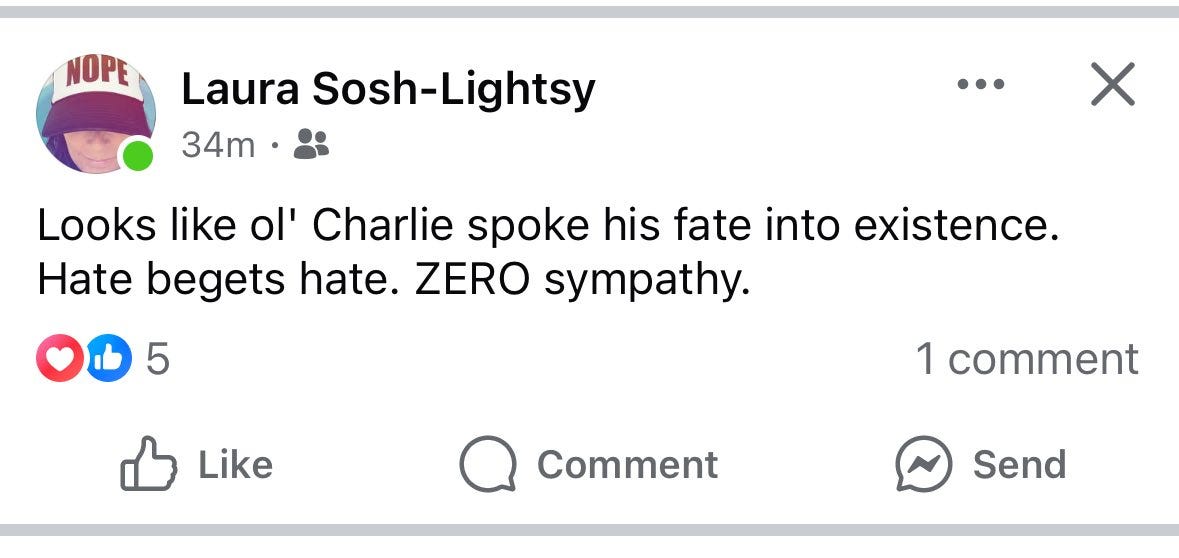
We know from Tyler Robinson’s texts that he harbored a lot of hatred against Charlie Kirk.
We know from the litany of comments made across social media that a number of people have either called for more violence in the wake of Charlie Kirk’s killing or celebrated that killing as an absolute good.
To what extent did such commentary play a role in Tyler Robinson’s choice to murder Charlie Kirk? At the very least, it played a role of some kind.
Does the continuation of such commentary create a probability that others will target conservative figures and attempt to kill them? Charlie Kirk’s murder makes this more likely than not.
Are Kimmel’s remarks likely to produce further violence? Because of Charlie Kirk’s murder, that claim is less extravagant than it was prior to Charlie Kirk’s murder.
Do they fall within the boundaries for acts of speech which are a call to violence?
Before Charlie Kirk’s assassination, we might have been hard-pressed to construct an argument that Kimmel’s remarks rise to the threshold where criminal sanctions and government pressure become appropriate. After Charlie Kirk’s murder, we are faced with clear evidence that threshold has been lowered dramatically. That Charlie Kirk’s murder was motivated at least in part by years of online commentary calling Charlie Kirk “racist” and “fascist” leaves us with few other conclusions.
If Kimmel’s remarks significantly increase the chances of any other conservative being targeted with violence, they run afoul of the Brandenburg tests.
Moreover, the Brandenburg case is not an outlier for the Supreme Court. The opinion itself drew on earlier cases, such as 1937’s Herndon v Lowry2, which subjected the First Amendment right of peaceable assembly as well as of Free Speech to similar constraints, holding that membership in any political organization could be criminalized only when that organization constituted a threat of lawlessness and violence.
The power of a state to abridge freedom of speech and of assembly is the exception, rather than the rule, and the penalizing even of utterances of a defined character must find its justification in a reasonable apprehension of danger to organized government.
A similar delineation was made in the 1961 case Noto v United States3, which held that membership in the Communist Party could be criminalized only if it was shown that the Communist Party intended its members take to imminent lawlessness and violence.
…the teaching of the moral propriety or even moral necessity for a resort to force and violence, is not the same as preparing a group for violent action and steeling it to such action. There must be some substantial direct or circumstantial evidence of a call to violence now or in the future which is both sufficiently strong and sufficiently pervasive to lend color to the otherwise ambiguous theoretical material regarding Communist Party teaching, and to justify the inference that such a call to violence may fairly be imputed to the Party as a whole, and not merely to some narrow segment of it.
The case law established by the Supreme Court is clear on one point: any act of speech intended or likely to produce lawless action or violence is subject to legal sanction.
Do modern progressives and Democrats intend their supporters to take to imminent lawlessness and violence? While many would say otherwise, a resolution by the US House of Representatives honoring Charlie Kirk and rejecting political violence garnered the support of only 95 Democrats.
Add to that the explicitly violent agenda of groups like Armed Queers SLC, which is currently under investigation for possible connections to Charlie Kirk’s shooting. A similar group, the Socialist Rifle Association, has made similar calls for violence against conservatives.
After Charlie Kirk’s assassination, we are presented in this country with the reality that violent and demonizing rhetoric can and does lead to political violence. If a late night talk show host is demonizing one political group and implying that violence against that group is somehow permissible, it no longer can be automatically presumed to be immune from legal sanction vis-a-vis Brandenburg.
Brendan Carr may not only be right about there being a legal basis for action against ABC and Disney for Kimmel’s comments, he may have a legal duty to bring such action. That would make Carr’s comments on Benny Johnson’s podcast decidedly uncomfortable, but also uncomfortably correct. That would leave Ted Cruz—who as Solicitor General for the State of Texas has argued cases before the Supreme Court—rather wide of the mark.
That there could be legitimate basis for government action in response to the continued intemperate rhetoric celebrating Charlie Kirk’s killing and beatifying his killer is disquieting to say the least, but it is a poor defense of Free Speech to argue Free Speech is somehow above the rule of law.
Progressives Have Censored And Will Censor Again
To this conundrum we must also consider a second: Were progressives still in power, they would already be moving levers of government power against people who espouse the talking points of political conservatives in this country. We know this because it has already happened.
Facebook CEO Mark Zuckerberg has confirmed that the Biden Administration had been pressuring Facebook to censor COVID-19 related content that expressed views contrary to the Administration’s official position.
In 2021, senior officials from the Biden Administration, including the White House, repeatedly pressured our teams for months to censor certain COVID-19 content, including humor and satire, and expressed a lot of frustration with our teams when we didn't agree.
Zuckerberg also confirmed that the FBI had pressured Facebook to censor political content in the runup to the 2020 election, including commentary surrounding Hunter Biden’s infamous laptop, which corporate media outlets and later 51 former US intelligence officials would pan as “Russian disinformation”.
We know from the discovery leading up to the Supreme Court case Murthy v Missouri4 that such pressures were not limited to Facebook, but encompassed several social media platforms.
I know from personal experience that LinkedIn censored COVID-19 content it did not like. I was ultimately banned from that platform for nearly two years. My “crime” was using actual government data to condemn the White House “winter of death” rhetoric pushed by then White House COVID-19 “czar” Jeffrey Zients.
From Murthy v Missouri we know that my cancellation was not merely LinkedIn policy, but also government policy. Nor am I an isolated case. The “Twitter Files” established that beyond all dispute.
Even if one conceded that Jimmy Kimmel’s cancellation is ultimately government censorship due to FCC pressure, the reality remains that such pressures did not originate at the FCC and did not begin with Brendan Carr.
Democrats weaponized government against speech and speakers they did not like long before this. Targeting journalists and their sources was a feature of the Obama Administration even before Donald Trump descended the escalator in 2015.
Free Speech is a moral imperative, but defending that moral imperative demands that all political actors be constrained from targeting and suppressing speech. If only one side of the political spectrum respects the principle of Free Speech, the principle is already defeated.
The same Democrats and progressives condemning Jimmy Kimmel’s cancellation have called for the cancellation of other figures. Even if Jimmy Kimmel’s cancellation amounts to censorship of Free Speech, progressives have sown a wind of censorship and are now reaping a whirlwind of retaliation.
Even if we accept Jimmy Kimmel’s cancellation as an act of censorship, if we condemn that cancellation and do not in the same breath condemn all the many acts of censorship committed by Democrats, we are not defending Free Speech but denying it. If Democrats want to condemn Jimmy Kimmel’s cancellation, they cannot claim any moral credibility until they own their acts of censorship and suppression of speech—and this they have not done.
Can Free Speech Survive?
Free Speech must be a moral imperative if we are to be a Free People living in a Free Society. On this point there is no second option.
Yet Free Speech can only be a moral imperative if we acknowledge that every act of speaking, every utterance made, will carry with it unavoidable consequences. If we do not speak honestly, and with civility and respect for all, we invite at the very least moral sanction and social opprobrium. If we do not accept the consequences arising from our acts of speech, we will no longer have Free Speech of any kind.
We can only shield Free Speech from oppressive legal sanction if we admit that all must account for what they say as well as what they do. The moment we seek to place any utterance beyond the realm of consequence, in that moment we make the principle of Free Speech into a sword rather than a shield. In that moment we turn claimed defenses of Free Speech into assaults on Free Speech.
The outrage among progressives over Jimmy Kimmel’s cancellation is not merely that Jimmy Kimmel was cancelled, but that the Trump Administration is doing what progressives have done repeatedly over the years. Progressives want to be the censors, not the ones censored.
Free Speech is a moral imperative. There can never be any question about that. There can never be any debate about that.
Yet Free Speech will only endure so long as all people in all parts of the political spectrum are committed to defending Free Speech for everyone, not just political friends and allies. If even one group abandons the ideal that Free Speech is the moral imperative for everyone, Free Speech is eliminated for everyone.
Can we still have Free Speech in this country? At present, I do not know.
Brandenburg v. Ohio, 395 U.S. 444 (1969)
Herndon v. Lowry, 301 U.S. 242 (1937)
Noto v. United States, 367 U.S. 290 (1961)
Murthy v. Missouri, 603 U.S. ___ (2024)
When I saw that you were addressing the topic of freedom of speech, Peter, I knew you would do so better than anyone else - and you have!
My hope is that the judicial system will now be impelled to address this topic, as well. I believe they would have to conclude that most of the recent ideology of the Left, such as “cancel culture “, has been an advocacy for limitations on free speech. In fact, to my mind, “cancel culture” is pure fascism! I’ve read that the definition of fascism is (paraphrasing) “business and government colluding to enforce a sole allowed viewpoint”. Um, isn’t that what DEI and cancel culture ARE? No wonder so many Americans find these ideas annoying and infuriating - they infringe on our right to freedom of thought and speech!
Thanks, as always, for your dazzling eloquence, Peter!
The freedom to express ideas as any one person desires is indeed prized. Unfortunately the cost for preserving the prize of freedom of expression is life, liberty, and the pursuit of happiness in certain cases, particularly when the expressions cause needless harm to certain persons and people groups. While some could express appreciation to Margaret Sanger for the freedom to use contraception when engaging in coitus, the concept of sexual freedom as proposed by her is limited to those whom she viewed as superior human beings. I apologize for this vulgar point wholeheartedly.