


When we last discussed Iran the ceasefire was holding…sort of.
The IRGC may have thought it was making a bold move and doing a little geopolitical flexing with its attack on the UAE. It is quite likely this attack will prove to be an epic blunder.
Tonight the ceasefire is holding. Tonight, the IRGC is still in charge in Tehran.
How long either of those statements remains true is anyone’s guess.
Against all odds, the ceasefire is technically still in effect, although both sides are making an increasing number of attacks on the other.
Last Friday, the US disabled two ships attempting to run the blockade on Iranian shipping.
Previously, Iran fired missiles at US “enemy units” as they sought to intercept another ship trying to run the blockade.
Iran is also reported to have launched additional missile and drone attacks on the United Arab Emirates, a curious escalation by the IRGC in a conflict already fraught with regional and global tensions.
Meanwhile, both the US and Iran claim to be winning the war, an Iran in particular is demanding other nations acknowledge it as a regional superpower.
Most of the week has been spent waiting to see if Iran would formally respond to US peace proposals. Today Iran officially responded.
In light of the IRGC’s recent demands, we are on safe ground summarizing the Iranian response as an emphatic “no.”
While the escalations themselves have largely yet to happen, it is highly likely that the next phase of this war with Iran will be more actual war—more bombings, more drone strikes, and more destruction.
Iranian intransigence on their illicit nuclear weapons program and illegal seizure of the Strait of Hormuz are foreclosing all other options. At present, there is no realistic alternative on the table for dealing with Iran’s multiple threats to the world except by war.
The Peace Deal
At the start of last week, a curious lull had developed in the war with Iran. The ceasefire was (mostly) holding, although there had been no peace breakthroughs or signs that negotiations would resume.
That lull ended on May 4, when Iran struck the United Arab Emirates oil terminal and refinery at Fujairah, outside the Strait of Hormuz.
The UAE’s defense ministry said three cruise missiles coming from Iran were intercepted and a third fell into the sea, and told its citizens the loud booms heard inside the country were the result of those aerial interceptions.
As I observed in my last article, Iran might have revealed more about its strategic objectives than it intended with that strike. Fujairah is one of the few Persian Gulf oil terminals outside the Strait of Hormuz.
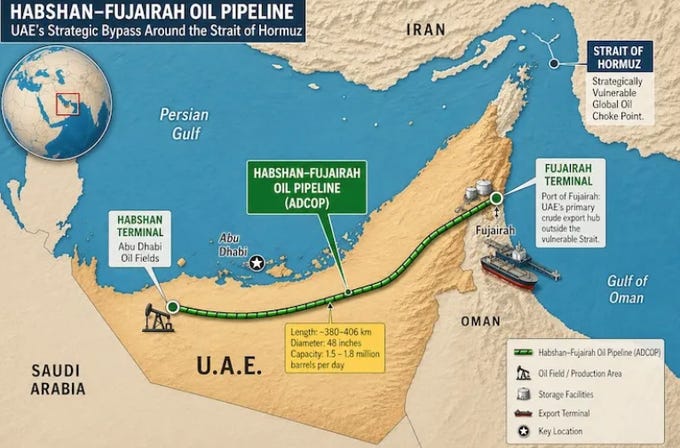
Even as Iran continues to push its claim of right to control traffic through the Strait—a claim which is completely rejected by the UN Convention on the Law of the Sea (UNCLOS)—Iran is separately attacking the infrastructures which Arab States might use to bypass the Strait and thus negate Iran’s diplomatic leverage of being able to deny Arab states in the Gulf the capacity to export their oil and natural gas.
If that is Iran’s intent, then the strikes on Fujairah are an unmistakable act of war. They are an aggressive demonstration of Iran on offense, not defense. That is not something that other Arab states, particularly Saudi Arabia, will have failed to notice.
It was against this backdrop that United States negotiators issued a “fourteen point memorandum” proposal, one that was less a proposal for peace than a proposal on how to negotiate a peace.
The document reportedly functions less as a full peace treaty and more as a temporary stabilisation mechanism. Under the current proposal, Iran would agree to suspend uranium enrichment activity for a prolonged period — reportedly somewhere between 12 and 15 years — while the United States would gradually ease sanctions and release billions of dollars in frozen Iranian funds.
The fundamental premise of the memorandum was that Iran and the US would stop shooting at each other or at neutral third parties, the Strait of Hormuz would be reopened with unfettered rights of transit passage for all nations recognized, and, most crucially, Iran would surrender its illicit nuclear weapons program.
At the heart of the memo lies the question that has shaped US-Iran tensions for decades: uranium enrichment. According to Axios, the United States wants Iran to commit formally to:
suspending enrichment activities,
abandoning any nuclear weapons ambition,
shutting down underground nuclear facilities,
and accepting expanded inspection powers, including snap inspections by UN monitors.
One particularly sensitive clause reportedly under discussion would require Iran to transfer its stockpile of highly enriched uranium outside the country — something Tehran has resisted repeatedly in past negotiations.
The nuclear weapons program has been the sticking point between the US and IRGC-dominated Khamenei Regime. The IRGC will not entertain any discussions that involve Iran surrendering its illicit nuclear weapons program—and yet that is the key topic in every discussion with Iran.
The US has acknowledged Iran could pursue a legitimate civilian use enrichment program, which would cap the degree of enrichment below 5%—well out of the range of any peaceful procet.
Secretary of State Marco Rubio told reporters Tuesday that if Tehran wants a “civilian nuclear program,” then it is free to pursue one.
“They could have that if that’s what they wanted, but they’re not acting like that’s what they wanted,” Rubio said in the White House briefing room. “They’re acting like they want a military nuclear program. That’s unacceptable.”
Under the memorandum of understanding, Iran would also agree to inspections by the United Nations on its nuclear program, while the U.S. would gradually lift sanctions and release billions in frozen Iranian funds, according to Axios.
President Trump has been clear and consistent on this point throughout the war with Iran: Iran cannot be allowed to possess nuclear weapons.
For its part, the IRGC refuses to concede that it will be blocked from doing whatever it wants involving weapons grade uranium and plutonium.
Iran’s Response
Officially, Iran has spent the past several days “reviewing” the US proposal, before rendering an official response. At the time, President Trump oscillated between pessimism and his reflexive optimism on the prospects the IRGC-led regime would accept the proposal.
An Iranian foreign ministry spokesperson cited by Iran’s ISNA news agency said Tehran would convey its response. U.S. President Donald Trump said he believed Iran wanted an agreement.
“They want to make a deal. We’ve had very good talks over the last 24 hours, and it’s very possible that we’ll make a deal,” Trump told reporters in the Oval Office on Wednesday.
Earlier in the day, Trump had sounded more pessimistic about the chances of a deal. In a Truth Social post, he threatened to restart the U.S. bombing campaign in Iran, calling the possibility of Tehran agreeing to the latest U.S. proposal a “big assumption.”
At the same time, Iranian media released several news items which called into question the key element of any peace proposal—Iran relinquishing its illicit control over the Strait of Hormuz.
While the regime was technically “reviewing” the proposal, the IRGC-linked Tasnim news agency published an article regarding Iran asserting control over the undersea data cables running through the Strait.
Tasnim, in an article titled “Three practical steps for generating revenue from Strait of Hormuz internet cables,” wrote that submarine fiber-optic cables passing through the strait carry more than $10 trillion in financial transactions each day, but said Iran has been deprived of the economic and sovereign benefits of this critical communications infrastructure because of what it called a traditional view of the strait.
The outlet said the Islamic Republic should take three steps: charge foreign companies initial licensing and annual renewal fees; require major technology companies such as Meta, Amazon and Microsoft to operate under Iranian law; and give Iranian companies exclusive control over maintenance and repair of the cables.
Tasnim said the measures would turn the Strait of Hormuz into a “strategic center for legitimate wealth creation.”
Fars, another IRGC-linked outlet, published a similar thread on X, describing Iran as the ruler of a “hidden highway” in Hormuz.
This proposal was and is nothing more than a mafia-like “protection” racket. It is blatant extortion, a point I noted when the article was released.
Folks from New York or Chicago will recognize the “protection” racket the IRGC is intimating (“that’s a useful data cable you have there. Be a shame if something happened to it.”)
Suddenly, the IRGC has decided that the Strait of Hormuz is sovereign Iranian territory, from the seabed on up.
We should note that the UN Convention on the Law of the Sea, which Iran has signed but not ratified, completely refutes Iran’s claims on the Strait. The Strait of Hormuz is and has always been a recognized international waterway, through which there is an unfettered right of transit passage per UNCLOS. As a Strait, under UNCLOS there is an unfettered right of transit passage per Article 38. Under UNCLOS, no states bordering a strait may interfere with the right of transit passage under Article 44.
Article 51 further refutes the notion that Iran has any claim to make on undersea cables.
However, international law and UN treaty obligations are not proving any obstacle for the IRGC regime, which is simply doubling down on bellicose rhetoric every time the Strait is mentioned.
With no breakthrough in sight, Iranian authorities continue to signal an elevated status in their doctrine for the strategic strait, perhaps rivalling the contentious nuclear programme for which the country has been sanctioned and isolated for decades.
The theocratic and military establishment in Iran has “neglected the blessing” of the strait for years, said Mohamad Mohkber, a senior adviser to slain Supreme Leader Ayatollah Ali Khamenei, and first vice president under late Ebrahim Raisi.
“In reality, it is a capability on the level of an atomic bomb, because when you have a capability that can affect the entire global economy with a single decision, that is an enormous capability,” he told state-linked Mehr news agency on Friday.
Following through on that rhetoric, even before the regime had officially sent a response, it made public statements that the Strait of Hormuz would remain entirely under Iranian control no matter what.
At that point, it was an open question if there was anything left in the proposal to which Iran had not already responded.
Earlier today, Iran finally submitted a written response to the US proposal, laying down several demands of its own.
According to diplomatic and Iranian sources cited by Arabic-language media, Tehran’s response places a ceasefire in Lebanon and the lifting of restrictions on Iranian oil exports at the center of any future understanding with Washington.
A diplomatic source speaking to Hezbollah-affiliated Al Mayadeen said the Iranian proposal calls for an end to what Tehran describes as the “siege” on the country and demands unrestricted Iranian oil exports. The source added that a ceasefire in Lebanon is considered one of Iran’s “red lines” in the negotiations.
In sum, Iran’s demands for a peace talks to begin was that the US acknowledge that the war was over, that the blockade of Iranian shipping was lifted, and that all US sanctions on Iran were terminated. All this while Iran kept control over the Strait of Hormuz, which it had already publicly stated it had no plans to ever surrender.
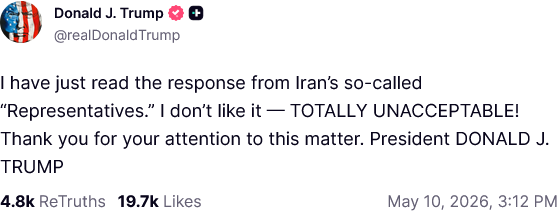
President Trump’s reaction to the Iranian response was not delayed at all, nor was it lengthy. Posting to Truth Social, President Trump pronounced the response “unacceptable.”
Thus ends the latest diplomatic effort to resolve and end this war.
Meanwhile, Provocations Mounted On Both Sides
While Iran “reviewed” the proposal, questions arose whether the ceasefire was still in effect, as there were reports of strikes coming from both sides:
In what US Central Command (CENTCOM) identified as blockade enforcement, US naval forces disabled the M/T Sea Star III and the M/T Sevda on May 8.
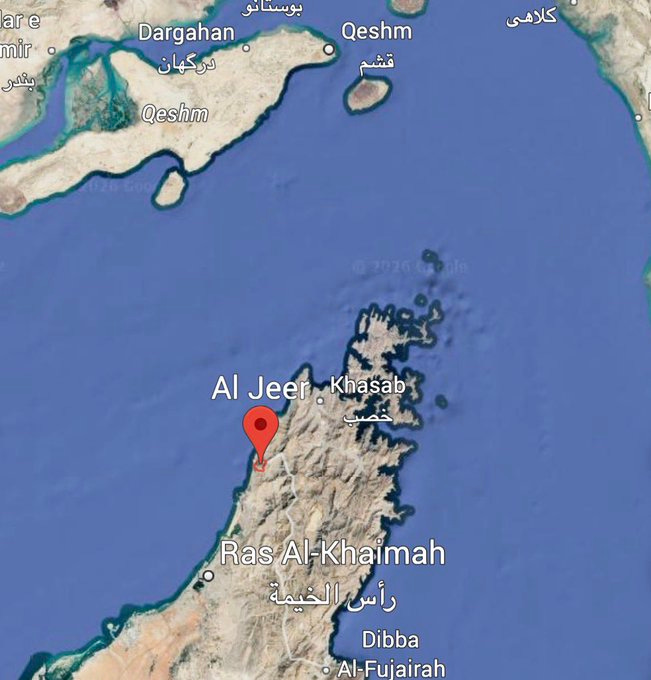
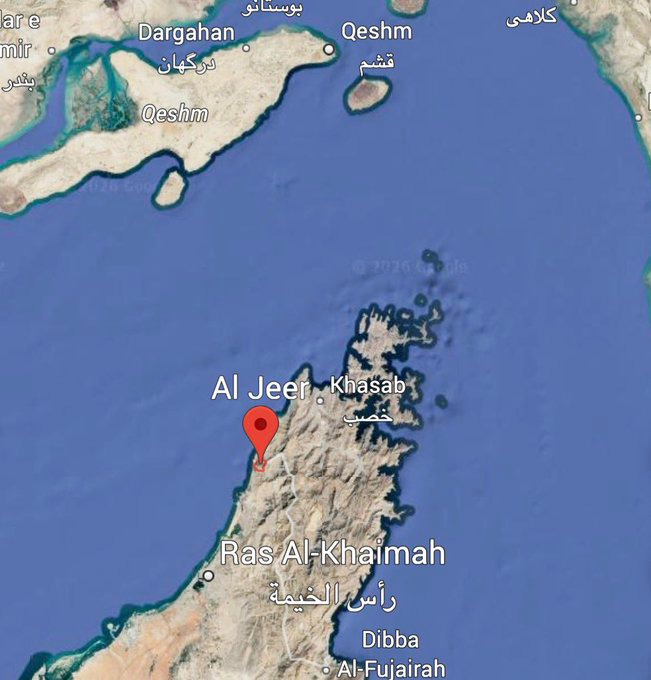
Separately, Iranian forces fired on a Chinese cargo vessel near the United Arab Emirates port of Al Jeer. Iran’s choice of targets was nothing if not ironic, given their reliance on Chinese economic assistance—nothing says “Help me, please!” so much like trying to blow up your financial patron’s boat.
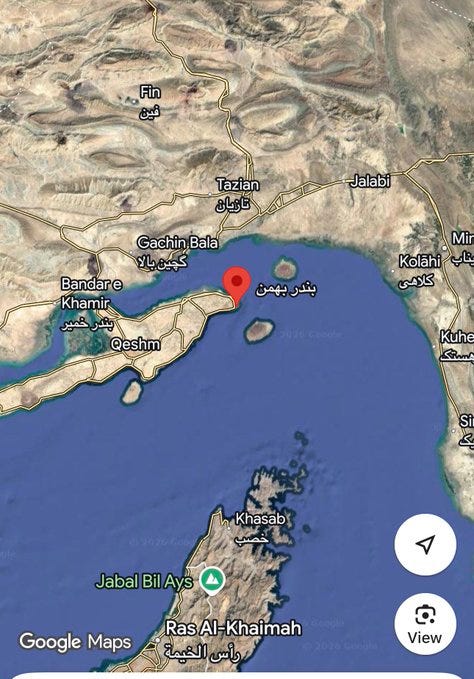
Shortly after the attack on the Chinese vessel, Iran reported that a commercial pier near Bandar Abbas had been attacked.
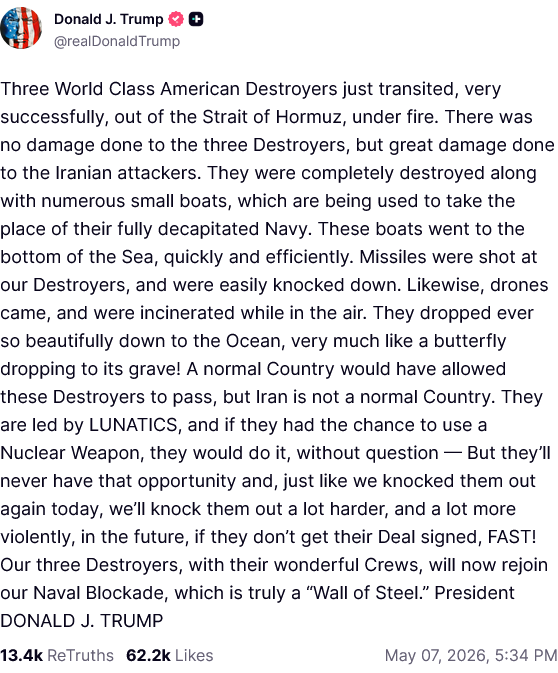
In a separate incident, the US Navy sent three destroyers through the Strait. While Iranian forces fired on them, the ships responded in kind and very successfully, according to President Trump posting on Truth Social:
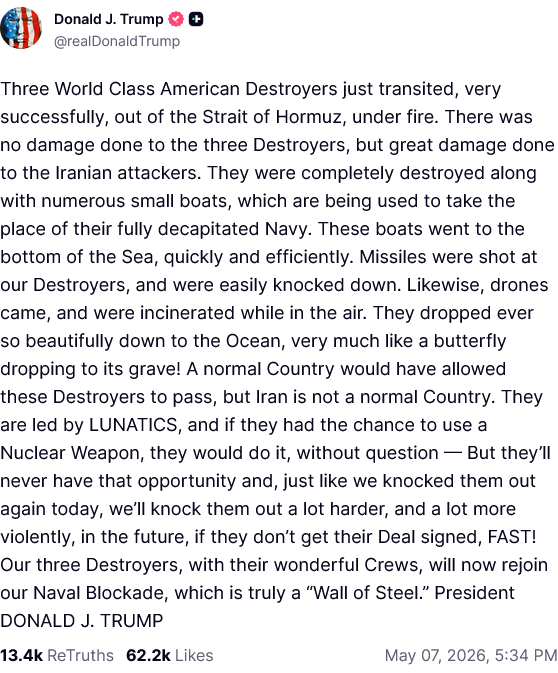
While the ceasefire was “technically” still in effect, outside observers might be forgiven for thinking that it had broken down, and that hostilities were ramping up once more.
More War?
With the Iranian response labeled completely unacceptable by President Trump, and there having already been an escalating sequence of tit-for-tat provocations between the US and Iran, the answer to the inevitable question “what next?” appears to have already been answered: there will be more war.
Within some analyses, that there would be more war has been largely inevitable. Even as Majlis Speaker Mohammed Bagher Ghalibaf has sought to thread the diplomatic needle between preserving the regime’s objectives and negotiating and end to the conflict, he is seen as being opposed—and largely blocked—by IRGC commander Ahmed Vahidi.
Yet he faces stiff opposition. “There’s a power struggle within the irgc,” says another Iran-watcher. The speaker’s most fearsome opponent is Ahmad Vahidi. A career soldier, former defence minister and the current head of the IRGC, he represents the hardliners. “He’s an end-of-days man,” says a former Israeli intelligence officer who worked on Iran, a reference to the Shia millenarianism that some reckon guides him. Mr Vahidi believes America will only tighten the noose. Iran should resist while it can. The current economic hardship, he argues, could spark renewed unrest of the sort seen in January. “They’re not sure they can survive another round of protests,” says a manufacturer. War, by contrast, would keep people indoors—and could rally some behind the regime.
If the hawks prevail, escalation will follow. Local commanders would revert to the tactics adopted at the war’s outset, reinstating a prepared list of targets. Strikes on tankers could resume, keeping Hormuz closed. They might also do the same in the Red Sea. American warships and Gulf cities could come under more fire.
Nor has President Trump’s objectives for the war shifted. The “red lines” he drew at the very start of the conflict have remained America’s “red lines” throughout.
Our objectives are clear.
First, we’re destroying Iran’s missile capabilities, and you see that happening on an hourly basis, and their capacity to produce brand new ones, and pretty good ones they make.
Second, we’re annihilating their navy. We’ve knocked out already 10 ships. They’re at the bottom of the sea.
Third, we’re ensuring that the world’s number one sponsor of terror, can never obtain a nuclear weapon. Never going to have a nuclear weapon. I said that from the beginning. They’re never going to have a nuclear weapon. They were on the road to getting one legitimately through a deal that was signed foolishly by our country.
And finally, we’re ensuring that the Iranian regime cannot continue to arm, fund, and direct terrorist armies outside of their borders.
To that list the only addition has been that Iran must surrender its illicit control over the Strait of Hormuz.
Meanwhile, Iran’s economy is collapsing. There is no speculation on that point, as even Iranian media outlets openly concede as such.
Iran has already begun tapping its wealth reserves just to fund basic necessities for the Iranian people. With traceable oil exports down over 80% since the blockade began, the economic pressure on Iran is immense, pressure that is only going to grow with reports that Iran has already maxed out its oil storage capacities and is having to shut in production wells.
Iranian sources confirm that some shut ins are already happening.
Tehran is proactively reducing crude output in a move to stay ahead of capacity limits rather than waiting for tanks to fill completely, according to the senior official, who asked not to be identified because the information is sensitive. And engineers have learned how to idle wells without lasting damage and restart them quickly, officials say, after years of sanctions and shutdowns pushed the country’s oil industry through cycles of disruption.
“We have enough expertise and experience,” said Hamid Hosseini, a spokesman for the Iranian Oil, Gas and Petrochemical Products Exporters’ Association. “We’re not worried.”
While Iran has shut in production wells before, back in 2020, when the wells were brought back on line, it was with a loss of over 400,000bbl/d.
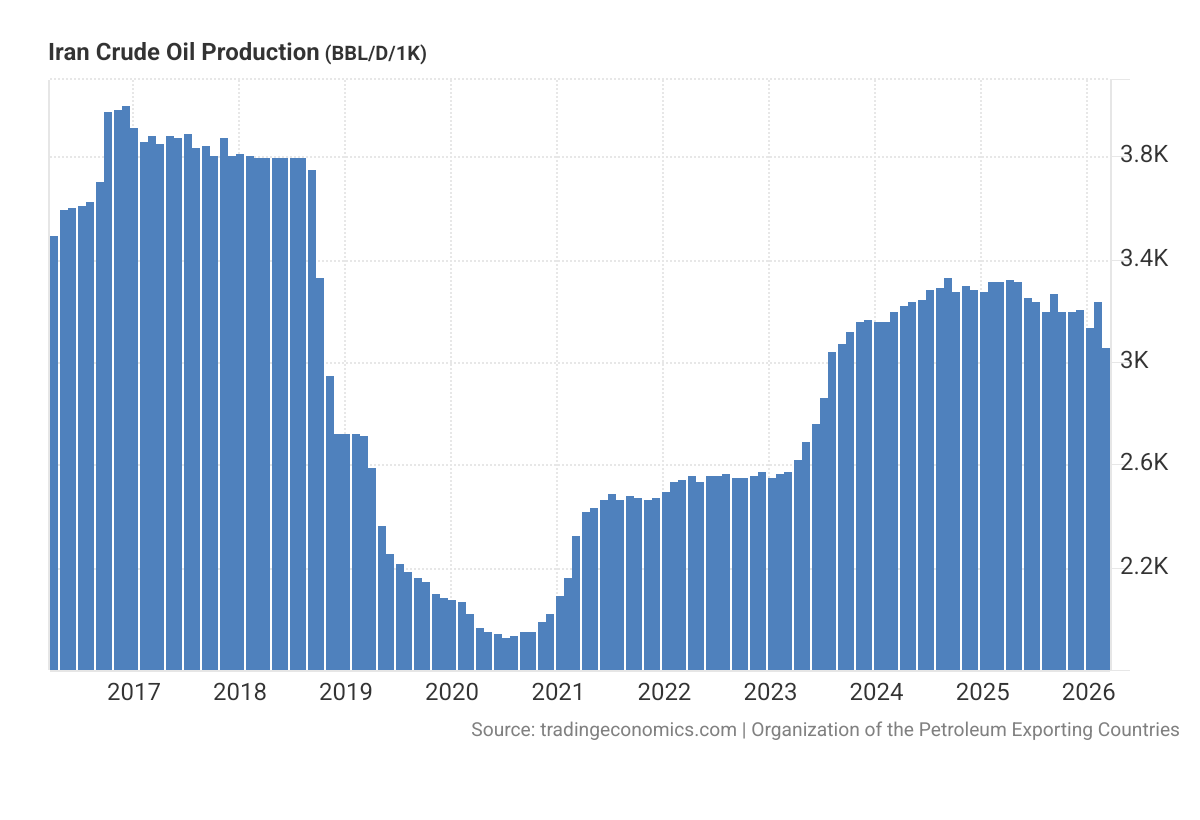
That Iran is understandably reluctant to proceed more quickly with shut ins than it absolutely must may be the cause of an oil slick detected recently off of Kharg Island, site of Iran’s primary oil terminal. If storage capacity is reached, crude may have simply spilled into the ocean—or was deliberately dumped.
Exactly how long Iran can endure this state of affairs is inherently problematic. While many independent analysts have assessed that Iran’s capacities to withstand the blockade run out after about a month—a time frame that has already largely passed—there have been contrarian assessments leaked from CIA sources suggesting that Iran has a far greater capacity to absorb the economic hits.
These assessments indicate that Iran has not been damaged as much by Operation Epic Fury as President Trump has maintained, and that the economic pressures of Operation Economic Fury are less than President Trump has maintained.
We must be cautious with such assessments, and not merely because they are obvious leaks to corporate media, which automatically implies an agenda of undermining the Trump Administration on Iran. As I have covered in previous articles, there are numerous open source assessments that Iran’s storage capacities and ability to endure without the influx of oil revenues exports had been providing are extremely limited. Part of Iran’s seeking land routes from the Pakistani port of Karachi to Iran is the economic strain the country is enduring.
At the same time, that oil flows from the Persian Gulf are disrupted is carrying significant economic risks for the world’s economies.
In an interview with CNBC, Maersk CEO Vincent Clerc warned on Friday that if oil flows were not quickly restored there would be significant price shocks across a number of goods, as shipping companies begin passing along the costs of elevated bunker fuel prices.
“What this this energy shock is going to mean is about $500 million of extra costs per month for as long as the oil remains around in the in the $100 per barrel neighborhood, that is significant,” Clerc told CNBC. “And there is so much we can do on reducing costs, but there is a lot we need to do on passing on these costs to customers, because it’s such a massive cost increase that we can’t shoulder it.”
We cannot dismiss Clerc’s warning out of hand, because it is already certain that Persian Gulf oil production is significantly reduced, with Saudi Arabia, the UAE, and Iraq all reporting major production cuts in March.
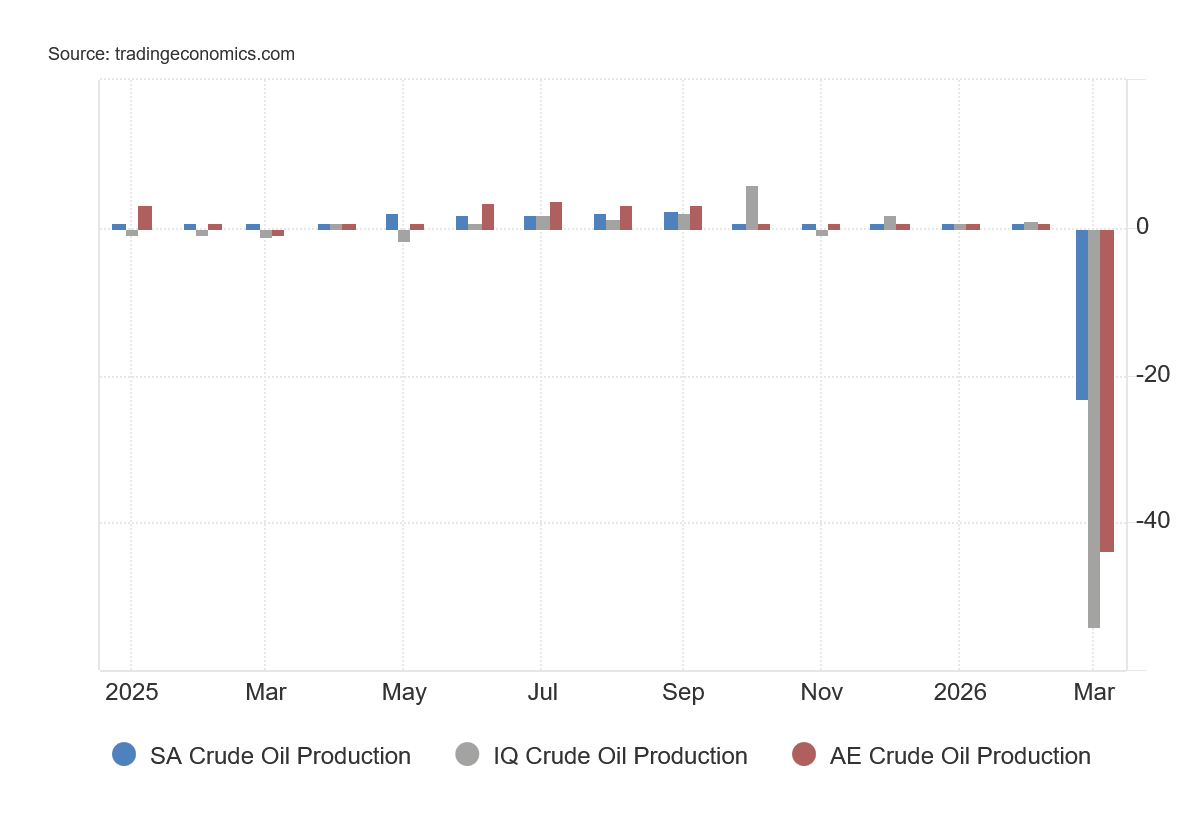
The disruptions are also impacting refined products which normally flow from the Persian Gulf, most notably aviation fuel.
Global shipments of jet fuel have fallen to their lowest level on record, as the blockage to the Strait of Hormuz threatens to suffocate supply to the world’s airlines.
Under 2.3m tonnes of jet fuel and kerosene were shipped around the world last week, according to analysts at Kpler, marking the lowest level since records began in 2017.
With the summer travel season rapidly approaching, jet fuel shortages could create significant increases in the costs of vacation travel, and a corresponding destruction of travel demand, as consumer respond to the expected price shock in air fares.
Looking farther ahead, food price concerns are also growing, as the increased costs for petroleum and natural gas impact fertilizer production and fertilizer costs.
The war in the Gulf connects to higher prices on a baguette via three slow steps. Gas becomes fertilizer. Fertilizer feeds crops. Crops become food. Each takes weeks; the full cycle lasts months.
“Most of the food currently on supermarket shelves was produced using inputs that were purchased or contracted before the crisis fully unfolded,” said David Laborde, who runs the Agrifood Economics Division at the U.N’s Food and Agriculture Organization. “The current stability mainly reflects timing, not immunity.”
Europe produces its own nitrogen fertilizer, but makes it from imported gas. When Gulf disruption pushes gas prices up, European-made fertilizer gets more expensive too.
Even in the US, farmers are experiencing significant and sudden increases in fertilizer prices, as the disruption of Persian Gulf oil flows raises petroleum prices globally.
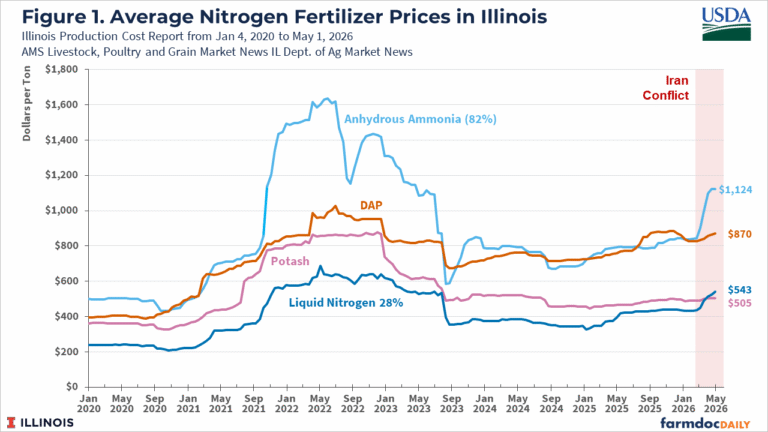
That energy prices have risen dramatically since the start of the war is empirically obvious—as is that the prices are falling more significantly on Europe than on the US.
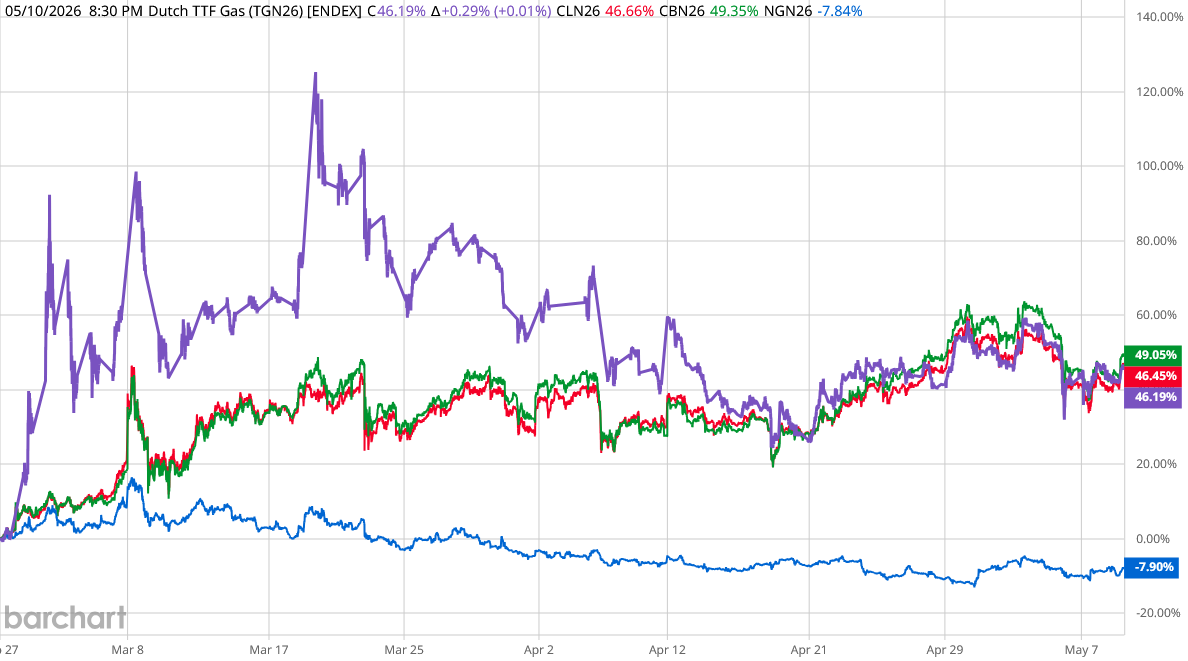
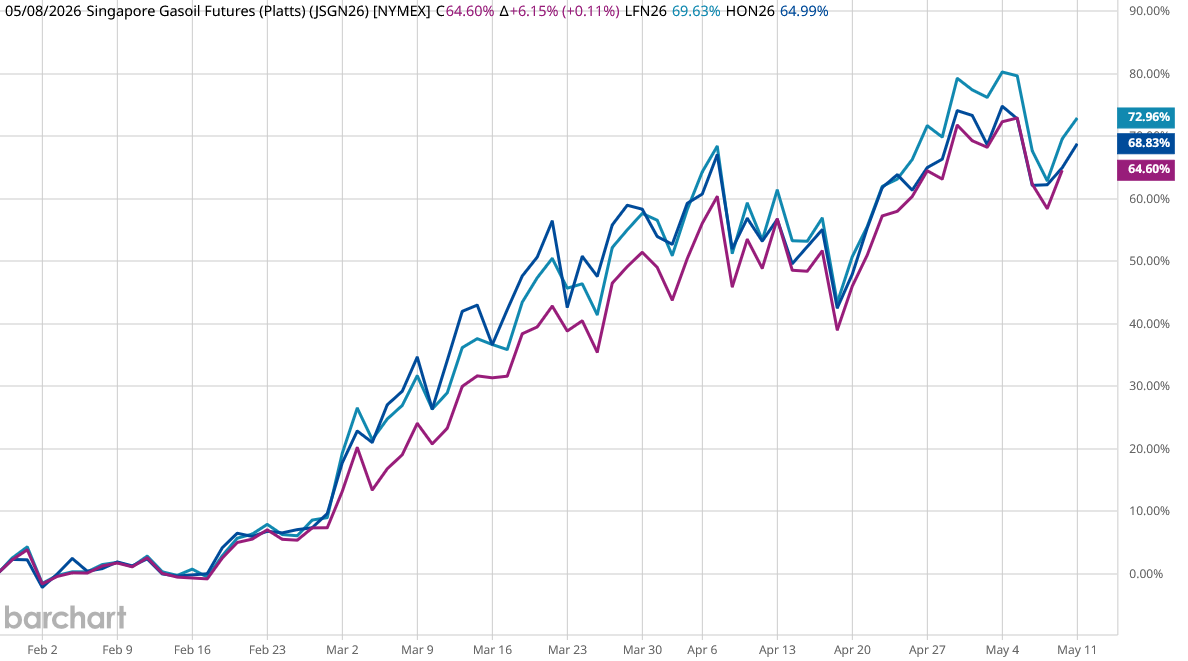
Even global diesel prices are up over 60% since the start of the war—and that will exacerbate the transportation cost shocks described by Vincent Clerc in maritime shipping.
Price shocks in essential manufacturing inputs is already creating a stagflation crisis in China.

If this war continues, stagflation is likely to spread through the rest of the world’s economies, including that of the United States.
As of this writing, we have not yet seen the April Consumer Price Index data—that is not due until May 13—but we are sure to see additional energy price inflation. The question will be if energy price inflation is having a contagion effect and pushing up other prices as well. If that should be the case, the US will be well on its way to having a stagflation crisis not unlike that of the 1970s, and driven by largely the same forces: disruption of global oil supplies.
It seems unavoidable that, at this point, there will be more war, and it is certain that the closure of the Strait of Hormuz will continue for at least a little while longer. It is therefore certain that the world, and not just Iran, will endure the economic ramifications of the war.
What Is The Alternative?
The grand question over everything taking place in the Persian Gulf is “what is the alternative?”
Is this war the right choice at the right time?
Is there an unexplored diplomatic possibility that needs to be considered?
Certainly the leaders of Europe have talked at length about the need for talks, and Pakistan has sought with diligence and industry to play mediator and bringing about talks between Iran and the US.
If there is a legitimate diplomatic option, the US would do well to consider it.
At the same time there is no getting around the reality that Iran’s actions in the Strait of Hormuz are a violation of every freedom of navigation principle there is, principles which predate even the UN Convention on the Law of the Sea, which clearly forbids Iran’s actions.
There is no getting around the reality that Iran’s nuclear weapons program has been an ongoing violation of Iran’s obligations under the Nuclear Non-Proliferation Treaty, which Iran signed and ratified.
There is no getting around the reality that the IRGC-led Khamenei Regime has doubled down on these violations of international law, even proposing that all sanctions be lifted while Iran continues to violate both UNCLOS and NPT.
There have been multiple diplomatic overtures extended to Iran, and in each one Iran has rejected what have been fundamental and essential positions from the United States: surrender illegal control of the Strait, dismantle the country’s network of support to a variety of Islamist terrorist militias—Hezbollah in Lebanon, Hamas in Gaza, the Houthis in Yemen—and surrender the entirety of the nuclear weapons program.
These are positions the IRGC has not wavered on, and they are positions the Trump Administration negotiators have not wavered on.
With neither side willing to back down on at least these points, is it possible to resolve this conflict by any other than force of arms? That seems unlikely.
The IRGC has for years been pursuing a course which contravenes established norms of international law and treaties Iran itself has signed. There is no serious debate to be had on that point. The lawlessness of the IRGC was the catalyst to last year’s Twelve Day War and it was the catalyst to Operation Epic Fury.
That lawlessness makes war with Iran more of an inevitability than an option. So long as the IRGC is determined to follow a course of shredding international maritime law and UN treaties, the question regarding war with Iran was never an “if”, and always a “when”.
This war has already cost the Iranians much, and will cost them even more. This war has already cost Europe much, and will cost them even more. This war has already cost the US much, and will cost us even more.
As steep as those costs are likely to become, is there any good answer to the question “what is the alternative?”
At present, the answer appears to be “none.” God help us all.
Sir, This is the only place I trust and can learn. I have sadly taken until middle-age to even try as I spent my younger years raising men. No regrets, but I very much appreciate your work.
The only way this ends is establishing some sort of DMZ on the Iranian side of the strait.