


In the ten days since the terms of the presumptive “peace deal” between the United States and Iran were made public, the media reporting on the resulting peace talks has been an endless tit-for-tat procession of the United States saying one thing, then Iran claiming the exact opposite.
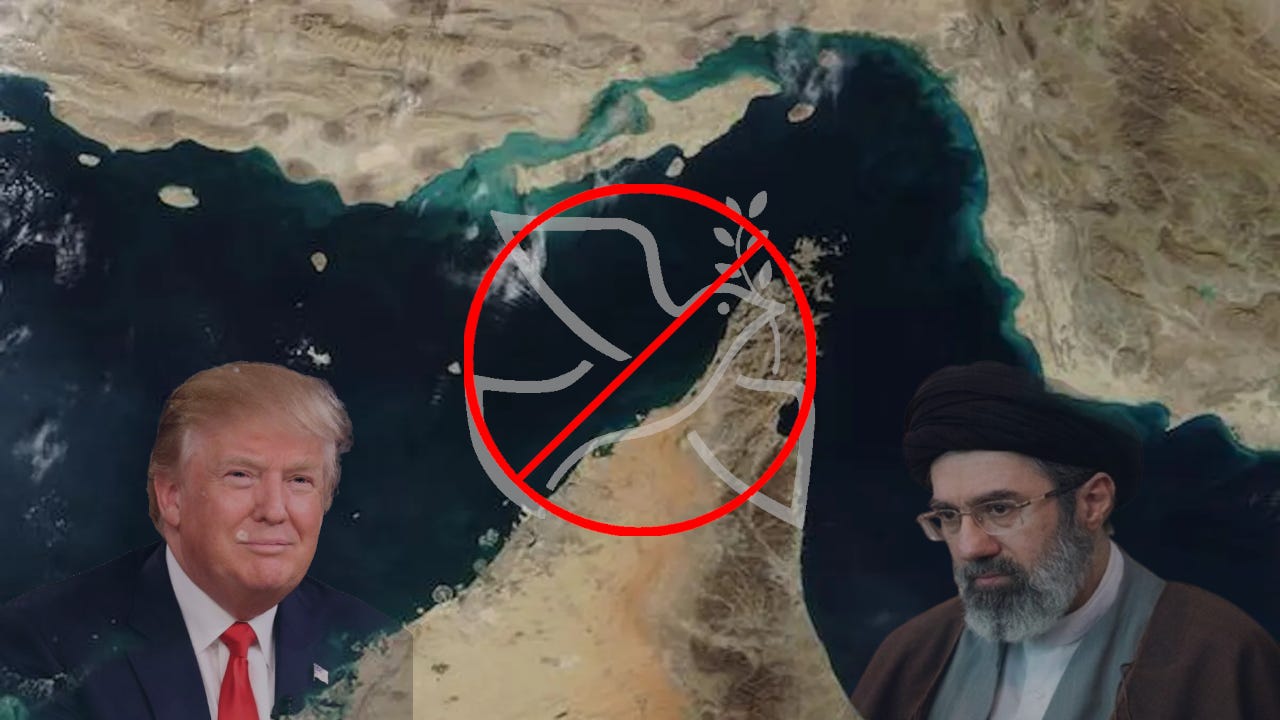
The fourteen-point Memorandum of Understanding was simultaneously clear on what would be negotiated and vague on the final outcomes, other than there was to be peace both in the Persian Gulf and in Lebanon.
Except peace never really emerged in Lebanon, and it is now fading rapidly in the Persian Gulf, as tit-for-tat media announcements metastasizes into tit-for-tat drone and missile strikes.
Is there still a ceasefire at this point? With escalating strikes between the US and Iran, that is a dubious assertion at best. Perhaps the ceasefire and peace talks are technically still in place, but the renewed exchange of drone and missile fire is hardening Iranian positions and attitudes, pushing the prospect of a final peace deal farther and farther beyond easy reach of negotiators on both sides.
A more honest appraisal arguably would be that the peace deal has been in slow-motion collapse almost since the completion of the Memorandum of Understanding ten days ago.
Is Iran Reading The Same MOU?
From the moment the memorandum itself was announced, and even before its terms were made public, Iran and the United States had wildly different views on what the memorandum stated, with each side quick to contradict the other.
Even as the Memorandum of Understanding was being accepted two weeks ago, Iran was claiming the MOU was vastly different from President Trump’s depiction. Initially, Iranian media outlets were circulating no fewer than three different claimed versions of the MOU.
The disparity between Iranian and American depictions of what was in the Memorandum did not stop pro-Trump media outlets such as Breitbart from triumphantly proclaiming the war to have ended.
Yet even as pro-Trump outlets were taking a victory lap over the MOU, Iran was asserting the MOU was something very much different from what had been reported, in particular reasserting its persistent claim it can charge a toll on shipping navigating the Strait of Hormuz.
Vessels that cross the Strait of Hormuz will need a mandatory insurance policy that is currently free but could have a cost in the future, the country’s Persian Gulf Strait Authority (PGSA) said in a document on its website. It also said that ships must follow its prescribed route, instructions that appear to run counter to guidance late Thursday by western naval groups, which advised ships to hug the Omani coast.
Point Five of the published terms of the Memorandum do not support Iran’s contention:
5 — Upon signing this Memorandum of Understanding, the Islamic Republic of Iran will immediately take steps to ensure that the movement of merchant ships from the Persian Gulf to the Sea of Oman and vice versa is resumed within 30 days to the pre-war volume, taking into account the need for the removal of technical obstacles and the neutralization of mines by Iran.
Also contradicting Point Five was the recurring IRGC demand for an upfront release of frozen Iranian assets, before even any substantive talks took place.
The Strait of Hormuz should not be reopened until several conditions under the Iran-US MoU are met, among them the release of at least $12 billion in Iranian assets, the implementation of oil sanctions waivers, and Israel’s withdrawal from Lebanon, the IRGC-affiliated Tasnim News said on Saturday.
This was a contention that has been rejected by President Trump every time it has been raised.
In a reference to criticism over the deal from both sides of the political aisle in Washington, President Trump reiterated his insistence in his Friday post that Iran would “get no money, not ten cents!” under the deal signed this week.
When Vice President JD Vance intimated that frozen assets might be released to allow Iran to purchase needed humanitarian supplies for the Iranian people from the US, the Iranians were quick to insist that no strings would be attached to the release of any Iranian assets.
The dichotomy began pushing tensions to a breaking point when Iran rejected the idea of discussion inspections of its nuclear facilities by the International Atomic Energy Agency.
US Vice President JD Vance said the talks with Iranian officials in the Swiss mountain resort of Buergenstock laid a good foundation for a final accord and that Tehran had agreed to allow nuclear inspectors back into the country.
But Iran denied it had begun discussions on its nuclear program at the talks, mediated by Qatar and Pakistan, and said it had not agreed to invite back International Atomic Energy Agency inspectors.
IRAN SAYS IT WILL DECIDE ALONE ON ASSETS’ USE
Foreign Ministry spokesperson Esmail Baghaei said on Tuesday Iranian officials had not held a meeting with IAEA chief Rafael Grossi in Switzerland and had no plans for the UN nuclear watchdog to inspect Iran’s damaged nuclear facilities.
We should take careful note that the Nuclear Non-Proliferation Treaty, of which Iran is a signatory, obligates non-nuclear states such as Iran to submit to IAEA inspections to ensure treaty compliance.
Each non-nuclear-weapon State Party to the Treaty undertakes to accept safeguards, as set forth in an agreement to be negotiated and concluded with the International Atomic Energy Agency in accordance with the Statute of the International Atomic Energy Agency and the Agency’s safeguards system, for the exclusive purpose of verification of the fulfilment of its obligations assumed under this Treaty with a view to preventing diversion of nuclear energy from peaceful uses to nuclear weapons or other nuclear explosive devices. Procedures for the safeguards required by this Article shall be followed with respect to source or special fissionable material whether it is being produced, processed or used in any principal nuclear facility or is outside any such facility. The safeguards required by this Article shall be applied on all source or special fissionable material in all peaceful nuclear activities within the territory of such State, under its jurisdiction, or carried out under its control anywhere.
Iran’s leaders are simply ignoring both past and present treaty commitments as part of its overall negotiating posture.
At no point have Iranian and US depictions of the peace talks taking place in Switzerland aligned with each other. So wide is the disparity one has to wonder if the negotiators are actually talking with each other.
Iran Broke The Ceasefire?
With both sides clearly talking past each other publicly, the question of the 60-day ceasefire initiated by the Memorandum breaking down has perhaps always been more of “when” rather than “if”.
Even so, tensions began to mount when reports emerged from UK Maritime Trade Operations of fresh attacks on ships transiting the Strait of Hormuz.
The UK Maritime Trade Operations (UKMTO) previously reported that a vessel was struck by “an unknown projectile” while operating off the coast of Oman, but did not attribute the attack to any particular nation-state or actor. The UKMTO, which is operated by the British Royal Navy, said the projectile damaged the bridge of the vessel but reported no injuries or environmental impact as a result of the attack.
When reached for comment about the attack, a U.S. official said Iran’s Islamic Revolutionary Guard Corps launched a drone at the vessel in question.
The U.N. International Maritime Organization paused its operation to escort ships through the Strait of Hormuz on Thursday after Iranian forces attacked a cargo vessel in the Strait of Hormuz a day before.
Perhaps predictably, the United States responded with strikes on Iranian targets near to the Strait.
U.S. aircraft struck Iranian missile and drone storage locations and coastal radar sites after Iran hit M/V Ever Lovely on June 25 with a one-way attack drone. The Singapore-flagged cargo ship was exiting the Strait of Hormuz along the Omani coast at the time of Iran’s attack.
The unwarranted aggression against commercial shipping by Iranian forces clearly violated the ceasefire. Furthermore, Iran’s dangerous behavior undermined freedom of navigation as commerce increasingly flows through the vital international trade corridor.
Prior to the strike, President Trump was coy about how the US would respond to the Iranian drone strike on a civilian ship. When asked if the US would respond Trump’s answer to the media was simply “you’re gonna find out.”
Shortly after Trump made those remarks, Iran really did “find out.”
In the alternate reality that is global geopolitics, this naked exchange of hostilities was not considered an abrupt cessation of the ceasefire, as various media outlets pushed competing narratives on whether the strikes were substantial or performative.
Perhaps if that had been the only exchange between the US and Iran, we could plausibly consider the ceasefire to be in place. It has not been the only exchange.
Iran Escalates, The US Escalates, Iran Escalates Its Escalation
In response to the US strikes on Iranian targets, Iran chose to escalate with a ballistic missile strike on Kuwait, according to the Kuwaiti Ministry of Defense.
The official spokesperson of the Ministry of Defense, Major General Saud Abdulaziz Al-Otaibi,
stated that the armed forces detected at dawn today two hostile ballistic missiles within Kuwaiti airspace, which were intercepted and dealt with in accordance with approved operational procedures.
No material damage or human injuries resulted from this.
The armed forces affirm their continued performance of their duties and responsibilities with efficiency and capability, within a framework of ongoing readiness and permanent preparedness, thereby enhancing the security of the homeland and preserving the safety of citizens and residents.
There were reports of an attack on a second ship in the Strait of Hormuz as well.
Almost predictably, the US has responded with another round of air strikes against Iran.
In a statement, US Central Command (CENTCOM), which directs military action in the Middle East, explained that the latest attacks came “at the Commander in Chief’s direction”.
“CENTCOM forces launched strikes today in direct response to continued Iranian aggression against commercial shipping,” the command centre wrote.
“U.S. military aircraft targeted Iranian military surveillance infrastructure, communication systems, air defense sites, drone storage facilities, and minelayer capabilities.”
Explosions were reported in southern Iran, around the village of Tahrui, near the port of Sirik, which was also the focal point of Friday’s US attacks. State media also indicated that Qeshm Island had been hit.
Iran responded by targeting Bahrain as well as Kuwait.
Iran’s Revolutionary Guards said on Sunday local time that it carried out strikes against Kuwait and Bahrain in retaliation for U.S. attacks on Iranian territory, warning any further aggression would be met with a “crushing response.”
Separately, Iranian Foreign Minister Abbas Araghchi has reiterated Iran’s claim of sovereignty over the Strait of Hormuz, asserting that Iran alone has control—and responsibility—over the Strait’s reopening.
Iran alone is responsible for managing and fully reopening maritime traffic in the Strait of Hormuz under recent understandings, Foreign Minister Abbas Araghchi said on Sunday in Baghdad.
Speaking at a news conference with Iraqi Foreign Minister Fuad Hussein, Araghchi said the reopening would take place after existing obstacles were removed and that implementation was underway.
“No other country or institution has any responsibility in this regard,” Araghchi said.
Most ominously is a recent article appearing in IRGC-affiliated Iranian news outlet Fars claiming that Iran “must” develop nuclear weapons in order to preserve peace in the Persian Gulf.
During the transition to the new order, Iran has no choice but to reach nuclear deterrence to remove the military option to occupy and break up Iran. In order to achieve the peace needed by Iran, it must be necessary to reach a nuclear deterrence to ensure that the rest of the negotiations will be resolved. Only then can the negotiation take place from the right position.
Bear in mind that Iran agreed explicitly in the Memorandum that it would never develop nuclear weapons (Point Eight).
8 — The Islamic Republic of Iran reiterates that it will never produce nuclear weapons. The Islamic Republic of Iran and the United States have agreed that the fate of enriched material and the fate of all other mutually agreed nuclear-related issues, including Iran’s nuclear needs, will be adequately addressed in a final agreement; the final agreement will confirm the provisions of this Article.
This is in addition to being a signatory to the Non-Proliferation Treaty, which further obligates Iran not to pursue a nuclear weapons program.
We must note also that Iran has not been in compliance with the NPT for many years. The origin of many of the sanctions against the regime have arisen from its refusal to cooperate with the IAEA on inspections and to otherwise confirm to the expectations of the NPT.
More War? Or A Faux Peace?
Whether the ceasefire is still in place, or whether Iran and the US have resumed hostilities probably depends very much on whom one asks the question.
Technically, the 60-day ceasefire is still in place. Technically, the Switzerland peace talks have not been suspended.
But even as the MOU was being finalized and signed, the rhetoric coming out of Tehran has been contradictory and bellicose. President Trump has been quite willing to match Tehran’s muscular warlike remarks. As the recent tit-for-tat strikes have demonstrated, both sides are willing to inflict a modicum of damage on the other, although neither side has committed to an all-out attack in the vein of Operation Epic Fury.
We might even question whether the recent exchanges between the US and Iran are a true shift, or if they are merely the inevitable progression from the contradictory and ultimately uncooperative rhetoric which has been the hallmark of the Switzerland peace talks.
We should definitely question whether either side is truly ready for peace talks, and truly wants a peaceful, diplomatic resolution to Iran’s (illegal) nuclear weapons program and (illegal) seizure of the Strait of Hormuz. If we go strictly by the events of the past week, we would be hard pressed to conclude that Iran and the US genuinely desire to have peaceful relations at this point.
Whether there is still technically a ceasefire, still technically peace talks being conducted, is becoming increasingly irrelevant as tit-for-tat attacks on each other’s strategic assets in the region escalate. At some point such back and forth attacks will escalate to the point where talk of ceasefire seems quaint; we may already be at that point.
Despite the high hopes that accompanied President Trump’s initial announcement that the MOU had been agreed and adopted, the reality has been that the IRGC especially, but broadly the whole of the Iranian government, simply does not want peace.
The Trump Administration says it desires peace, but its rhetoric has been more along the lines of making peace with the possibility of renewed war. President Trump has not shifted his initial “red lines” on Iran, most especially the absolute prohibition on Iran ever obtaining nuclear weapons.
As the peace deal continues its slow and seemingly inevitable collapse, the question of whether or not there is still a ceasefire is increasingly likely to be answered in the negative. If escalations continue, the current faux peace will eventually be acknowledged as more war.
That appears to be where this has always been headed, and we’re just now finally arriving there.
Iran is yet to truly cry for mercy. Unfortunately I posit that mercy for Iran be limited to the actual people and not any of the regimes government and military apparatus. I think the people want us to completely overthrow the regime. They are unwilling to sacrifice for their happiness, unless I see wrong
I think Trump holds the cards vis a vis financial stranglehold, e.g., Kharg Is., and this will not be the last death spasm of the incorrigible regime, such as it is.