


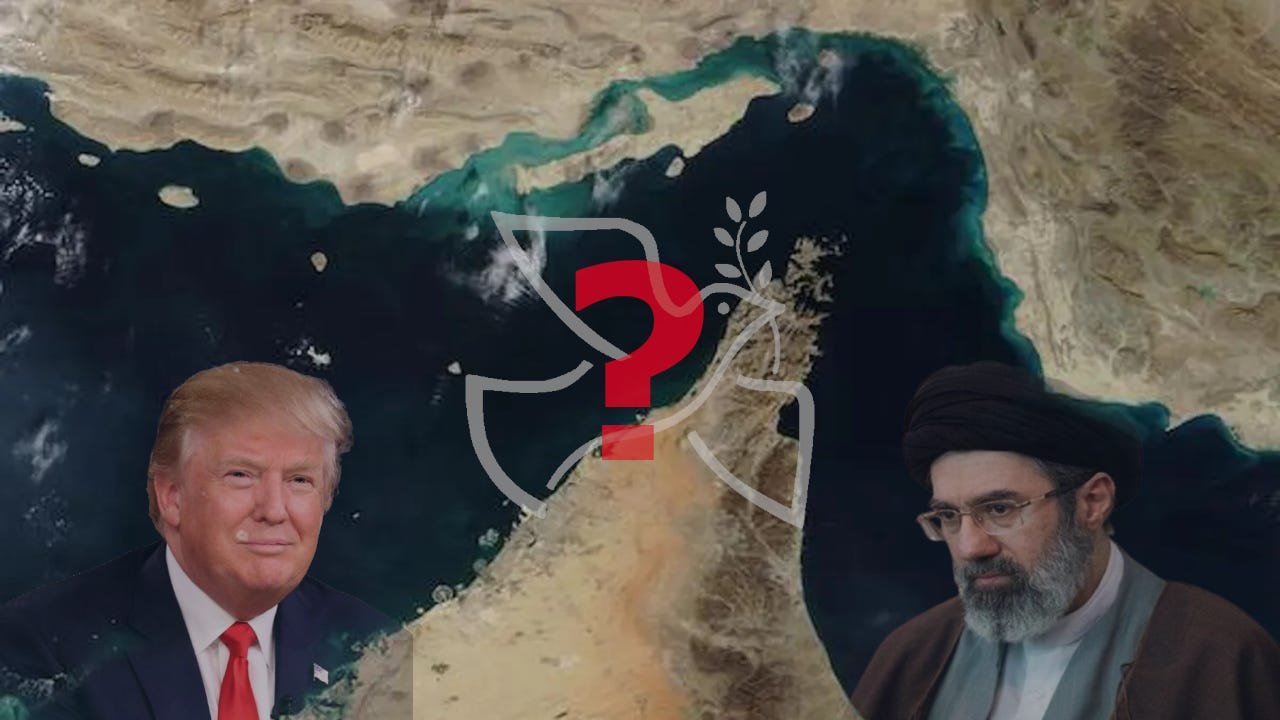
Despite the many signals suggesting this would not happen, we now have a deal between the United States and the Islamic Republic of Iran to end hostilities between the two countries.
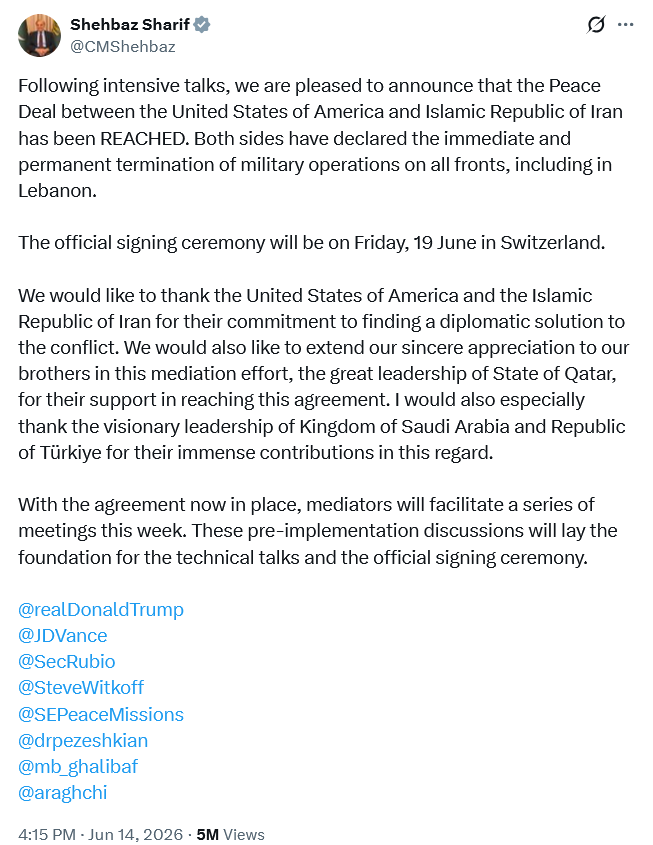
Earlier this afternoon, Pakistani Prime Minister announced that a deal had been reached between the US and Iran, with a formal signing ceremony to be held next Friday.
The question that began the day has now been answered in the affirmative. There will be a deal, which means there may actually be peace.
However, while we have announcements of a deal, what we do not have is any official text of that deal. We have a deal, but no details.
Deal Against All Odds
While President Trump had been quite upbeat and bullish that a deal would get done today, there were many reasons to doubt if even this much of a deal would happen.

Throughout the day there were even more reasons to doubt if this would happen.
The Iranian Majlis (Parliament) decided to inject itself into the mix, asserting its need to review any agreement before it could be final.
The prospects were not enhanced by Iran’s circulating multiple versions of the proposed agreement.
That Hezbollah and Israel were continuing their tit-for-tat strikes was definitely not helping to further the cause of peace.
Somehow, through all the negativity and unhelpful actions by allies on both sides, at the day’s end a basic agreement was apparently reached by the parties.
No One Knows What Is In The Deal
While there is quite a bit of hooplah about there being a deal between the US and Iran, there has been very little in the way of official details about the deal itself.
Even corporate media, when reporting on Sharif’s announcement of the deal, acknowledged that little was known about the particulars of the deal.
“Following intensive talks, we are pleased to announce that the Peace Deal between the United States of America and Islamic Republic of Iran has been REACHED,” Sharif said on X.
He continued, “Both sides have declared the immediate and permanent termination of military operations on all fronts, including in Lebanon.”
A signing was scheduled for Friday in Switzerland, Sharif said.
No other details of the agreement were immediately available. The White House did not immediately respond to requests for comment.
However, shortly after the announcement Reuters released what the Khamenei regime claimed were the key points of the deal:
STRAIT OF HORMUZ:
* Iran immediately reopens the Strait of Hormuz to all commercial vessels, while the U.S. lifts its naval blockade on Iranian ports. The lifting of the U.S. blockade would begin immediately after the memorandum is signed and be completed within 30 days.
FINANCIAL:
* The U.S. agrees not to impose any new sanctions on Iran until a final deal is reached.
* Following a final agreement, all U.S. and U.N. sanctions on Iran would be lifted according to an agreed timetable.
* The U.S. will waive oil sanctions on Iran for a specified period, allowing Tehran to sell oil and receive revenue.
* The U.S. agrees to release $25 billion of Iran’s frozen assets, including via direct cash transfers, cooperation among regional countries, and financial credit lines.
* Washington, in coordination with its regional allies, would prepare a reconstruction and development plan for Iran, to be negotiated and agreed with Tehran within 60 days.
NUCLEAR:
* Tehran agrees that it will neither produce nor acquire nuclear weapons.
* Pending a final agreement, Iran would maintain the current status of its nuclear programme, refraining from further uranium enrichment and expansion of nuclear facilities.
* The United States agrees to allow Iran to dilute its stockpile of highly enriched uranium on Iranian soil under a future comprehensive agreement.
* Iran’s nuclear programme, uranium enrichment activities and mechanisms for handling its stockpile of highly enriched uranium would be negotiated within 60 days of the memorandum and addressed in a final agreement.
These points have not been confirmed by the Trump Administration.
Are these the point to which the Trump Administration has agreed? Until we see the official text of the agreement, or until these points are confirmed by Donald Trump, we cannot be sure that they are.
The Terms Are Troubling
The most significant term in the Reuters list is, of course, that the Strait of Hormuz is to be reopened and made freely navigable. If that comes to pass, Persian Gulf oil flows once more, and a global stagflation crisis might be averted.

Also significant is an apparent agreement to allow Iran to “downblend” its stockpile of enriched uranium, lowering the enrichment level to presumably the civilian range of 3%-5%. While there would be an obvious comfort factor in removing the fissile material from Iran altogether, if the enriched uranium is downblended to civilian levels, Iran no longer has “breakout" capacity, where it can quickly enrich its store of 60% enriched uranium to the 90%+ needed to produce a nuclear weapon.
Downblending is arguably in line with the earlier “red lines” established in the first round of Islamabad talks with Iran:

As I have noted previously, the US “red line” conditions are easily and succinctly stated:
Iran will not enrich uranium
Iran will not pursue nuclear weapons
Iran will not develop long range ballistic missiles
Iran will not maintain its network of terror militias across the Middle East
Iran will not close the Strait of Hormuz
Iran will not threaten Arab states in the Persian Gulf
Downblending lacks the finality of complete removal of the fissile material, but downblended uranium eliminates “breakout” capacity where Iran can quickly complete the steps necessary to create a nuclear weapon.
What is troubling is the assertion that the United States will release some $25 billion in frozen Iranian assets. We must remember that Donald Trump has previously said very explicitly the US would not be paying Iran off.
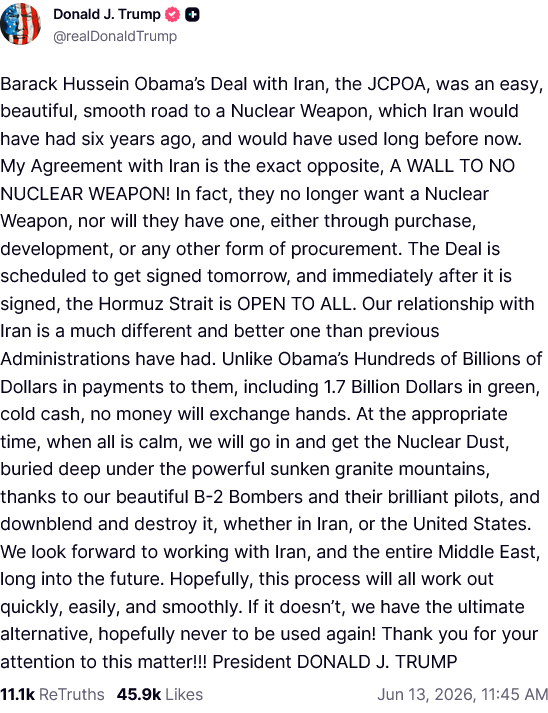
If we take the Reuters report at face value, we can anticipate Iran arguing that the $25 billion in frozen assets is to be released at once. However, it is also possible that President Trump envisioning releasing the frozen assets one the enriched uranium is verifiably downblended—a “pay for performance” standard that is not out of line with what the Trump Administration has said previously on this point.
Equally problematic is the establishment of a “reconstruction fund” to help rebuild Iran.
On the surface, this is perhaps the most reasonable “ask” of the Iranian negotiating team. Iran’s infrastructure was already decrepit before the war began. Fresh rounds of bombing during Operation Epic Fury certainly did not help improve that infrastructure.
No matter who is in charge, Iran needs to rebuild its infrastructure, and that is going to require outside investment.
However, that puts the IRGC on the wrong side of whatever strings a Trump Administration would attach to a reconstruction fund. It would be a simple matter for President Trump to tie reconstruction funding to the successful and verified demolition of Iran’s nuclear weapons program.
Is that what will happen with the reconstruction fund? Of that I have no idea. Remember, this list of negotiated points is what Iran claims were in the agreement—this list might not be the negotiated points at all.
Per Iran’s Tasnim news agency, we won’t see the final text of the agreement until after the signing ceremony next Friday. The delay presumably reflects Iran’s deep distrust of the United States (although how not releasing a text to which both sides have already agreed in full helps is not made clear).
Will The Deal Hold?
What we know today is that we have a deal.
We do not know the terms of that deal. We are not going to know the terms of the deal for at least a few more days.
We do not even know if the deal will hold. Hezbollah and Israel might pop off at each other and derail the entire process. Iran might be slow in clearing their mines from the Strait of Hormuz. A dispute over when/if frozen asset funds are to be released seems almost sure to arise.
Any one of these outcomes—and quite a few more besides—could lead to the collapse of any peace deal and a return to a state of war between the United States and Iran.
What we know is today is that we have a deal. We will not know more than that until next Friday. Even then, the full ramifications of both the deal and the war are not likely to be known at that time.
The US and Iran have apparently made a deal to give peace a chance.
We have that deal. We just do not have any of the details making up that deal.
As usual, a very intelligent and level-headed assessment, Peter. And I agree: the removal of financial sanctions is a big problem. My bet is that as soon as certain IRGC players have that $25 billion in their personal pockets they will go right back to terrorizing the MidEast. Color me the brightest hue of skeptical.
"We Have A Deal But No Details", more aptly put would be "We Don't Have A Deal Because There Are No Details". A “memorandum of understanding” is really not a deal, as many have pointed out. The U.S is still basically back to square one on the nuclear issue and that is if it's really an issue or not, ( after 40 some years of hearing about this, it makes one wonder quite honestly) and the Iranians get some frozen cash back. Not much of a deal if you ask me, By tomorrow, it will probably all change anyway!!!