


Iran is publicly declaring the Twelve Day War to be over.
Iranian President Masoud Pezeshkian announces the “end of the 12-day war” imposed by Israel, in a message to the nation carried by the official IRNA news agency.
“Today, after the heroic resistance of our great nation, whose determination makes history, we are witnessing the establishment of a truce and the ending of this 12-day war imposed by the adventurism and provocation” of Israel, Pezeshkian says.
For the Iranian President to make a statement like that in public, one thing is certain: this war is over.
Now what?
How does what President Trump has named the “Twelve Day War” change the trajectory of events in the Middle East? What global impacts might the ending of the war have?
The answers to these questions will be not just days or weeks but months and even years unfolding. A lot depends on what Iran and Israel do over those months and years.
Even so, we can step back and see how the ripples from this event are beginning to spread out.
Contents
Oil Prices Down, Stock Market Up
The most obvious good news emerging from war’s end has been immediate drop in oil prices. In any other circumstance we would call the price shift a “collapse”, as oil prices have eliminated all the increase since the start of Operation Rising Lion and then some.
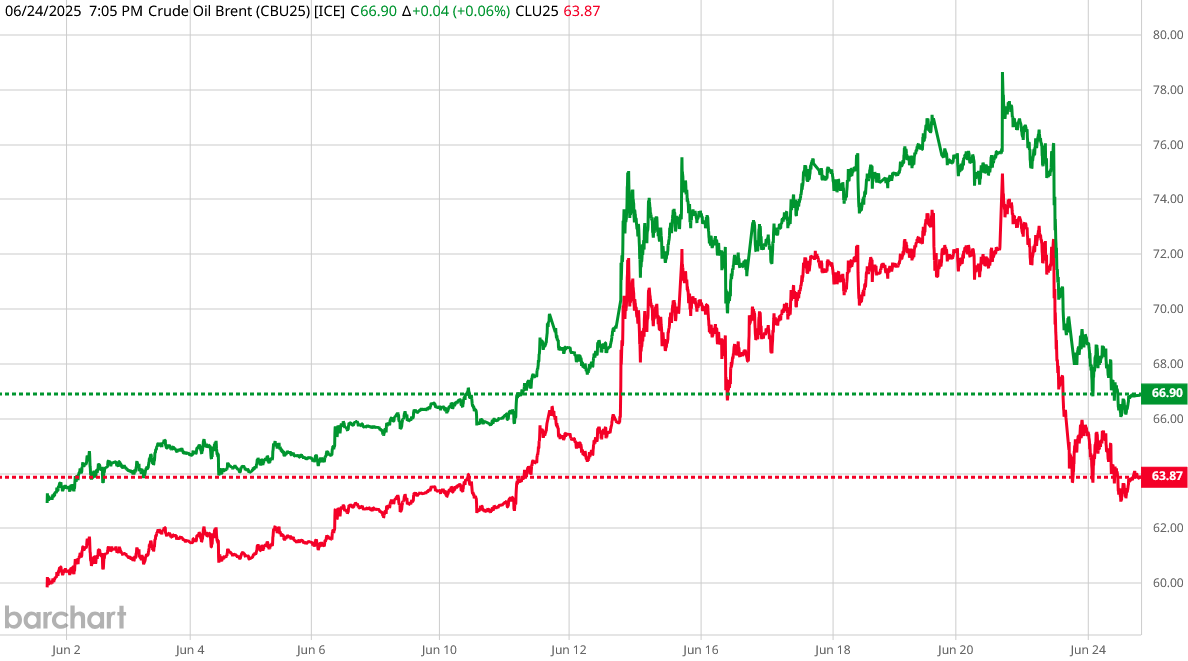
While we are still looking at the potential for some significant energy price inflation in June, that the price decline has continued into the ceasefire creates the possibility of energy price deflation in July and beyond.
That’s good political news for President Trump and excellent economic news for the American consumer.
The drop in oil prices is very bad news for Russia and Vladimir Putin. Russia’s benchmark Urals Crude typically trades at a discount of between $5/bbl and $10/bbl to Brent Crude.
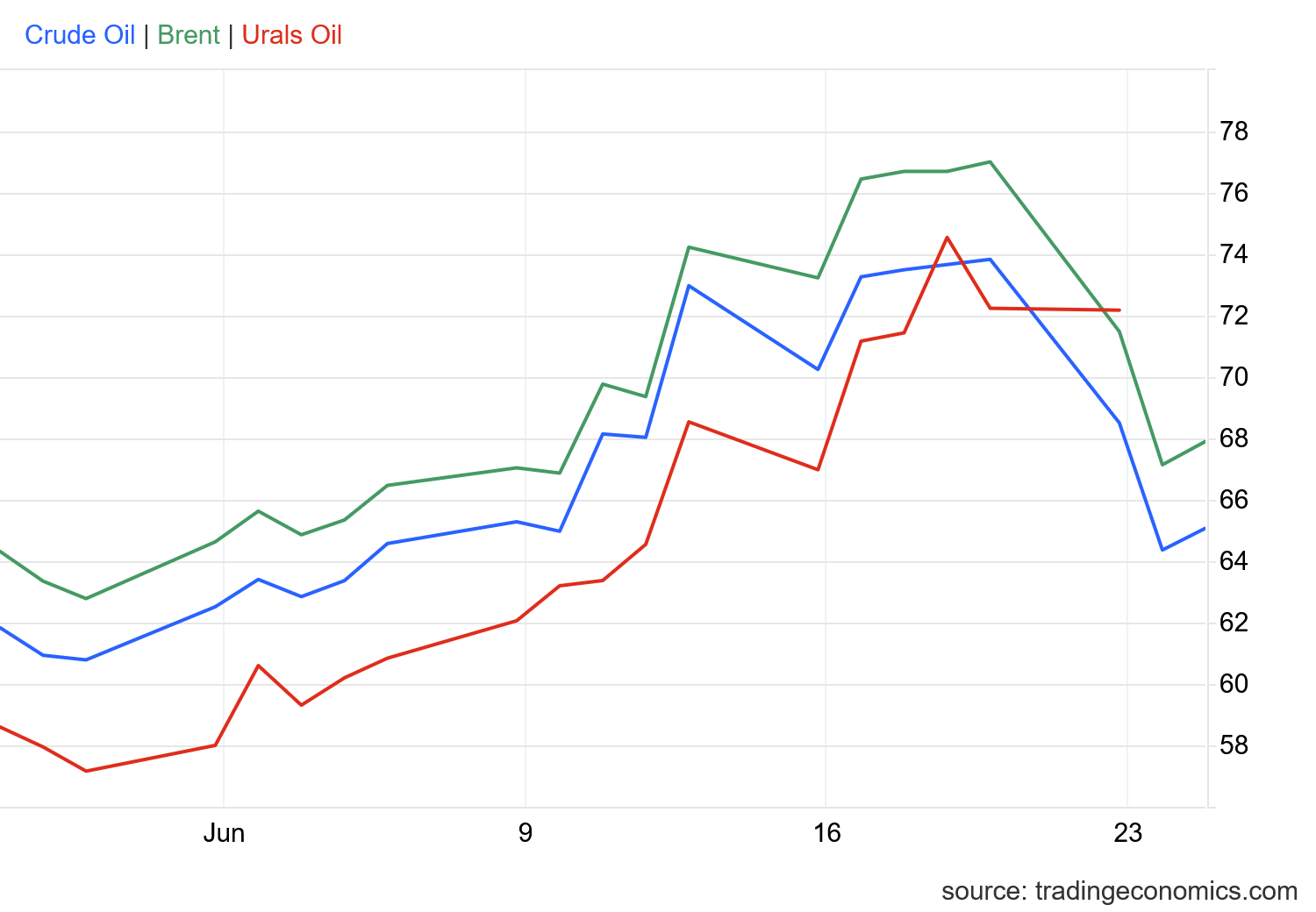
While it make take a day for the markets to reflect the new price, Russian oil is headed for a drop of as much as $10/bbl. That loss of revenue will put renewed strain on the Russian economy as it struggles to fund Putin’s war in Ukraine.
Two unexpected beneficiaries of oil market movements apparently are going to be China and, ironically, Iran. Powering oil’s extended drop has been Trump’s announcement on Truth Social that China could continue to buy oil from Iran, an indication the US may be easing sanctions on the Islamic Republic.

China is Iran’s primary customer, but while China will benefit from lower oil prices, Iran stands to gain from having unimpeded access once more to global oil markets.
While oil prices have trended down in the past 24 hours, stocks have trended up.
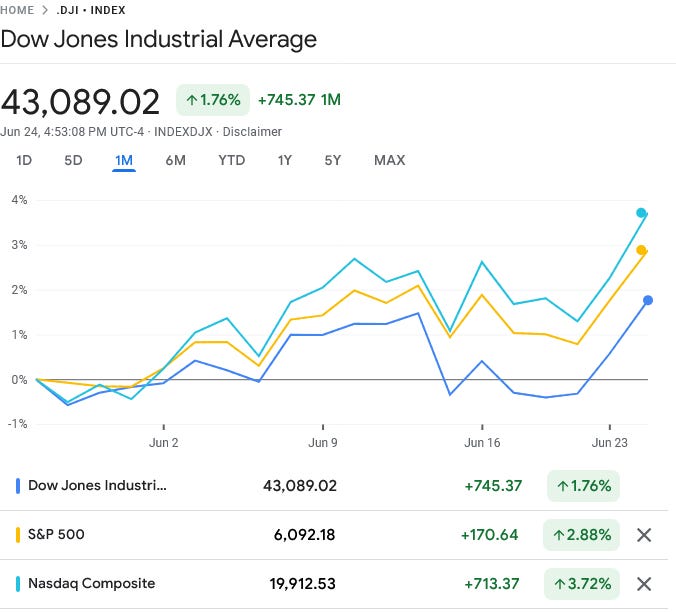
All three major stock indices on Wall Street are not only higher on the month, but they have completely recovered their price positions from right before Israel commenced Operation Rising Lion.
Nor is it just Wall Street that is feeling bullish. Chinese markets are up significantly since the ceasefire announcement as well.

Peace is always good for business!
How Much Damage Was Done?
The one question that everyone is asking in some form or fashion is how successful were Israel and the US in damaging Iran’s nuclear weapons program?
Depending on which damage assessment you want to believe, the damage was somewhere between “a little” and “a lot”.
A classified US Defense Intelligence Agency assessment leaked to CNN and the Washington Post suggests that the damage particularly to the Fordow enrichment site was not as dramatic as President Trump has claimed.
An initial U.S. intelligence report assesses that airstrikes ordered by President Donald Trump against Iran’s nuclear facilities set Tehran’s program back by months but did not eliminate it, contradicting claims by Trump and his top aides about the mission’s success, according to two people familiar with the report.
However, without even contemplating the specifics of the assessment, we must remember that it is a very preliminary one. The Defense Department is not likely to be prepared to present Trump with a final battle damage assessment for days or even weeks. DoD assessment protocols are not going to allow that final assessment to be ready any sooner than that.
The leaked DIA assessment is almost completely contradicted by Israel’s own assessment. Israeli intelligence estimates indicate the damage done was dramatic and set Iran’s nuclear weapons program back “years”.
Israeli intelligence assesses that US and Israeli strikes set back Iran’s nuclear program by “several years,” but did not completely destroy it, as US President Donald Trump has repeatedly claimed, a senior Israeli official tells The Times of Israel.
The extent of the setback is relevant as it sets the context for deciding whether the Twelve Day War was worth fighting.
An independent assessment by the Institute for Science and International Security, an independent and presumably non-partisan organization, provides a detailed breakdown of the apparent damage done at each of Iran’s nuclear sites. This assessment concludes that Israel and the US have done significant damage to Iran’s nuclear weapons programs.
Overall, Israel's and U.S. attacks have effectively destroyed Iran’s centrifuge enrichment program. It will be a long time before Iran comes anywhere near the capability it had before the attack. That being said, there are residuals such as stocks of 60 percent, 20 percent, and 3-5 percent enriched uranium and the centrifuges manufactured but not yet installed at Natanz or Fordow. These non-destroyed parts pose a threat as they can be used in the future to produce weapon-grade uranium.
If this assessment is even just partially accurate, Iran’s enrichment centrifuges have suffered significant damage, although Iran might still possess some centrifuges from equipment not yet installed at Fordow or Natanz.
The Institute in particular assessed that Fordow was heavily damaged if not destroyed, just as President Trump has boasted multiple times.
Which assessment is the most accurate? At the present time, there is no good way to tell.
Yet if the centrifuge cascades at Fordow and Natanz are even just partially damaged, Iran’s ability to enrich uranium may very well be at a standstill until the cascades are rebuilt and repaired. Without functioning centrifuge cascades, Iran cannot enrich its 60% enriched uranium to weapons-grade 90%+.
Arguably, even partial damage to the centrifuges is far closer to “severe” rather than “superficial” level of damage to Iran’s overall nuclear weapons program.
What is the correct assessment of damage done? At present, we simply do not know.
Regime Change?
Much has been made of President Trump’s post to Truth Social apparently calling for regime change in Iran.

White House Press Secretary Karoline Leavitt downplayed the significance of the post.
Asked about the president's remarks on Monday, White House Press Secretary Karoline Leavitt said Mr. Trump "was just simply raising a question that I think many people around the world are asking: If the Iranian regime refuses to give up their nuclear program or engage in talks — we just took out their nuclear program on Saturday night, as you all know — but if they refuse to engage in diplomacy moving forward, why shouldn't the Iranian people rise up against this brutal terrorist regime? That's a question the president raised last night. But as far as far as our military posture, it has not been changed."
However, while President Trump may not have called for explicitly ending Iran’s theocratic government, Trump Administration officials have conceded that among the potential outcomes of the Twelve Day War is the collapse of the Islamic Republic.
Rubio was the first to flag the possibility on Sunday. While he reiterated that toppling Iran’s theocratic republic was not the goal of the strikes, he said that if the country remained committed to becoming a nuclear power, it could imperil the survival of the regime. “I think it would be the end of the regime if they tried to do that,” Rubio said, speaking on Fox News’ Sunday Morning Futures.
While en route to the NATO Summit in the Netherlands, Trump himself indicated he did not actually favor regime change in Iran.
However, a piece in the Atlantic on Sunday openly speculated on the possibility that Iranian Supreme Leader Ayatollah Ali Khamenei might not remain in control of the country for much longer.
In the days leading up to the American intervention, a group of Iranian businessmen, political and military figures, and relatives of high-ranking clerics, two sources involved in the discussions told me, had begun hatching a plan for running Iran without Khamenei—whether in the event of the 86-year-old leader’s death or of his being pushed aside. Constitutionally, the Assembly of Experts, a body of 88 clerics, would need to vote to dismiss Khamenei from his position, but organizing such a vote under current circumstances is unlikely. The leader could also be more informally sidelined, say, by insiders who pressure or persuade him to pass real power to a temporary replacement. The plotters have agreed that a leadership committee consisting of a few high-ranking officials would take over running the country and negotiate a deal with the United States to stop the Israeli attacks.
Whether or not the United States formally backs regime change in Iran, the devastation inflicted on Iran in just under two weeks could give Khamenei’s political rivals within Iran the opportunity to force Khamenei to step aside, even if unofficially.
Can Iran move forward from this defeat while Khamenei remains in control? At the moment, that question is unanswerable—which means that the answer may prove to be “No”.
Power Vacuum
With or without regime change in Iran, however, there are already indications that Iran’s defeat has created something of a power vacuum in the Middle East, with various actors good and bad rushing to fill it.
In particular, there is the perhaps unavoidable speculation that the remnants of the once-powerful Islamic State, as well as its progenitor al-Qaeda, will exploit Iran’s defeat to regain power and influence in the Middle East.
"We should pay attention to this in our policy discussions," Joseph Votel, a retired four-star Army general who served as chief of U.S. Central Command (CENTCOM) from March 2016 to March 2019, told Newsweek.
Votel described militant groups such as ISIS and Al-Qaeda as being "opportunistic by nature," noting how "they will often take advantage of voids created by a lack of governance, disenfranchisement, unemployment, lack of opportunity, and social and economic disparity to develop inroads with vulnerable populations."
"How successfully they can do this in Iran is a matter to be watched," he added. "The state still controls the population, but the degradation of control will provide them with operating space in the long term, either to co-opt the population or to further utilize the area as a sanctuary for their planning and operations."
The same command and control infrastructures Israel targeted to degrade Iran’s military capabilities are also the ones which allow Iran to combat militants not part of the terror proxy network Iran has built up over the years. The loss of those infrastructures could give ISIS and other groups hostile to the Tehran regime an opportunity to flourish.
Yet not all the opportunities are for bad actors. Iran’s setbacks in recent months, most notably the toppling of Bashar al-Assad in Syria last December, has opened up a number of diplomatic opportunities for Israel.
Israeli National Security Adviser Tzachi Hanegbi confirmed that Israel and Syria are currently pursuing a “daily” dialogue.
Hanegbi today confirms comments he made during a classified session of the Knesset Foreign Affairs and Defense Committee on Sunday, saying “There is direct daily dialogue at all levels between Israel and the regime in Syria. I am leading it with political officials there,” the Hebrew outlet reports.
Hanegbi told the committee that Syria and Lebanon are candidates for the Abraham Accords normalization agreements, the paper reports.
We should note that just last month President Trump urged Syrian President Ahmad al-Sharaa to take exactly that step.

As I noted at the time, joining the Abraham Accords would be impactful not just for Syria and Israel but for the whole of the Middle East.
Acceding to the Abraham Accords would not merely mean Syria was normalizing diplomatic relations with Israel. The Abraham Accords involve establishing peaceful relations and the pursuit of greater economic cooperation.
While not formally establishing alliance between Israel and the signatory Arab states, they do establish a framework for improving the overall prosperity of the Middle East, with Israel and the signatory Arab states pursuing joint economic goals.
That step is apparently becoming more and more plausible, as al-Sharaa has been looking increasingly westward in charting Syria’s geopolitical future.
Turkey and the Gulf monarchies – particularly Riyadh and Doha – played a decisive role in supporting Hayat Tahrir al-Sham, the Islamist faction that now forms the backbone of Syria’s post-Assad government. The new leadership has rapidly diversified its international partnerships, ranging from Middle Eastern capitals to Brussels and Washington. Most recently al-Sharaa has backed Israel in its conflict with Iran by giving the Israeli air force permission to use Syrian airspace to refuel its fighter jets. Smagin noted that “Riyadh and Doha have already paid off Damascus’s $15mn debt to the World Bank, and offered to pay government salaries.”
Al-Sharaa’s successful ouster of the Assad regime in Damascus gave his Turkish backers a geopolitical boost over Iran. Al-Sharaa achieving diplomatic normalization with Israel, in particular accession to the Abraham Accords, is likely to do the same for Israel. Al-Sharaa has apparently taken at least one substantive step towards normalization by siding with Israel over Iran in a way that is substantive and not merely performative.
Iran’s declaration tonight that the war is over, and that there is now a truce between Israel and Iran, is almost certain to give a boost to Israel’s diplomatic engagements with Syria and even Lebanon. Syria acceding to the Abraham Accord would be a particularly noteworthy accomplishment for Israel, given the history of war the two countries have shared in the past.
The geopolitical chessboard that is the Middle East has been almost completely rearranged over the past twelve days, an outcome no one anticipated twelve days ago.
There is no way to predict exactly what moves will be made on that chessboard going forward. There are certain ripples that suggest a number of possibilities are emerging. Only time will tell how far those ripples spread and in what directions.
Welcome to interesting times!
I doubt anyone else has done such an excellent job of sifting out the facts in this situation, Peter. You are so impressive!
The unknown factor is what is the mindset of the ordinary citizens of Iran now. Are they feeling (convinced by propaganda) that this was an honorable negotiated peace, or are they feeling humiliated by a stinging defeat - one they will bitterly blame on the existing regime? Time will tell.
Any day we can wake up to find that a despotic government has declared an end to a war is a great day. And, let’s face it, any person in power, no matter how entrenched, is facing regime change when he’s 86 years old.
I’m optimistic!
Here’s the other aspect the “MSM experts” seem to be missing with regard to damage to the nuclear facilities - Israel completely degraded Iran’s air defense system. They had…had…the advanced Russian S-300 system and derived their own based on that same system. They also had older SA-2 and SA-5. They have been effectively neutralized and won’t be reconstituted overnight. The US and Israel have unfettered access to the Iranian airspace to strike those systems again as required in the near future. That’s a good thing and a definite medium-to-long term impact.