


In the early hours of January 3, 2026, the United States military, operating in conjunction with federal law enforcement, made a lightning strike on Venezuela and captured Venezuelan President and strongman Nicolas Maduro.
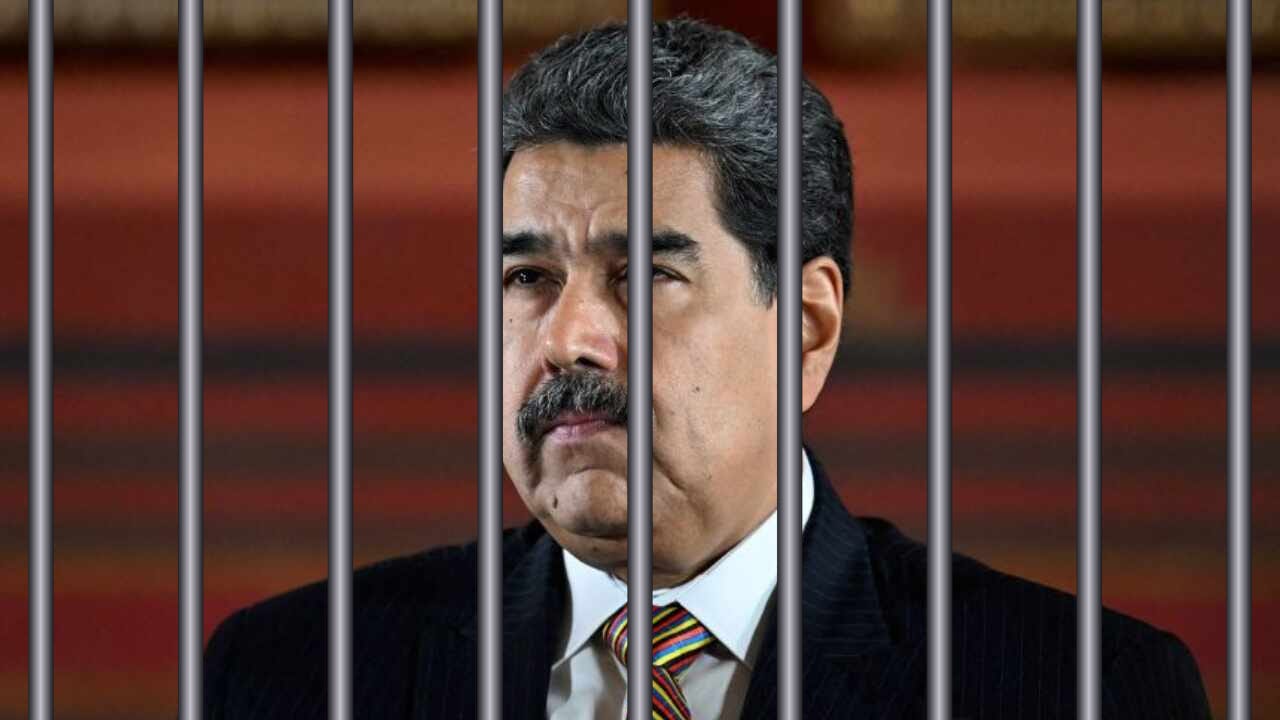
Brutally, bluntly, but quite effectively, Donald Trump looked at the corrupt and thuggish Nicolas Maduro and said, quite simply, “you’re fired!”
By so doing, Donald Trump has demonstrated yet again that the way to expand American power is to wield American power.
Initially, US government sources said little more to the media other than that the US was carrying out an operation in Venezuela. However, video footage quickly emerged on X and other social media platforms indicating that the operation was not just an aerial assault but involved putting forces on the ground.
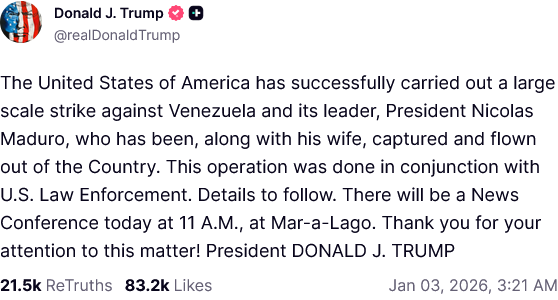
Shortly after, President Trump released his post on Truth Social announcing that Nicolas Maduro was in custody.
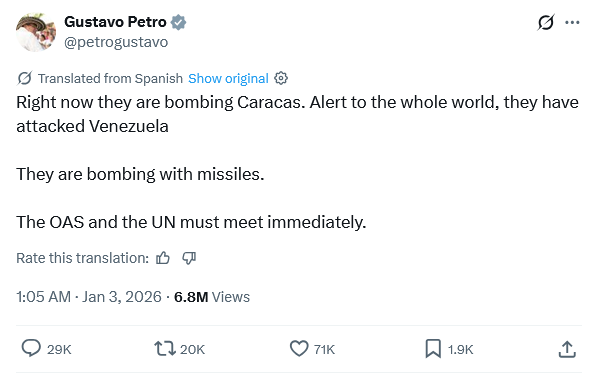
Unsurprisingly, many Latin American leaders were not pleased with this sudden turn of events. Colombia’s President Gustavo Petro took to X to call for United Nations intervention.
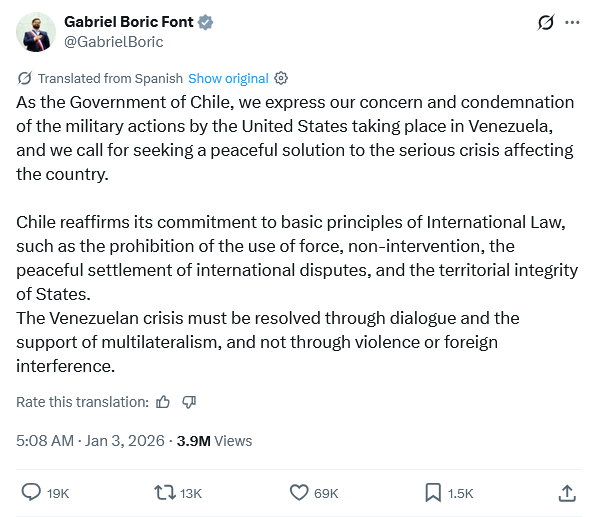
Chile’s Gabriel Boric Font called for the crisis in Venezuela to be resolved “through dialogue.”
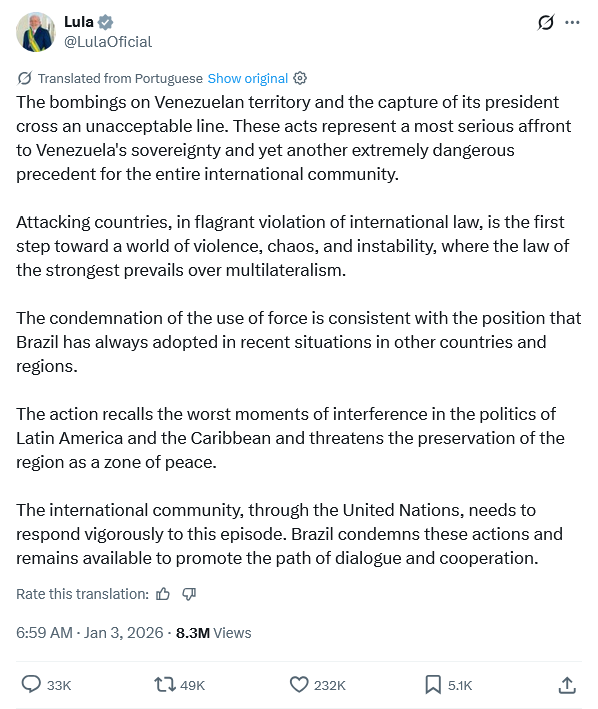
Brazil’s Luiz Inacio Lula da Silva said the American raid and seizure of Maduro “cross an unacceptable line.”
Meanwhile, Mexico’s Claudia Sheinbaum denounced the attack in no uncertain terms.
The Government of Mexico strongly condemns and rejects unilaterally executed military actions in recent hours by armed forces of the United States of America against targets on the territory of the Bolivarian Republic of Venezuela, in clear violation of article 2 of the Charter of the United Nations (UN).
Based on its foreign policy principles and pacifist vocation, Mexico urgently calls for respect for international law, as well as the principles and purposes of the UN Charter, and to cease any act of aggression against the Venezuelan government and people.
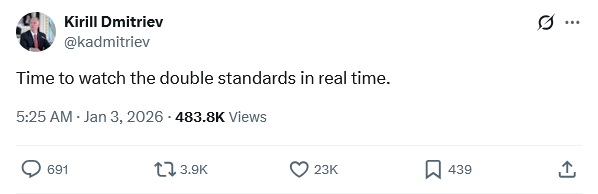
Similarly, Russia was equally nonplussed by the raid, with Kremlin Special Envoy Kirill Dmitriev decrying the “double standards” at play.
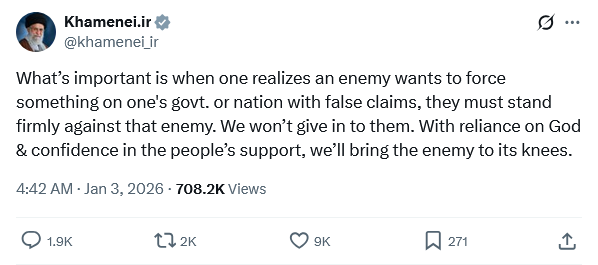
Iran’s Supreme Leader Ayatollah Ali Khamenei used the occasion to yet again promise to bring the United States to its knees.
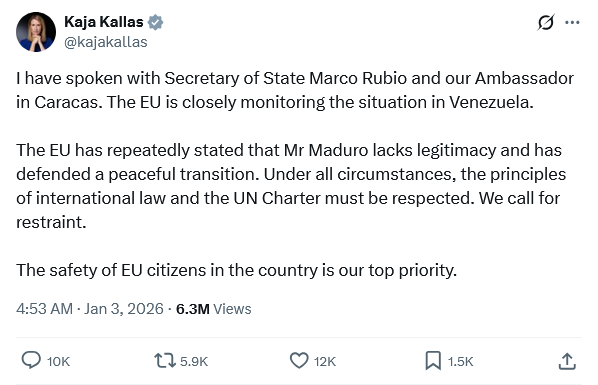
On the other side of the pond, the reaction was far more muted and circumspect, noting that Nicolas Maduro was not considered a legitimate political leader by many nations. Kaja Kallas, the European Union High Representative for Foreign Affairs, merely called for restraint and the safety of EU citizens.
Spanish President Pedro Sanchez called for “de-escalation and responsibility.”
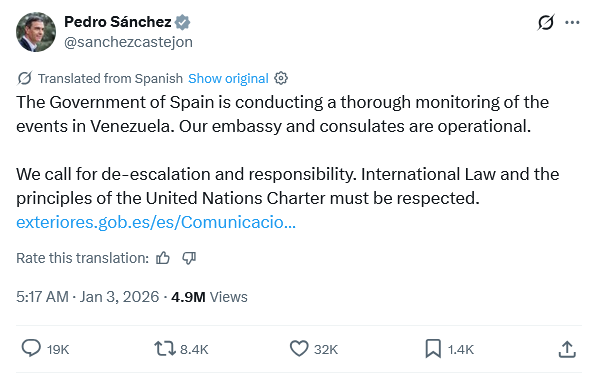
In its official communique, Spain also noted that it had not recognized Venezuela’s last election.
Britain’s Nigel Farage had perhaps the most realistic appraisal of the American action:
“The American actions in Venezuela overnight are unorthodox and contrary to international law — but if they make China and Russia think twice, it may be a good thing. I hope the Venezuelan people can now turn a new leaf without Maduro.”
In other words, Maduro was a bad dude, what the Americans did was a violation of all our comforting illusions about “international law,” but they took down a bad dude and gave other bad dudes reason to worry—so deal with it.
Such rhetoric by world leaders recalls reactions to President Trump’s equally sudden targeted killing of Iran’s Quds Force Commander Major General Qassem Solemani five years ago almost to the day.

Leaders all over assessed President Trump wrong then and they are assessing him wrong now.
First, we should not presume that Trump’s animus towards Maduro is of recent vintage. As Jonthan Turley points out, Maduro was indicted by the first Trump Administration back in 2020. The narrative that Maduro is in bed with Venezuela’s narcoterrorists—that Maduro is himself a narcoterrorist—is not at all new, and has not been disputed on either side of the political aisle.
Further, we should also note that in August, 2025—well before President Trump ordered the first attack on the first go-fast boat running drugs into the US—the US Department of State posted a $50 million reward for information leading to Maduro’s capture.
Nicolas Maduro was not merely the de facto head of Venezuela, he was also a fugitive from American justice. That matters, because in 1989 the United States military invaded Panama in Operation Just Cause to capture and bring back to the US Panamanian strongman Manuel Noriega.
By the time this raid took place and Maduro was captured, there was both a legal precedent for his capture and a legal foundation for doing so.
Does this make the raid itself a wise move? Not at all. As noted in ZeroHedge, this strike on Venezuela could easily backfire on President Trump politically.
If Trump stumbles on this, Democrats will seize on every opportunity label him a warmonger. They will assert that Trump is empire-building, trying to steal oil, and that Venezuela is “just the beginning.” Keep in mind, these are the same people who tried to rally Americans to support WWIII against Russia over Ukraine, but that fact will be glossed over in favor of the narrative that the Dems will “bring peace and stability.”
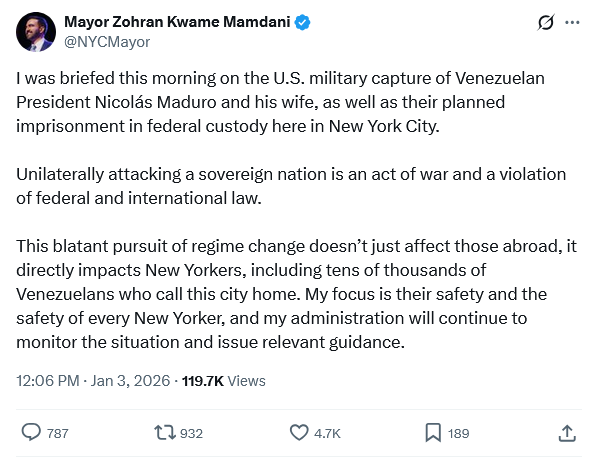
Already, leading Democrat mouthpieces such as the newly elected Communist Democrat Mayor of New York, Zohran Mamdani, condemned Trump’s actions.
At the same time, there is no denying that President Trump has once again charted his own course regarding international diplomacy—and has been charting that course for quite some time.
We must not forget that it was all the way back in September when Secretary of State Marco Rubio body-slammed the United Nations specifically in regard to Maduro and drug trafficking from Venezuela.
With the country’s top diplomat willing to say that publicly in a press conference, we should not be surprised that President Trump has few qualms about executing a raid to capture Nicolas Maduro himself.
This has been the hallmark of the Trump Administration from Day 1, however. Whether we look at his muscular use of Executive Orders, his controversial cabinet appointments, or his embrace of tariffs both as a revenue measure and a geopolitical weapon, Donald Trump has not been a conventional President. That alone assures he will be a consequential President, although only time will tell if that will be to his credit or his shame.
Donald Trump is, politically speaking, a wrecking ball. At every turn, and in every aspect of the modern Presidency, he is dismantling the status quo, sometimes with savage glee.
He is taking risks recent Presidents have been quite reluctant to even consider, such as directly bombing Iran’s nuclear weapons production facilities.
Yet as events after the bombing run on Iran have proved, President Trump is not merely taking risks—he’s getting away with taking risks.
Whether domestically or internationally, President Trump is reminding the world that the way to increase power and influence is to wield power and influence. While the EU wanted to dither and engage in endless rounds of diplomacy over Maduro’s illegitimate and thuggish regime in Venezuela, Donald Trump settled the matter in the space of a few hours, capping what had been weeks of steadily escalation pressure.
For all of Mexico’s discomfiture, for all of Democrat indignation, there is little that any country is willing or even able to do about Maduro’s seizure.
Rightly or wrongly, for better or worse, Donald Trump not only demonstrated that the UN does not know what it is talking about with respect to Nicolas Maduro, he demonstrated that the world does not hinge on UN resolutions or EU calls for “diplomacy.”
Rightly or wrongly, with this raid into Venezuela, Donald Trump is proving once again how toothless and irrelevant the bastions of the globalist “rules based order” truly are. While the supranational institutions of diplomacy sit around and talk, Donald Trump acted. Donald Trump acted on tariffs, he acted on Iran, and now he’s acted on Venezuela. Barring a sudden outpouring of revulsion by leading nations such as the other G7 nations—a display that so far has not happened—Trump will emerge from this latest exercise of US power as unscathed as prior uses.
Is this raid truly “America First”? That depends on who you ask, and what their particular agenda is.
Those who view any American action taking place outside the borders of the United States as a corrupt “neocon” conspiracy are not likely to view this action favorably.
Those who view unilateral American action as repugnant to international law are already sounding suitably horrified by Trump’s latest outrage. Of course, that they are unable to actually do anything but sound horrified suggests that “international law” might be more wishful thinking than a reality of international relations or national governance.
Those who are “all in” on Donald Trump’s MAGA personality cult are likely busy crafting new memes built around the theme “FAFO”.
Is this raid going to greatly reduce the efforts by drug cartels to smuggle illicit drugs into the United States? It may disrupt some smuggling routes for a time, but there are still plenty of cartel actors willing to move into the void left by Maduro and the Venezuelan gangs. The void left by the Medellin Cartel of Colombia after the death of Pablo Escobar was soon filled by others, and this void will also not be empty long. That is the reality of international drug smuggling.
Will other corrupt national leaders with ties to drug smuggling have cause to worry? Some might. Gustavo Petro of Colombia has already been tagged by the State Department as running a government that is in bed with narcoterrororists. In his February 1 Executive Order imposing punitive tariffs on Mexico because of the drug flows across the US southern border, President Trump stated explicitly the cartels have an “intolerable alliance” with the Mexican government.
Unsurprisingly, Mexico’s President Sheinbaum clapped back against the accusation.
Will Petro or Sheinbaum find themselves also indicted by the Department of Justice? Will they then be subject to a sudden midnight raid and forced rendition back to the United States?
At present, nobody knows—and perhaps that should be the cautionary here. Yesterday, everyone would have scoffed at the idea of the US sending forces to Mexico City to arrest President Sheinbaum. Is that idea really so outlandish today?
Whether that is or is not President Trump’s next policy objective is less important than the reality that Petro and Sheinbaum are grappling with an awkward “I do not know” when asking themselves and their staffs if they’re next on Donald Trump’s hit list. Everything these national leaders must now do and say regarding Donald Trump must invariably be calibrated with that thought in mind. There is no way for them to avoid that.
Whatever else comes from Maduro’s capture and forced rendition to the US, Trump has already altered the trajectory of relations between the US and the rest of Latin America, between the US and China, between the US and Russia, even between the US and the EU. That might end badly or it might end well, but in no circumstance will it end with the status quo intact.
Does that make this a Trump victory or a Trump fiasco? At present, no one knows—and that makes Donald Trump all the more powerful a geopolitical force.
Great Post Pete
Very few countries actually recognized Maduro as the rightful leader of Venezuela. < 🇮🇷🇨🇳🇷🇺 >