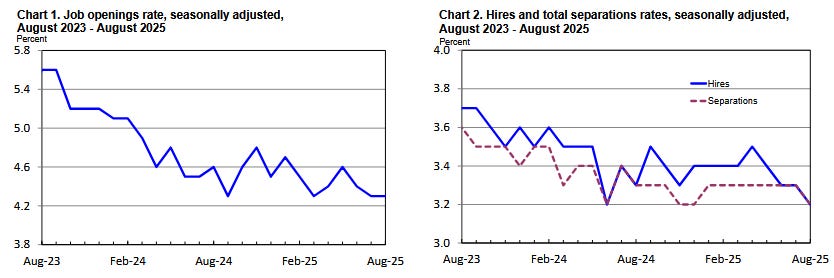
The number of job openings was unchanged at 7.2 million in August, the U.S. Bureau of Labor Statistics reported today. Over the month, both hires and total separations were little changed at 5.1 million. Within separations, both quits (3.1 million) and layoffs and discharges (1.7 million) were little changed.
Of course, the number of job openings did change, although an increase of a paltry 19,000 job openings is not the sort of variance which would make “unchanged” grotesquely inaccurate.
Join a growing community that values truth over noise. Become a paid subscriber today!
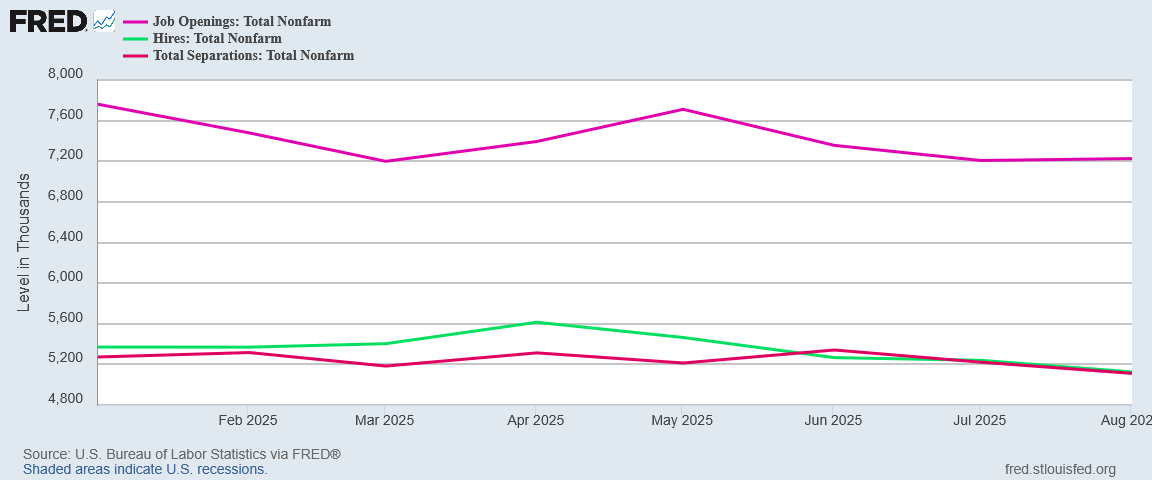
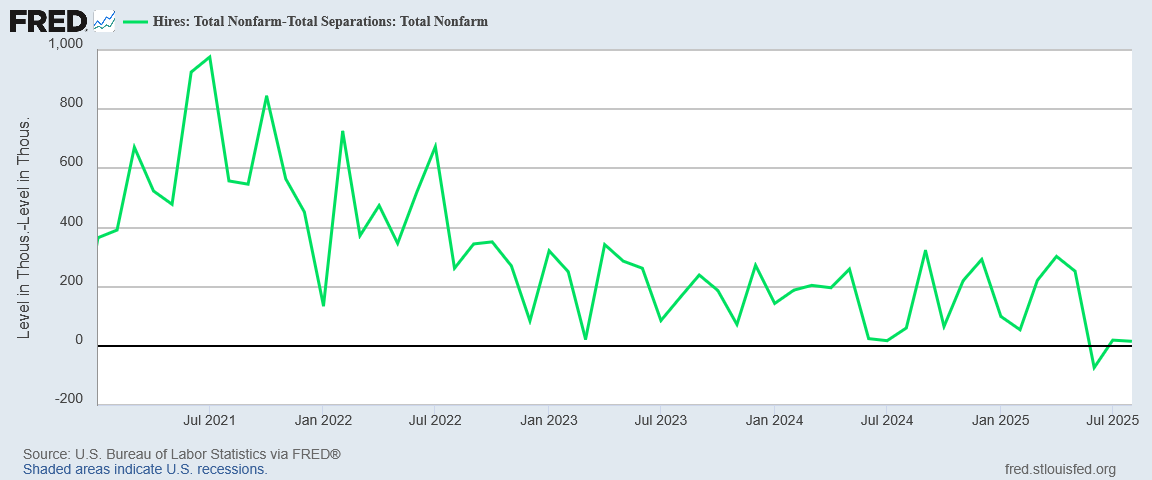
While job openings inched up by 19,000, labor markets overall continued their descent into stasis, with hires dropping by 114,000 and separations dropping by 110,000.
Even since the start of the year, hiring and separations have trended noticeably lower, while job openings themselves have fallen 6.8%.
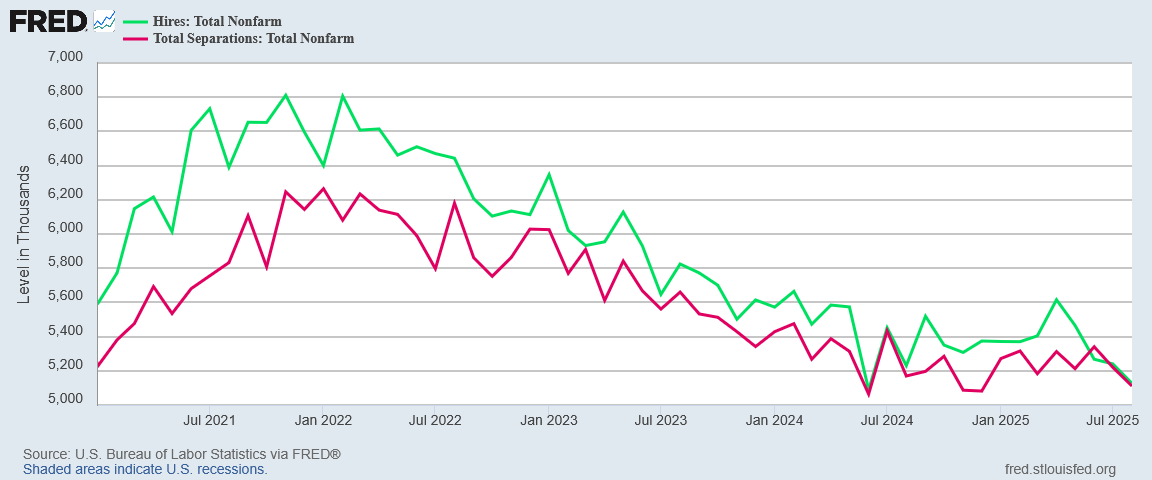
Labor turnover—a primary reason the JOLTS report even exists—remains in long-term decline, with fewer people losing or leaving their jobs and fewer people being hired into new jobs.
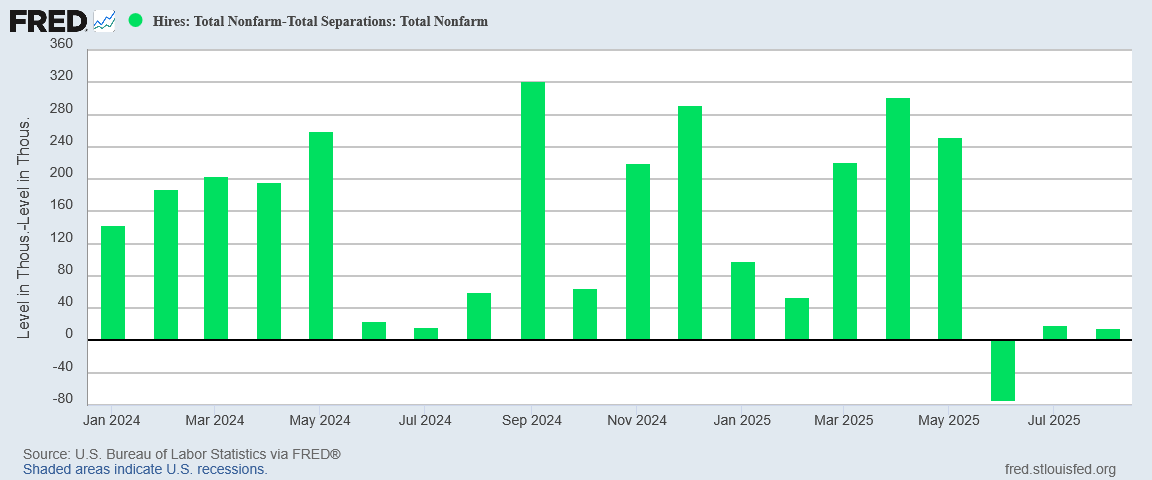
Not only has this summer’s job market been demonstrably weaker than last summer, compared to earlier in 2025 hiring has all but evaporated.
There is no scenario where this is encouraging economic news.
That collapse is even more apparent when we step back and look at net hiring since 2021.
If we were to use two words to describe the August JOLTS report, they would most likely be “not much”, as that describes almost perfectly the state of hiring in the US.
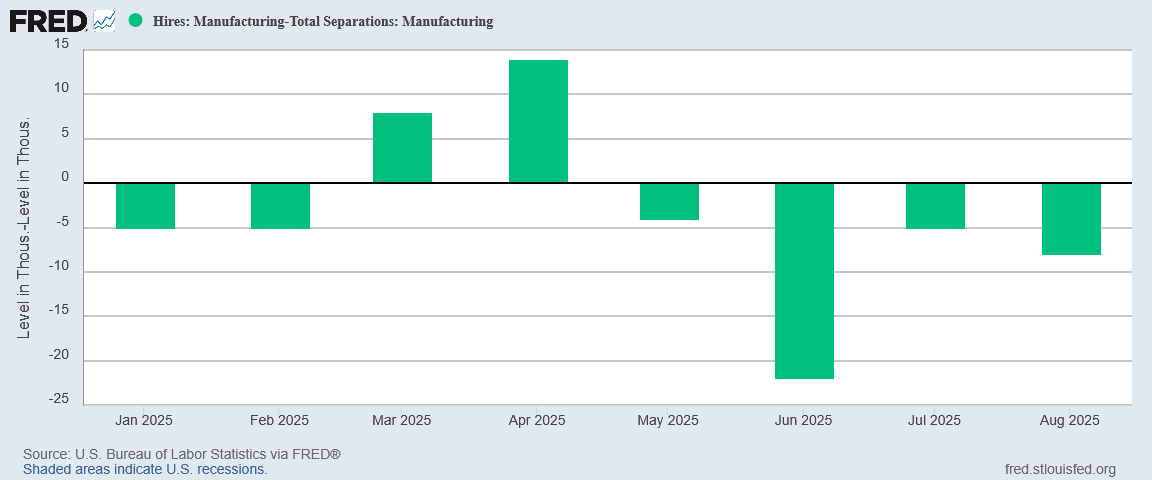
Not much certainly describes manufacturing, which shed jobs for the fourth month in a row, according to the JOLTS data.
The number of job openings for July was revised up by 27,000 to 7.2 million, the number of hires was revised down by 68,000 to 5.2 million, and the number of total separations was revised down by 68,000 to 5.2 million. Within separations, the number of quits was revised down by 42,000 to 3.2 million, and the number of layoffs and discharges was revised down by 21,000 to 1.8 million.
American labor markets are deteriorating. American labor markets have been deteriorating for some time, and that has accelerated in recent months. That’s what the JOLTS data has been saying for a number of months now.
The JOLTS data has been saying what the inflation data has been saying: President Trump’s “Golden Age” has not started. President Trump’s “Golden Age” certainly did not start in August.
With official Washington officially closed due to shutdown, the August JOLTS data is quite possibly the last thing the BLS will have to say about both America’s labor markets and President Trump’s “Golden Age” for some time.
With official Washington officially closed due to shutdown, the August JOLTS data makes the BLS last word on jobs for some time not a bang but a whimper.
The really discouraging aspect is that it will all be blamed on Trump, and will harm the Republican Party at the midterm elections. But it is NOT mostly Trump’s fault. Case in point:
A few years ago, the leftist Minneapolis politicians enacted a new minimum-wage law that required all small businesses in the city to raise wages until the minimum peaked at $15/hr as of last July. Small businesses had been just barely holding on for years, due to COVID shutdowns, riots, homelessness and other problems that were beyond the scope of business owners’ ability to modify. Now, and for the past several months, small businesses are closing at an accelerated rate. Restaurants, bars, retail, and other small establishments with razor-thin profit margins simply cannot absorb the higher wages they are mandated to pay. This is the fault of Democrats, not Trump! But too many unthinking people cannot connect the dots, and are so indoctrinated to blame everything on Trump that they don’t even try to think it through logically.
We may be in for a rough patch (at a minimum!) for a long stretch. You foresaw all of this ages ago, Peter. I hope you will continue to size up the trends and keep us informed - especially if you see any positive signs. Thanks!
There's truth in both the responses to Peter's analysis; as well as a solution.
When States (like MN & NY) set minimum wage requirements (as well as other compensation; health insurance, leave time, etc.) that are are economically difficult to impossible to achieve; businesses become unprofitable and cease to exist.
While the "market rate" for labor in some areas is well above minimum wage, there is a good argument to allow employers to determine compensation for labor vs. Gov't.






The really discouraging aspect is that it will all be blamed on Trump, and will harm the Republican Party at the midterm elections. But it is NOT mostly Trump’s fault. Case in point:
A few years ago, the leftist Minneapolis politicians enacted a new minimum-wage law that required all small businesses in the city to raise wages until the minimum peaked at $15/hr as of last July. Small businesses had been just barely holding on for years, due to COVID shutdowns, riots, homelessness and other problems that were beyond the scope of business owners’ ability to modify. Now, and for the past several months, small businesses are closing at an accelerated rate. Restaurants, bars, retail, and other small establishments with razor-thin profit margins simply cannot absorb the higher wages they are mandated to pay. This is the fault of Democrats, not Trump! But too many unthinking people cannot connect the dots, and are so indoctrinated to blame everything on Trump that they don’t even try to think it through logically.
We may be in for a rough patch (at a minimum!) for a long stretch. You foresaw all of this ages ago, Peter. I hope you will continue to size up the trends and keep us informed - especially if you see any positive signs. Thanks!
There's truth in both the responses to Peter's analysis; as well as a solution.
When States (like MN & NY) set minimum wage requirements (as well as other compensation; health insurance, leave time, etc.) that are are economically difficult to impossible to achieve; businesses become unprofitable and cease to exist.
While the "market rate" for labor in some areas is well above minimum wage, there is a good argument to allow employers to determine compensation for labor vs. Gov't.