

The August Employment Situation Summary (ESS) was received by Wall Street as “bad good news”. Job growth surged, so yields spiked and equities tanked.

With the peculiar “Through The Looking Glass” sort of reasoning that passes for expertise at the Federal Reserve, because jobs were created, interest rates must be raised to stop jobs from being created, because inflation.
As we saw during the 2022 hyperinflation cycle, former Federal Reserve Chairman Jerome “Too Late” Powell and his minions among the Fed Governors were quite explicit about their reasoning. Their cure for inflation is to make jobs too expensive to create, and consumption too expensive to consume.
It “worked” for Paul Volcker, so it must work for all central bankers in all circumstances for all time.
When we look at the hard data, both for Paul Volcker’s time and for the present circumstance, we find reality has a different take both on Volcker’s rate hike “shock therapy” of 1979-1982, and on the Fed’s rate hikes in 2022-2023.
That take, if Kevin Warsh can be bothered to do some of his own research for a change, also says raising the federal funds rate now is the wrong move. There is no need and it will do no good.
Rate Hike Is Assumed
As I noted the other day, Wall Street is convinced that the Federal Reserve will raise the federal funds rate 25bps at the September meeting of the Federal Open Market Committee.
As the Associated Press reported, the expectation of a rate hike pushed equities down on the day Friday.
The S&P 500 fell 0.4%, though it managed to eke out a modest gain for the week. The Dow Jones Industrial Average fell 0.5%, and the Nasdaq composite gave back 0.3%.
Wall Street expects the Federal Reserve to raise interest rates before the year ends in an effort to cool inflation, which has been running hot due to rising oil prices amid the U.S. war with Iran and remains well above 3%. The Fed has a stated goal of cooling inflation to a target of 2%.
The expectation of a rate hike was also the reason given for Treasury yields rising on the day, according to CNN.
The two-year Treasury yield jumped after the data release, reflecting increased expectations that the Federal Reserve has room to raise interest rates at its policy meeting later this month. The 10-year yield moved slightly higher.
The reasoning: more jobs mean more reasons to raise interest rates. Morgan Stanley economist Ellen Zentner gave that logic explicitly to CNBC.
“An upside surprise in payrolls will likely ramp up concerns about a rate hike, but that outcome is in the hands of next week’s inflation numbers,” said Ellen Zentner, chief economic strategist at Morgan Stanley Wealth Management. “If those come in cooler than expected, the Fed will likely feel comfortable discounting potentially inflationary signals coming out of the labor market.”
The jobs report pushed the probability of a 25bps rate hike to 60% for September.
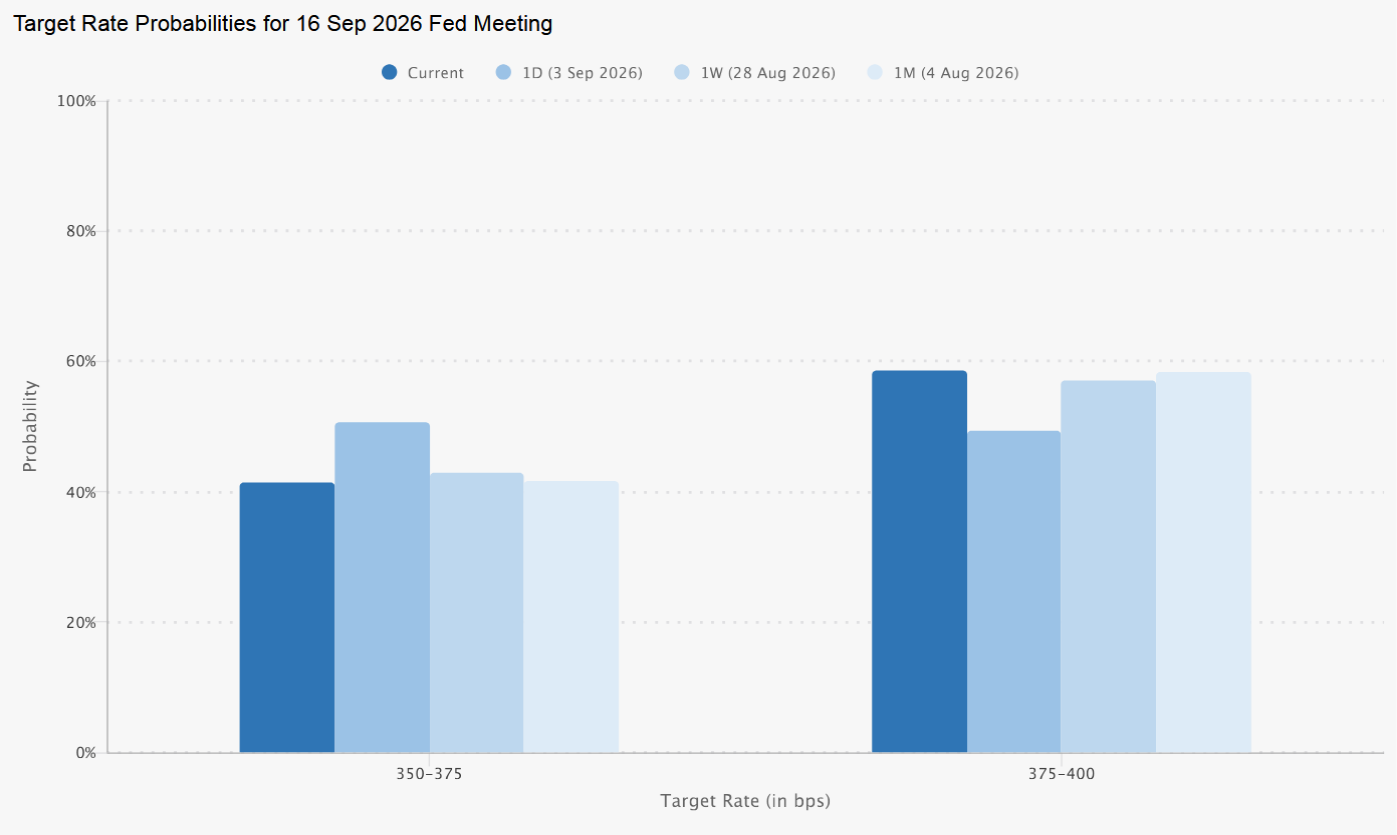
Part of this belief stems from Wall Street’s assessment that the Federal Reserve is going to push rates even higher in 2027. By this time next year, Wall Street’s expectation is for an additional 25bps rate hike.
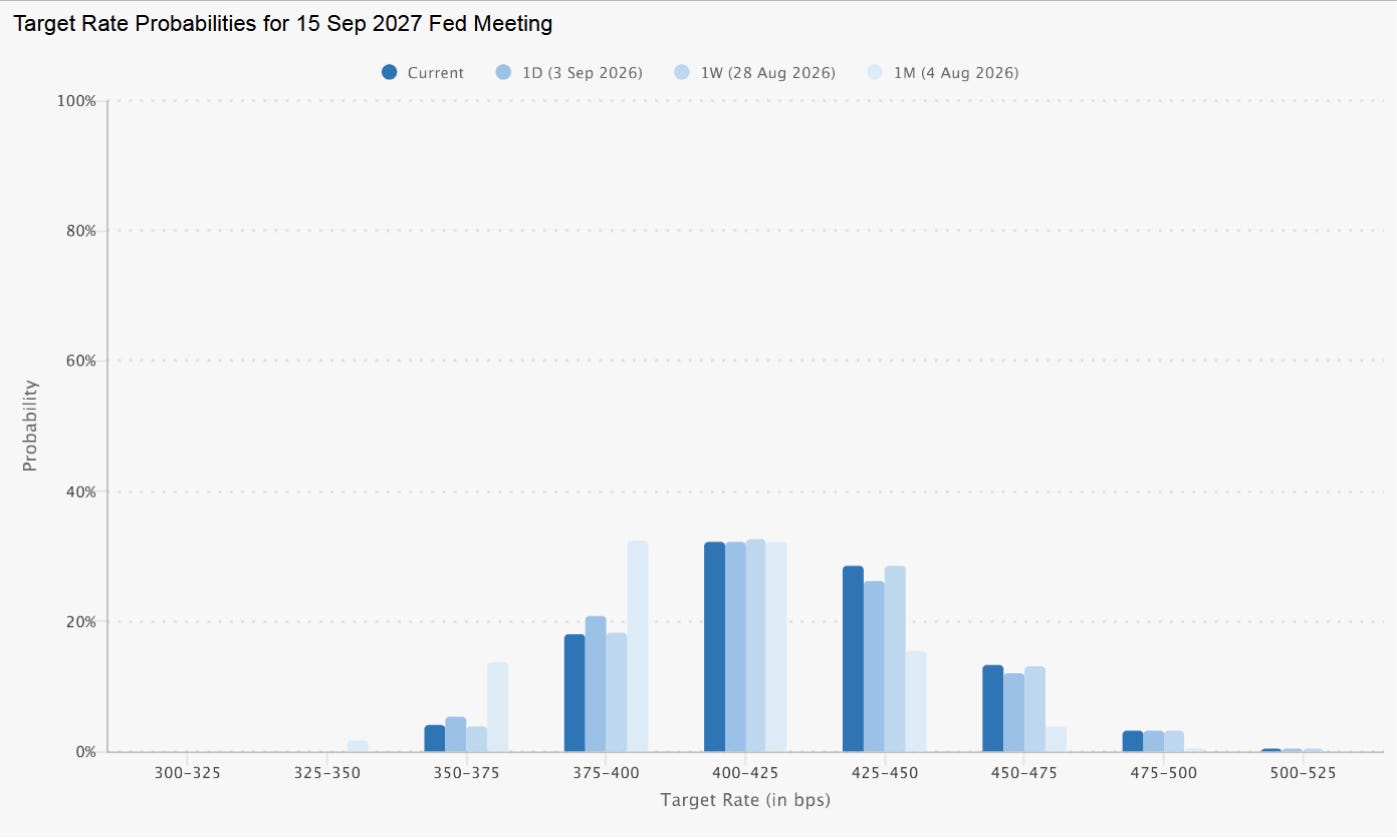
This is part and parcel of Kevin Warsh’s reticence towards forward guidance, Wall Street’s programmed expectation of what the Federal Reserve is going to do twelve months down the road—well beyond what any prognostication of economic conditions can rationally sustain.
This is also why Kevin Warsh doubling down on the 2% inflation “Holy Grail” number at Jackson Hole was a bad idea. Publicly placing that marker down was Ben Bernanke’s bright idea (apparently he was looking for another midwit mistake after causing the Great Financial Crisis in 2008 with his reckless interest rate hikes for no reason), but it was anathema to his predecessor Alan Greenspan, and this is the primary reason why.
How Did Rate Hikes “Cure” Inflation For Paul Volcker?
The reflex response of central banks to inflation is to raise interest rates, and has been since Paul Volcker did it in 1979 to break America’s “stagflation” crisis.
The prevailing narrative is that raising interest rates squelches inflation. However, what is overlooked by that narrative is the mechanism by which higher interest rates constrain consumer price inflation: as multiple Fed officials said during the 2022 hyperinflation cycle, interest rates work by reducing hiring and spending.
Jay Powell was blunt about it at Jackson Hole in 2022.
Restoring price stability will take some time and requires using our tools forcefully to bring demand and supply into better balance. Reducing inflation is likely to require a sustained period of below-trend growth. Moreover, there will very likely be some softening of labor market conditions. While higher interest rates, slower growth, and softer labor market conditions will bring down inflation, they will also bring some pain to households and businesses. These are the unfortunate costs of reducing inflation. But a failure to restore price stability would mean far greater pain.
Inflation means the economy is broken, and so long as there is inflation labor markets will suffer….but to reduce inflation and restore price stability requires breaking the economy and making the labor markets suffer.
Yeah, that makes sense…not.
Squelching consumption, however, was exactly what Volcker achieved with his interest rate hikes in 1979, as we can see when we look at real personal consumption expenditures from 1977 through 1984, using the PCE Price Index and the Consumer Price Index as deflators.
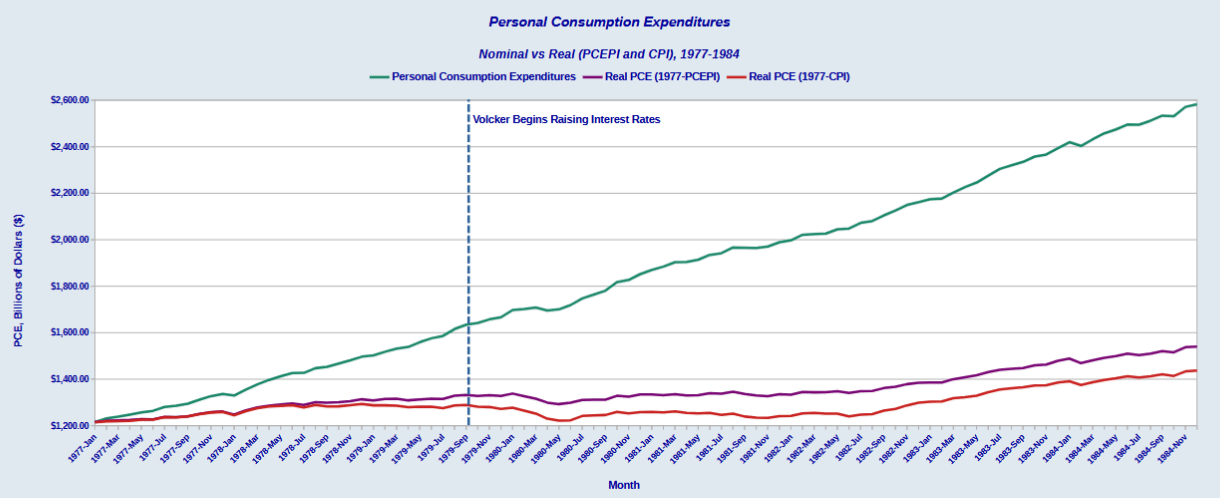
By raising interest rates and keeping interest rates elevated through 1982, Volcker succeeded in putting consumption in stasis. In real terms, there was no meaningful increase in real consumption until around July of 1982, by which time core inflation had dropped to “only” 7.5%.
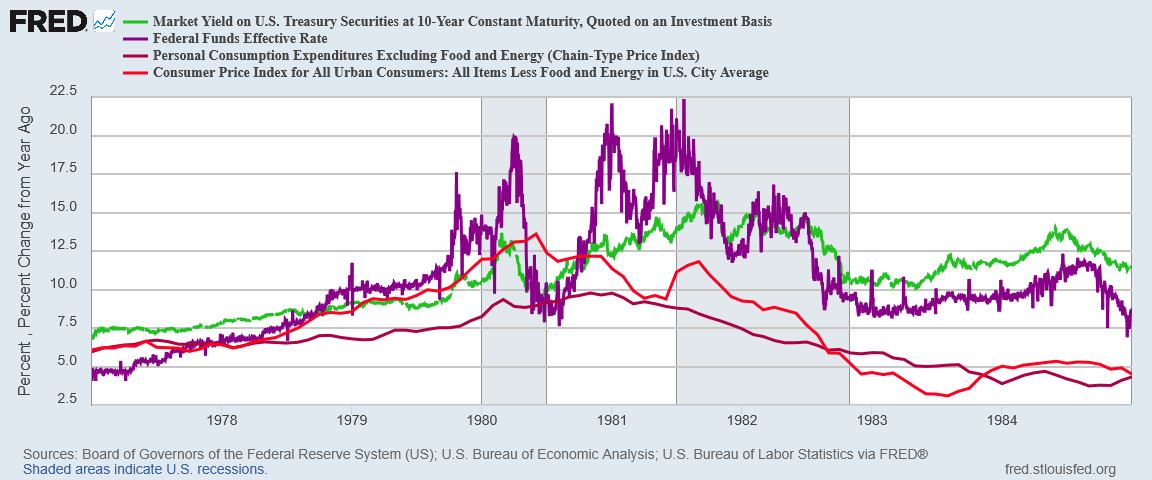
Put simply, Paul Volcker put the American consumer through a deflationary wringer to get inflation under control.
Technically it worked…but it was the American consumer (which is to say the American worker) who paid the cost of Volcker’s shock therapy.
Why did it work? By slowing down consumption for a time, Volcker was able to achieve sustainable symmetry between the US money supply (M1) and the velocity of that money supply, with inflation moving comfortably between the two.

The significance of the oscillations of money supply and money velocity is that they are one side of the fundamental equation in the Quantity of Money Theory1.

When money supply changes and money velocity changes move in cycles which are the inverse of each other, much of the monetary pressure which leads to inflation is mathematically negated. This symmetry was not well established prior to Volcker’s interest rate hikes, and inflation frequently moved outside of the bands established by money supply changes and money velocity changes.
Why Did Volcker Raise Rates, And Does That Logic Apply Now?
Why did Paul Volcker believe this approach was necessary? In large part because the US economy was grappling with its second oil supply shock of the decade, as demonstrated by energy price inflation rising faster than energy expenditures.
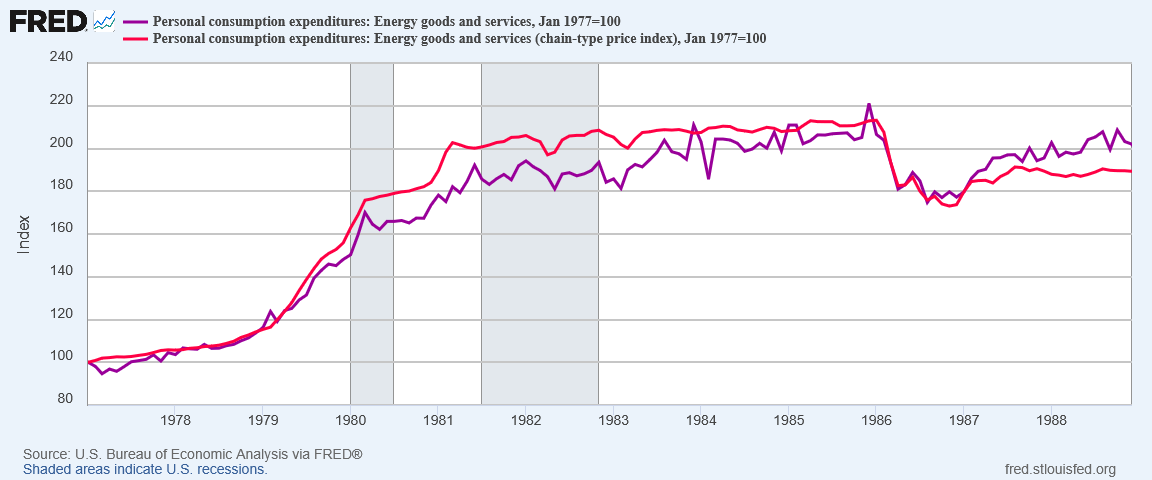
Energy price inflation remained problematic until the oil glut of the mid-80s.
The trigger for the stagflation crisis of the late ‘70s was a sudden and severe oil supply shock. Simply put, the supply of oil available to the United States suddenly dropped after the Islamic Revolution in Iran and the toppling of the Shah.
When energy price inflation accelerated in 1979, it touched off a spiral which pushed consumer price inflation to new heights, creating a severe pricing squeeze that was felt throughout the US economy.
Is that what is happening now?
As I have assessed previously, there has indeed been a global oil supply shock as a result of Operation Epic Fury and the US war with Iran.
However, the inflationary impact of that supply shock has been muted thus far. If we look at real energy consumption vs energy price inflation, indexed to 2021, energy price inflation remains below energy consumption.
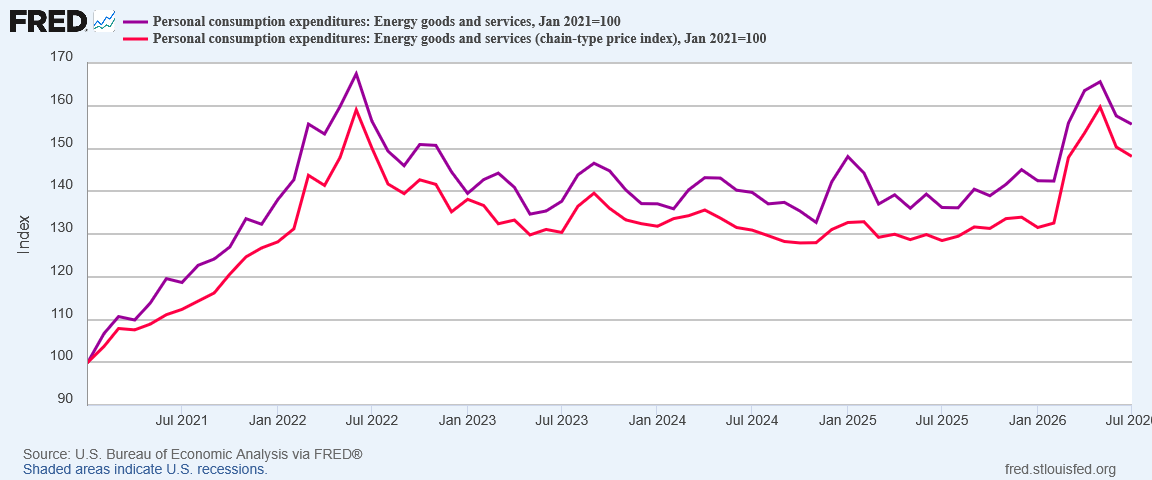
While energy price inflation has been highly volatile since 2021, it’s ultimate impact on the overall PCE Price Index has been fairly muted, and it has had minimal distortion on energy consumption expenditures, as we can see from the year on year change for each.
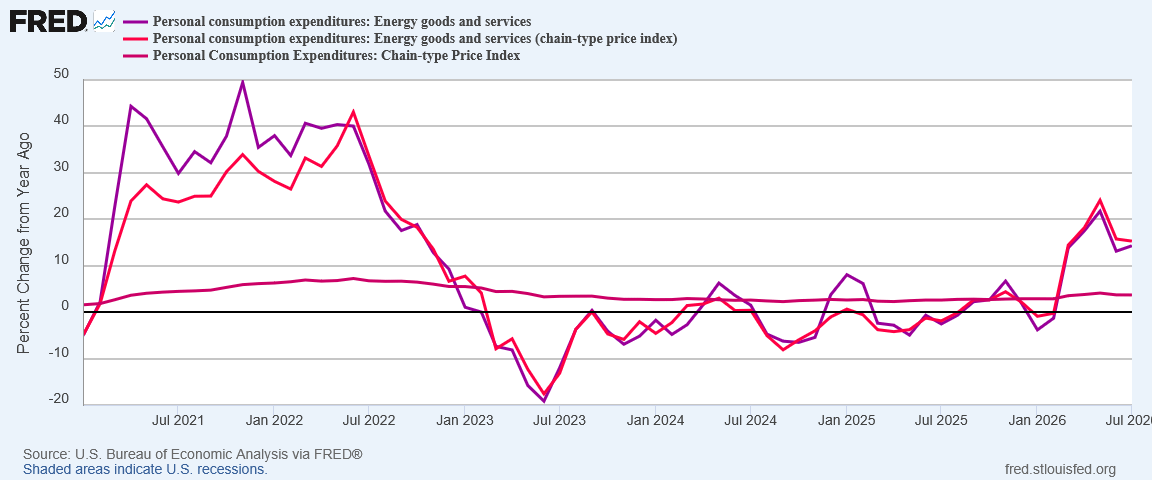
We should also note that energy price inflation’s overall impact on consumer price inflation in the late 1970s was also less than we might surmise from the oil supply shock. The extent to which Volcker’s shock therapy was even necessary as anything more than a tool of political convenience is debatable. Even without the rate hikes, it is quite possible inflation would have settled down on its own without the Fed intervening.
As we can see just by looking at the headline and core PCEPI year on year inflation rate since 1977, we are not facing the stagflationary crisis the US was in 1979.
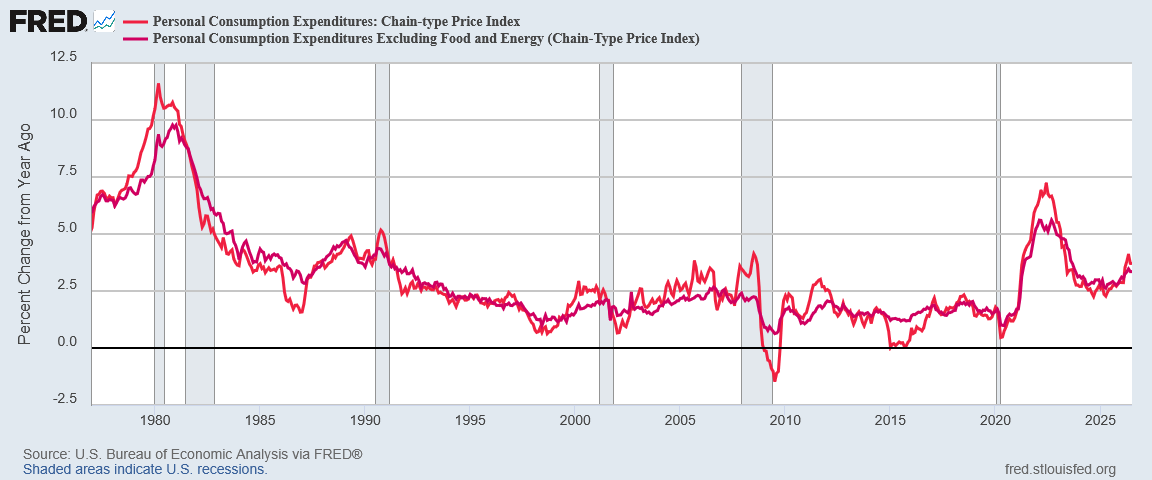
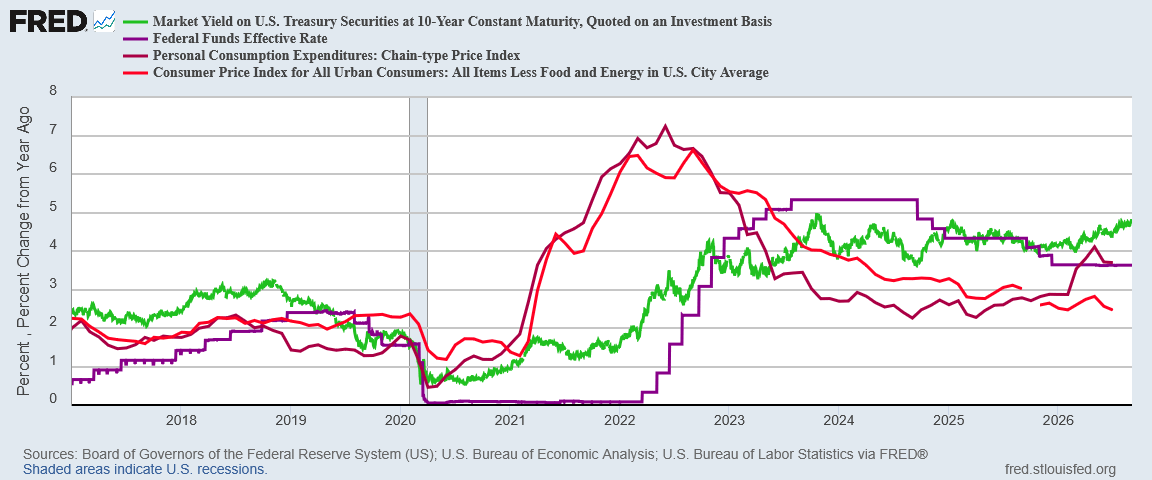
More importantly, ever since Volcker “reset” the relationship between money, interest rates, and inflation, manipulating the federal funds rate has been steadily less and less impactful on consumer price inflation.
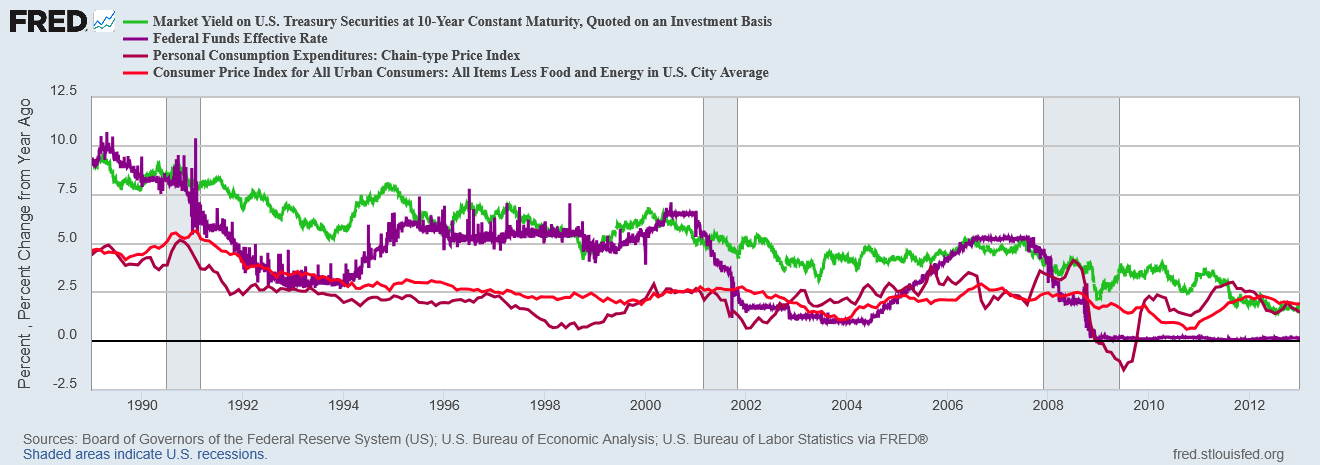
Interest rate fluctuations have had smaller impact on consumer price inflation than during Volcker’s chairmanship of the Fed. After the Great Financial Crisis, when Ben Bernanke dropped the federal funds rate to near zero, inflation remained largely steady.
The dubious wisdom of manipulating interest rates during the 2022 hyperinflation cycle is made plain when we consider that Powell’s rate hikes were nowhere near the same magnitude as Volcker’s and showed nowhere near the proximate impact on consumer price inflation.
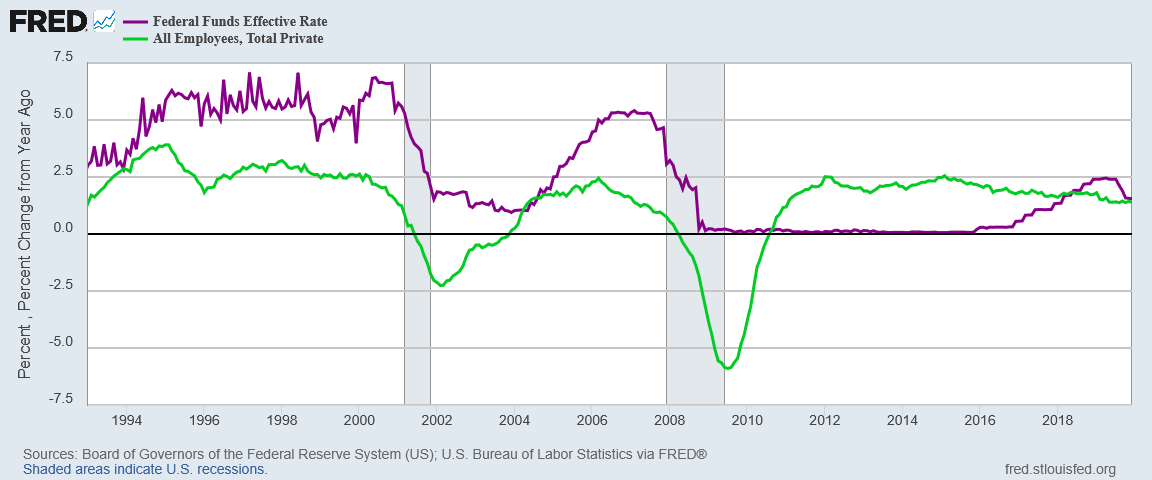
What we do see when we look at the federal funds rate vs job growth in the US, looking at the data from the Alan Greenspan era through the start of the Jay Powell era, is that raising interest rates tends to suppress job growth.
We can see that Powell’s rate hikes, regardless of their problematic impact on inflation, have suppressed job growth in this country.
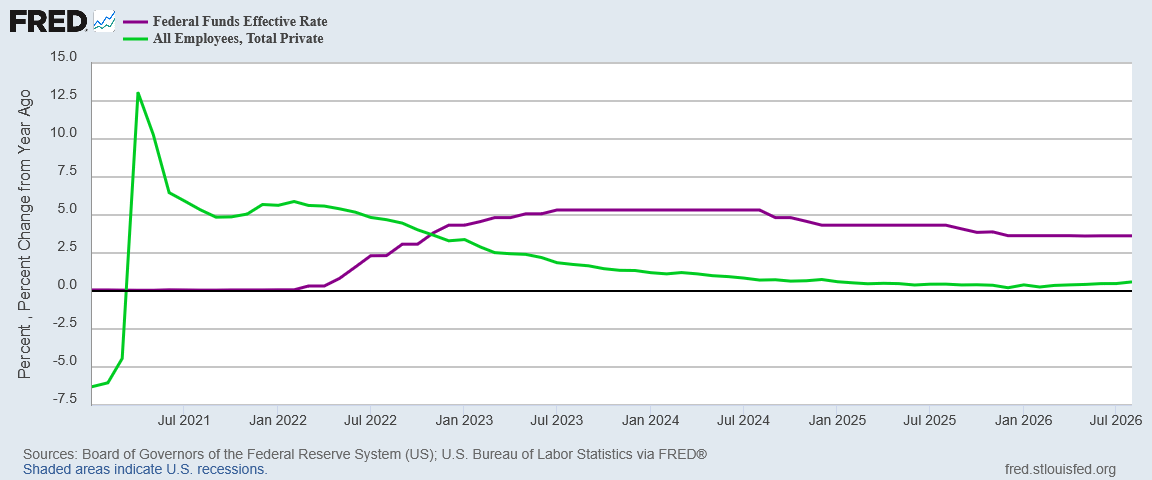
How interest rates which demonstrably suppress job growth are supposed to fulfill the Federal Reserve’s dual mandate, which includes pursuing full employment2, is something neither Jay Powell nor Kevin Warsh had bothered to explain.
One final nail in the “let’s raise interest rate” argument’s coffin: According to the current Cleveland Fed inflation nowcast, the inflation impact of the August Employment Situation Summary report was precisely zero.
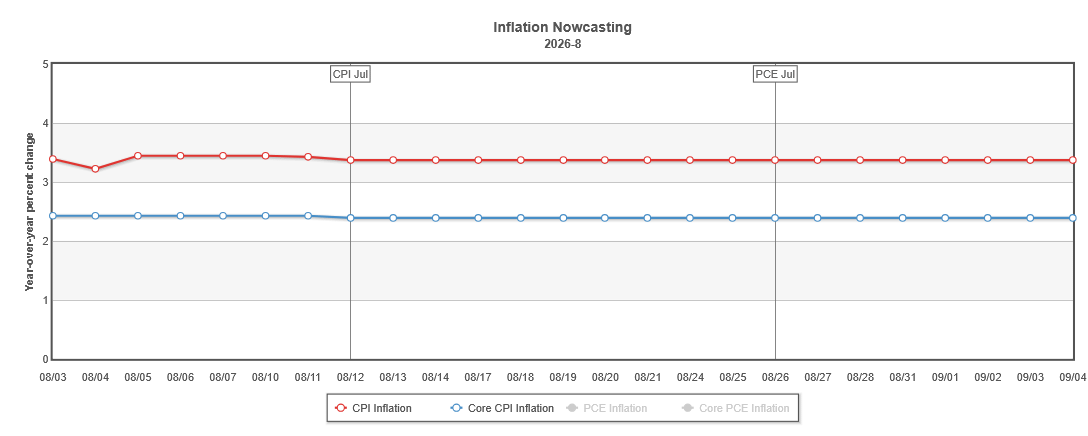
The Federal Reserve is literally on the verge of responding to a problem that arguably does not exist. Job growth in the US is not pushing up prices, and hasn’t been.
Maybe after a year of job recovery there will be inflationary effects, but not after a few months of job recovery. Not when the jobs recession lasted nearly three years.
A Rate Hike Will Not Impact Inflation, Will Impact Job Growth
What a thorough review of the data demonstrates—and what Kevin Warsh and the Federal Reserve should understand (but do not)—is that a 25bps increase to the federal funds rate is not going to move the needle much on inflation. That 25bps increase is going to act as a further drag on job growth in this country.
The US economy only recently emerged from an extended jobs recession. Before the August Employment Situation Summary report came out, the data indicated the US is flirting with a return to jobs recession.
If the August numbers are subject to significant downward revisions we may yet find ourselves returning to jobs recession.
With a recovery still very much in a fragile early stage—assuming is still ongoing—a jobs-suppressing federal funds rate hike in September would only end that recovery. It would not push consumer price inflation down towards the “Holy Grail” of 2% year on year.
Will the Fed stand pat on the federal funds rate? Wall Street does not believe they will, and I am inclined to believe Wall Street has the sense of where the Fed is at on interest rates. Wall Street is expecting a 25bps rate hike this month, and I suspect they will be proven correct.
The Fed is not likely to stand pat on the federal funds rate, but the fed absolutely should stand pat on the federal funds rate. What the FOMC wants to achieve with a rate hike it will not achieve—it cannot achieve.
Kevin Warsh is not Paul Volcker. The 2020s are not the 1970s. The circumstances which made Volcker’s shock therapy work in 1979 did not apply in the 2022 hyperinflation cycle and they do not apply now. Without those circumstances, interest rate hikes will never have the desired impact on the US economy.
Barone, A. What Is the Quantity Theory of Money: Definition and Formula. 17 May 2022, https://www.investopedia.com/insights/what-is-the-quantity-theory-of-money/.
Just when we see some early signs of President Trump’s manufacturing re-shoring agenda coming to life coupled with the AI data center investments, the raising of interest rates can do nothing but harm. High demand is offset by higher supply to provide price equilibrium. With the increased manufacturing activity and data center construction activity and increase in gas and oil production this process has just started. Reducing demand through interest rate hikes is counter to growth.
Do you have a good link to where Powell admitted he was trying to create unemployment to fight inflation? I read quite a few articles at the time covering it but I regret not saving any.