


Kevin Warsh’s Jackson Hole speech was supposed to be a pivotal moment for the recently minted Fed Chairman. Investors the world over were presumably watching to see if Warsh would say what they want him to say.
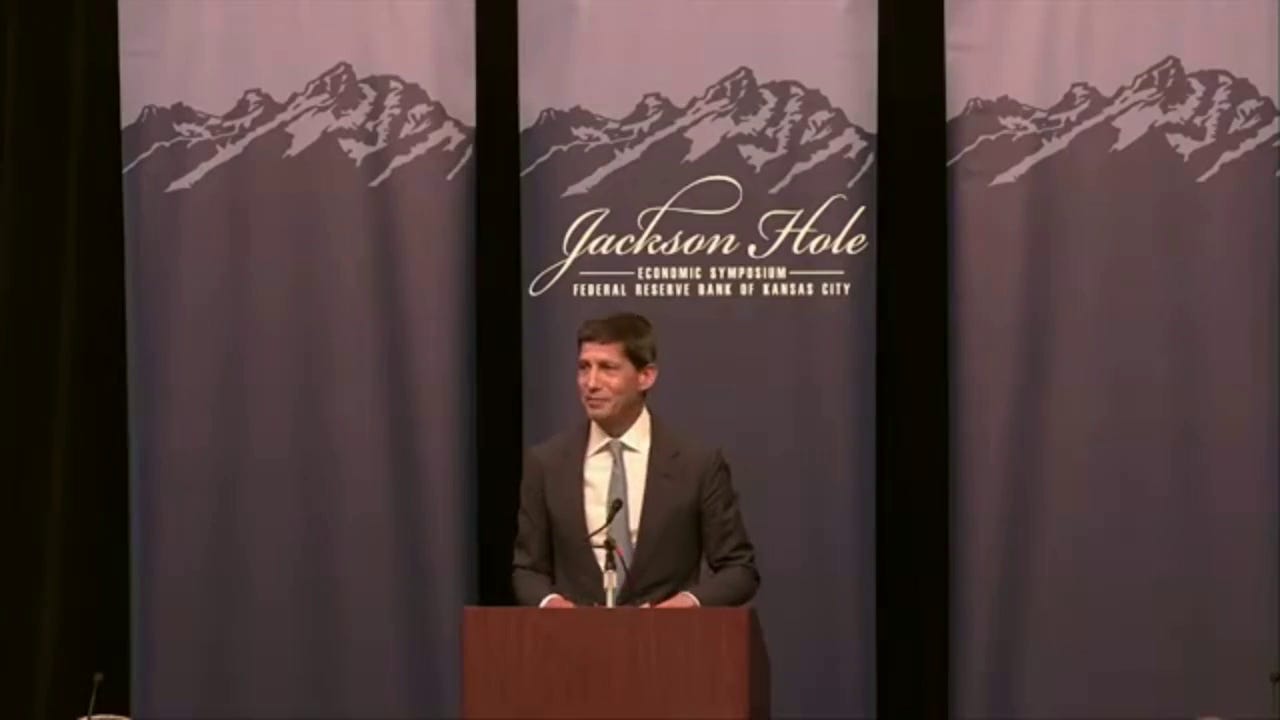
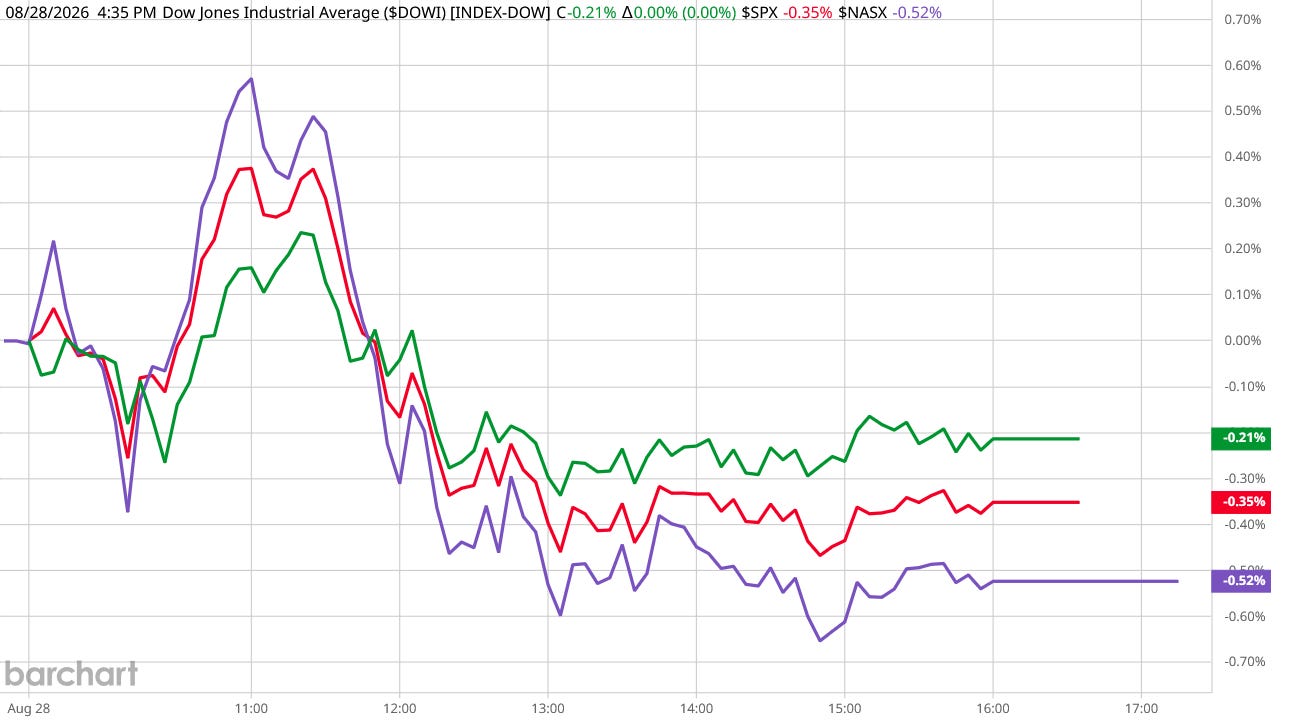
Wall Street was not long in giving its take on his speech—investors were not pleased. Warsh proved to be every bit as effective as his lamentable predecessor Jerome “Too Late” Powell in spiking equities and goosing Treasury yields.
If we look closely at what he actually said, it’s not hard to understand why Wall Street was non-plussed. Despite giving one of the longer Jackson Hole keynote addresses in recent years, Warsh failed to give a clear message on anything. Far from charting a clear course or drawing clear policy lines for the Federal Reserve going forward, Warsh’s speech was a muddled mess, a pile of words that were more salad than substance.
Wall Street likes clarity. They didn’t get it from Kevin Warsh on Friday.
Wall Street Nonplussed
Markets began last Friday on a burst of optimism, with equities rising and Treasury yields dropping.
Then Kevin Warsh opened his mouth. After that, equities and yields went south.
There’s no denying the timing. Kevin Warsh began his address at 10:00AM eastern time, and finished just after 10:30. Just after 11AM, all three major stock indices reversed and remained in decline the rest of the day.
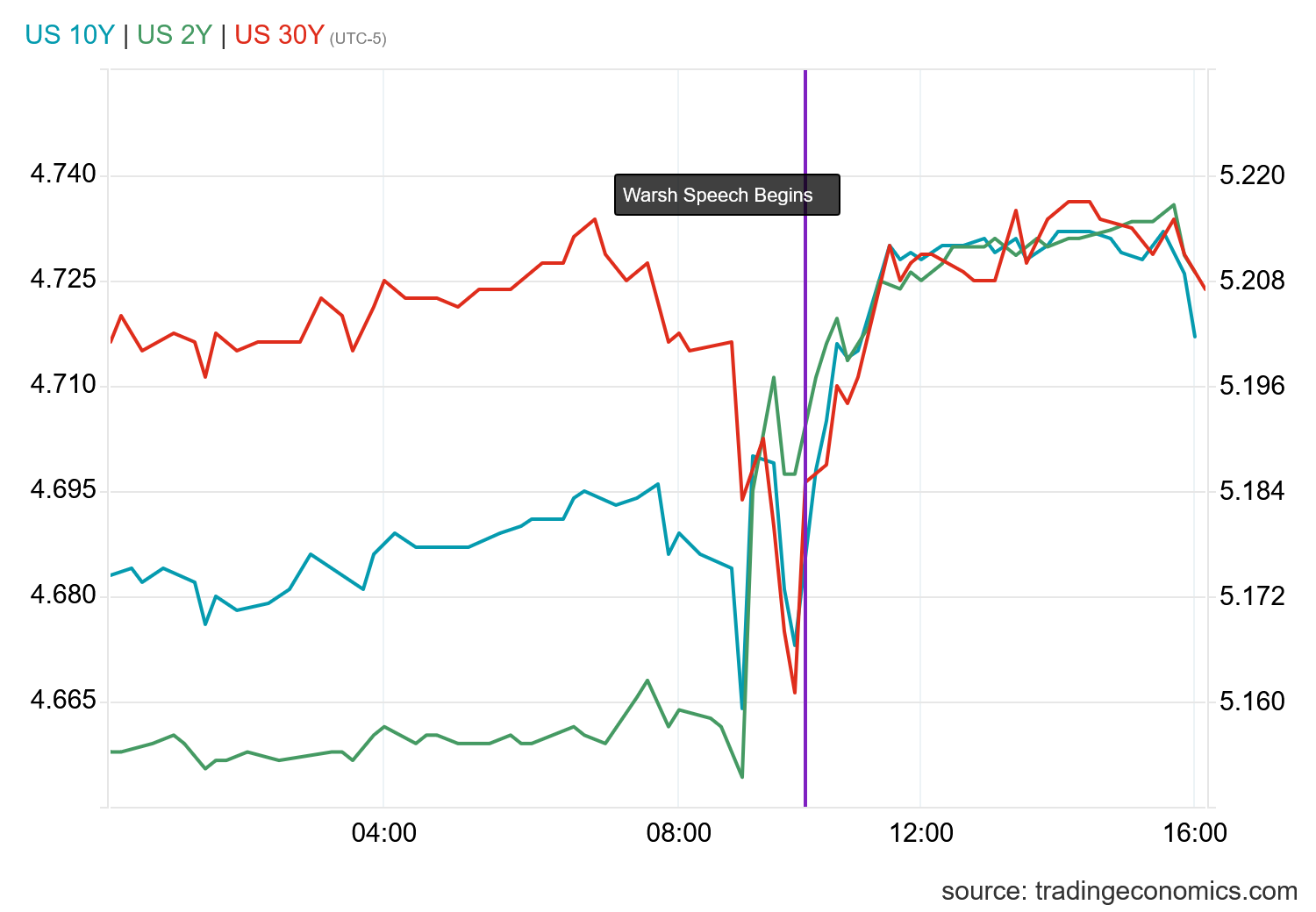
Treasuries were even quicker to respond, rising almost as soon as he took the stage and not stopping throughout the trading day.
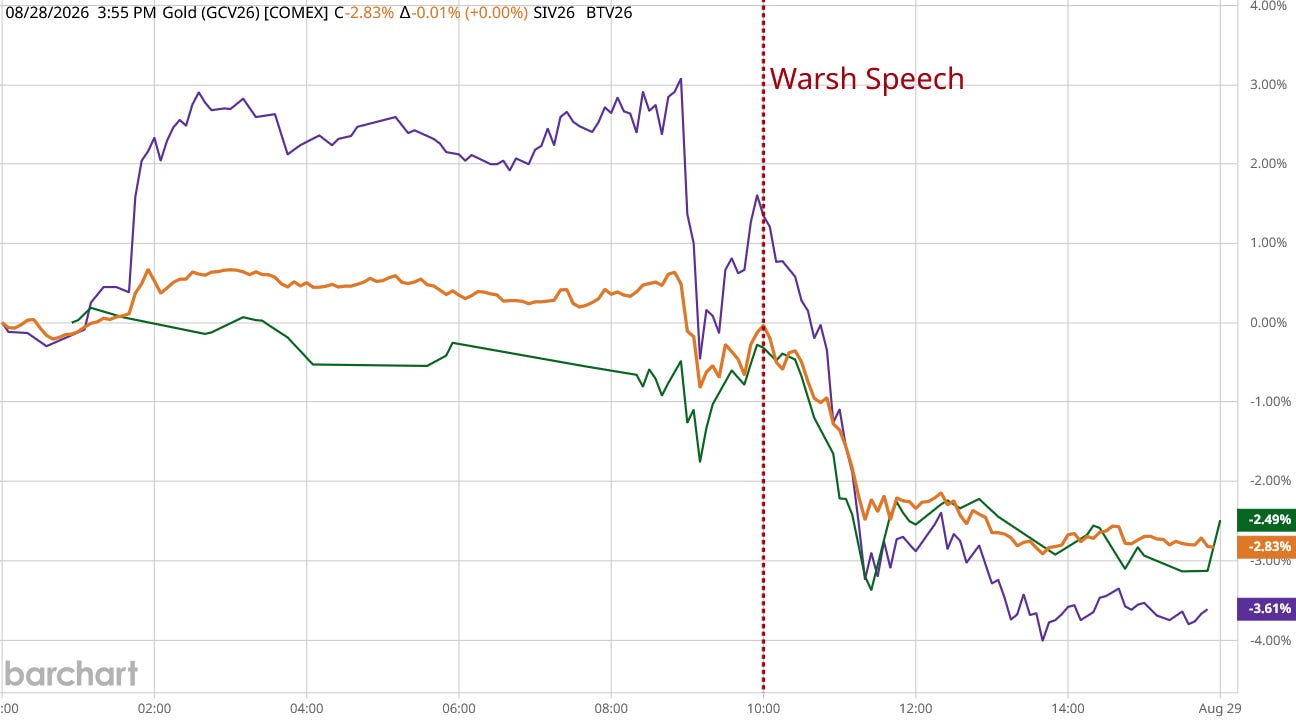
Even gold, silver, and Bitcoin—presumed “safe haven” assets when inflation is not under control and monetary policy is askew—dumped on Warsh’s words.
Wall Street clearly took no comfort in what Kevin Warsh had to say—probably because it’s not clear what Warsh had to say. Even corporate media found his message on inflation mixed and muddled.
Warsh’s closely watched remarks at the Fed’s annual symposium in Jackson Hole, Wyo., avoided committing either to forward guidance — or verbal cues about the Fed’s intentions — or reaction function, the economic signals that would warrant an adjustment in rates.
However, he did acknowledge that inflation is running hot, saying, “while this summer’s [inflation] readings were better than expected, they do not tell me that underlying trends have meaningfully improved.”
He added, “We must be confident that underlying inflation is moving to our objective, clearly and at sufficient speed. Otherwise, we have work to do. That’s our job . . . our mandate . . . and our charge to keep.”
What Kevin Warsh did do was persuade Wall Street that next month there would be an interest rate hike, because “inflation”.
Traders added to bets on a September rate hike after Warsh also said he felt recent inflation data did not suggest a change in trend.
Traders are now split between a rate hike and a hold in September, as they were before inflation data this month painted a mixed picture.
“Why the market is modestly reacting is he (Warsh) is very adamant that the 2% inflation target is going to remain. He is reiterating the hawkishness, but in a more of a consistent way than an incremental way,” said Mark Hackett, chief market strategist for Nationwide.
“There’s been somewhat misguided thoughts among investors that this would soften a little bit. Clearly, that’s not the case.”
The hawkish stance with no follow up on policy is becoming a recurring theme for a Kevin Warsh address. He has been similarly hawkish on inflation in his FOMC press briefings, and has similarly frustrated Wall Street with his lack of policy specifics for how the Fed will respond to that inflation.
Investors were disappointed last month when Warsh promised to restore price stability but refused to offer a detailed roadmap. He remains reluctant to provide detailed guidance on where interest rates might be going in the near future. Warsh says such commentary can tie the central bank’s hands and also distort market signals about where the economy is going.
Forbes Magazine took the “stiff medicine” approach that Wall Street may not have heard what it wanted, but rather what it needed, which is to do their own research and form their own conclusions on inflation and economic trends in this country.
Will the Fed cut, hold or perhaps signal that rates need to remain higher for longer? Those questions matter, but they miss the bigger story emerging from the Warsh Federal Reserve. Warsh is changing the relationship between the central bank and financial markets, and market participants may have to get used to doing more of their own homework.
That shift may ultimately prove more consequential than whether the Federal Open Market Committee moves the federal funds rate by 25 basis points at its next meeting. Warsh appears to believe that the Federal Reserve should clearly explain its objectives and the economic principles guiding its decisions, but it should not provide investors with a detailed roadmap of future interest rates. The Fed should conduct monetary policy. Markets should study the evidence and determine prices.
As a matter of core principles, the idea of financial markets not taking investing cues from the central bank is a good one. However, the theory behind that idea tends to collide with the reality that the Federal Reserve frequently opts to muck around in those same financial markets, as it did in 2023 when regional lenders Silicon Valley Bank and First Republic Bank went through highly visible collapses in no small part because the Fed’s interest rate manipulations undermined both banks’ considerable investment in long-dated Treasuries.
If the Fed wants to avoid inflicting similar chaos on markets in the future, the Fed chair has little choice but to give investors a clue where interest rates are heading, to allow them to hedge Treasury investments accordingly.
Kevin Warsh may not like forward guidance, but unless the Fed is prepared to be completely hands off in banking crises, a policy of “no guidance” is hardly an improvement.
Looking at equities and Treasuries, that is also how Wall Street views the situation.
Task Force AI
Even beyond the muddled messaging that Wall Street noticed, Warsh displayed an intellectual hubris that was quite at odds with his call for the Fed to be “humble”. That was most prominently on display when he tried to talk about the coming role for Artificial Intelligence in the US economy by first admitting that he knew next to nothing about what that role might be.
Will the application of AI cause a significant sustained rise in productivity across the economy? If so, when?
Will token usage be complementary or competitive to labor?
Will the next generation of AI models demand even greater capital intensity too? Or will the models themselves help devise a capital light solution?
Among the other yet unknowns is the resulting market structure. Who gets to make the money? It’s not obvious where the returns on capital will land or on what time scale.
Early on, how much of the surplus goes to owners of scarce assets, the AI labs or chip makers or energy producers or cloud providers?
Over time, how much of that value accrues to businesses and consumers? And importantly, what are the implications for workers and for the employment side of the Fed’s mandate?
How will Kevin Warsh solve his apparent AI illiteracy? One of his five magic task forces—the one on productivity and jobs—will take it upon themselves to figure out AI and then educate the Fed Chair on the topic.
Well, we’ll be thinking through these matters with the help of a task force on productivity and jobs.
The task forces were an idea Warsh broached in his first FOMC press briefing in June. The Fed formalized the task forces in July, naming a number of Wall Street insiders as well as former Fed officials.
Interestingly, or perhaps disturbingly, some of the task force members, such as former Bank of England Governor Mervyn King and former Reserve Bank of India Governor Raghuram Rajan, do not even have established backgrounds in American banking and commerce. Wall Street is neither London nor Mumbai, and the possibility of the task forces promoting a globalist model of governance will almost certainly raise a few eyebrows.
With the task forces noticeably well supplied with Wall Street names such as venture capitalist and former tech wunderkind Marc Andreesen—who will sit on the productivity and jobs task force which Warsh has charged with answering all things AI—and Doug McMillon, former CEO of Walmart, Wall Street might perhaps be forgiven for thinking that Kevin Warsh would be inclined to give a Wall Street friendly speech. However, for Warsh to do that he would have to actually say something, and, as he made clear in his two FOMC press briefings thus far, saying something is not the Warsh way.
What is most disappointing is Warsh’s blithe acceptance of the Wall Street narrative on AI, that it is the “next big thing” and the single most important innovation of the 21st century. Warsh gave no indication he is even aware of the severe shortcomings in AI search engines documented last year by the Columbia Journalism Review, or the running list of major AI errors and faux pas which suggest such problems are not getting any better. Warsh might be waiting for the task force to tell him about the PwC Global CEO Survey earlier this year which found more than half of the companies surveyed have yet to see any financial benefit to AI.
AI may be Wall Street’s latest obsession, but it has not even begun to make good on claims that it will be a game changer in either the American or the global economy. Kevin Warsh remains blissfully unaware of these things.
The Holy Grail Is Still The Quest
For all of Kevin Warsh’s skepticism about “forward guidance”, he remains firmly anchored to another misbegotten recent idea at the Federal Reserve: that 2% year on year inflation should be the Federal Reserve’s policy Holy Grail. On that point he was explicit:
The Fed’s price stability objective of 2%, as measured by the PCE price index, is a firm, fixed target.
Since one of Warsh’s ballyhooed task forces is supposed to be reviewing the Fed’s inflation frameworks, his commitment to the 2% benchmark is at best a premature stealing of task force thunder, and at worst a complete sabotage of the inflation frameworks task force’ mission.
The reality of the publicly stated 2% inflation target is that it was something that both Paul Volcker and Alan Greenspan—the two Fed Chairs of the closing decades of the 20th century and arguably the most influential Fed Chairs in history—opposed. Volcker was arguing against the practice as late as 2018, pointing out the ironic inefficacy of the target in achieving price stability:
I puzzle about the rationale. A 2 percent target, or limit, was not in my textbooks years ago. I know of no theoretical justification. It’s difficult to be both a target and a limit at the same time. And a 2 percent inflation rate, successfully maintained, would mean the price level doubles in little more than a generation.
In 2001, Greenspan, while still Federal Reserve Chairman, flatly rejected the idea of an inflation target as misleading.
‘’A specific numerical inflation target would represent an unhelpful and false precision,’‘ Mr. Greenspan said at a monetary policy conference sponsored by the Federal Reserve Bank of St. Louis.
While the Federal Reserve’s Federal Open Market Committee had adopted 2% year on year inflation as an implicit target over the course of multiple FOMC meetings during the 1990s, Greenspan was emphatic to the Committee members at the time that the target should never be made public, as the Federal Reserve’s own history on the inflation target attests:
With an eye on potential political and market blowback, he warned, “I will tell you that if the 2 percent inflation figure gets out of this room, it is going to create more problems for us than I think any of you might anticipate.”
Making the 2% target public was the 2012 brainchild of Ben Bernanke, Alan Greenspan’s successor as Fed Chair. Bernanke, we should note, was the driving force behind the interest rate hikes which imploded the subprime mortgage market in 2006-2007, leading to the 2008 Great Financial Crisis. Bernanke was also the architect of the FOMC press briefings, begun in April 2011, where much of the “forward guidance” Warsh has panned previously became established Fed practice.
Nor is the 2% inflation target completely supported by Federal Reserve officials. As Brookings economist David Wessel noted in his 2018 paper on alternatives to the 2% target, several Fed policymakers favor reexamining the inflation target, either to raise the target rate of inflation or to adopt a different policy framework altogether.
Nonetheless, several current and former Fed policymakers advocate examining the merits of keeping, changing or replacing the 2 percent inflation-target framework so the Fed can better to manage the economy in the years ahead. The choice matters: The framework guides Fed officials as they decide when and how much to move interest rates. With a different framework, the Fed might not have been raising short-term interest rates so much in 2017 and 2018. The framework influences financial market expectations and, thus, the level of longer-term interest rates and the stock market. If credible, a framework gives businesses and consumers, borrowers and lenders, an idea of how much inflation to factor into their decisions. And, importantly in a democracy, a well-explained framework gives citizens and their elected representatives a yardstick against which to measure the Fed’s performance.
Wessel’s thesis from 2018 arguably would be a plausible point of departure for Warsh’s inflation frameworks task force, but how much traction can the task force hope to get if Warsh is declaring his support for the 2% inflation target even before the task force has had a chance to get started?
Warsh’s Words More Salad Than Substance
While Kevin Warsh’s speech at Jackson Hole managed to strike a hawkish note on inflation, despite all the words spoken he said nothing about how he would tackle that inflation. Most of the speech was long-winded word salad rather than substance. The only two messages that Wall Street heard clearly were “inflation is still a problem” and “don’t count on the Fed for clarity.”
Neither message was one to fill investors with confidence, and market behaviors after Warsh’s keynote address demonstrated how little confidence investors took away from his address.
Warsh said “AI is big" but admitted he didn’t know how or why, or even if it would continue to be big.
Warsh said “inflation is a problem” but offered no clue how the Fed planned to tackle it.
Warsh said “forward guidance is a bad idea”, but managed to persuade Wall Street that “no guidance” was an even worse one.
As Wall Street demonstrated numerous times during Jerome Powell’s Reign of Error atop the Federal Reserve, muddled and unclear messages from the Fed podium will send equities south and Treasury yields north, the complete opposite of what good news and positive messages are supposed to catalyze in financial markets.
As Wall Street demonstrated on Friday, investors are showing no more confidence in Kevin Warsh than in Jerome “Too Late” Powell. That’s a problem for Kevin Warsh, and not one that is going to simply disappear any time soon.
By the way, I’ve ordered more of the coffee I sent you for your birthday, Peter, (Happy Monday!) and it’s listed as out for delivery today! Unfortunately, they sent it via USPS this time. I hope that doesn’t necessitate a special trip to the Post Office for you, but, well, you’ll do it for good coffee, right?
The interesting response to watch for now is Trump’s. Will he express disappointment at Warsh’s wimpy word salad? Can he goad Warsh into being more like, say, Hegseth?
Thanks for explaining some historic Fed actions (Greenspan, Bernanke, et al) that puzzled me at the time, Peter!