


It was clear two weeks ago that the ceasefire brokered between the US and Iran, that was supposed to last 60 days, barely lasted three weeks before being abandoned.
Since then, the US and Iran have been engaging in an increasing series of tit-for-tat strikes, with the US hammering Qeshm Island and several cities in the south of Iran, while Iran retaliates against US bases as well as the infrastructure of Iran’s Arab neighbors.
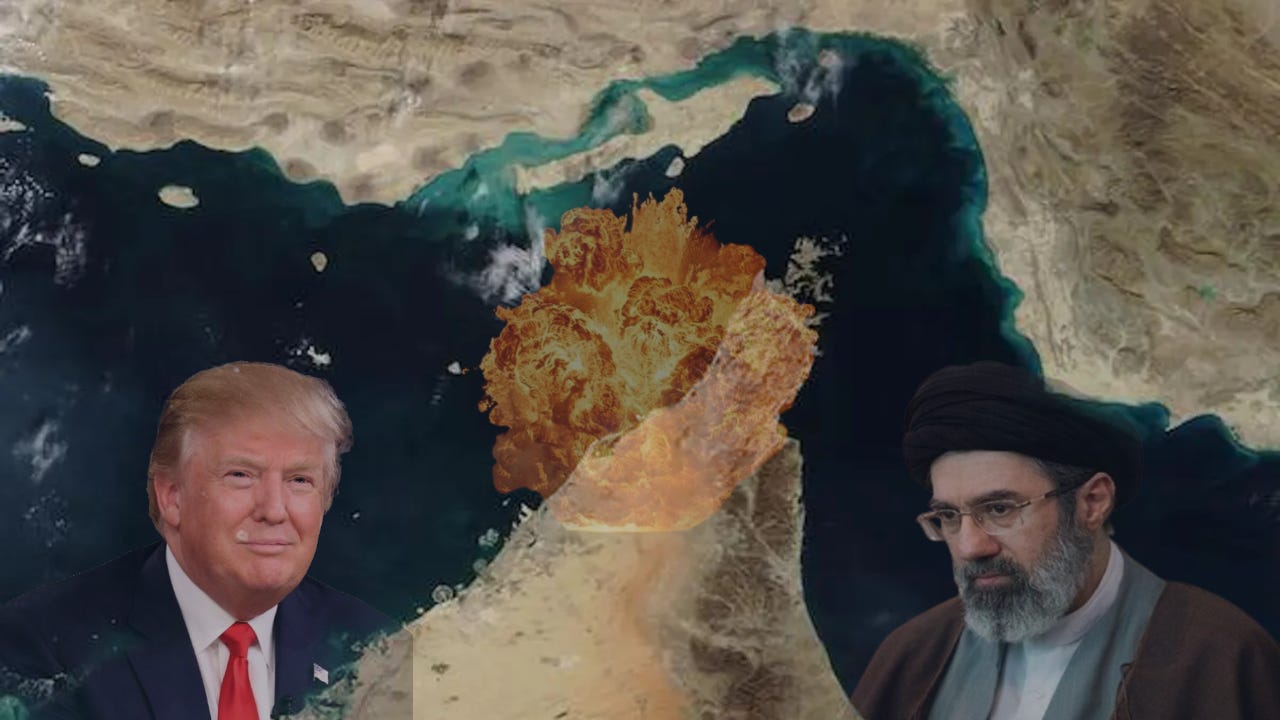
The prevailing narratives have all been stoking fears of a “wider war.” Yet the real risk has always been that the war will drag on.
The longer the US and Iran are at war, the longer the Strait of Hormuz will be shuttered. The longer the US and Iran are at war, the longer Persian Gulf oil will be stoppered up behind the Strait, forcing increasing shut-ins of production wells around the Gulf. The longer the US and Iran are at war, the higher the price of oil, the higher the price of oil’s refined products, and the greater the magnitude of the inevitable supply shock that will hit global markets.
There is no version of that which is not acutely painful for the entire world, oil importers and oil exporters alike. Some version of that is an increasingly probable outcome for the war—and sooner rather than later.
Welcome to Oilpocalypse Maybe.
War Update
The baseline facts of the war since the collapse of the ceasefire are little more than a repetition of earlier news reports: The US and Iran are trading air strikes, missile strikes, and drone strikes. Civilian infrastructures are coming under attack. Neither side seems all that interested in another ceasefire.
While narratives are fearful of a “wider war”, there is little sign of a war substantially different from the one before the the Memorandum of Understanding. There has been little sign of the war expanding to theaters beyond the Persian Gulf states. While Israel has not yet rejoined the fight, it is not hard to imagine them soon opting to do so, particularly if the Iranian-backed Houthis in Yemen continue to make noises about blockading the Bab al-Mandeb Strait at the entrance to the Red Sea. Already, the Houthis have claimed credit for attacks on two tankers in the Red Sea.
Regional mediators from Qatar, Egypt, and Pakistan are continuing to push resurrecting the Memorandum of Understanding and its 60-day ceasefire, but are meeting with lukewarm enthusiasm at best. President Trump is reported as willing to listen to ceasefire proposals, but is building up forces in the region as he listens, a clear sign that a major military attack against Iran is likely to happen in the near future.
In the end, the options for the US are effectively reduced to two:
Option 1: Pursue a new 10-day ceasefire aimed at reopening the Strait of Hormuz.
Option 2: Launch a massive joint military campaign with Israel to force Tehran’s capitulation.
Iran’s choices are not much different.
Option 1: Pursue a new 10-day ceasefire aimed at reopening the Strait of Hormuz.
Option 2: Launch a massive campaign against the whole of the Persian Gulf to force the US to back down.
Capitulation or conquest. Those are the choices for both sides.
At the moment, Option 2 seems to be the preferred choice for both sides.
President Trump is steadily building forces in the region, while telling the media that, with the attacks to date, the US has been “nice.”
Iran’s Foreign Minister Abbas Araghchi, for his part, is warning the US that Iran will attack Arab infrastructures in the region if the US targets Iranian infrastructures.
Persian Gulf Oil Is Not Flowing
Meanwhile, traffic through the Strait of Hormuz has collapsed yet again. It had not fully recovered from its closure in March, but what little traffic increase there had been has been snuffed out by the resumption of hostilities.
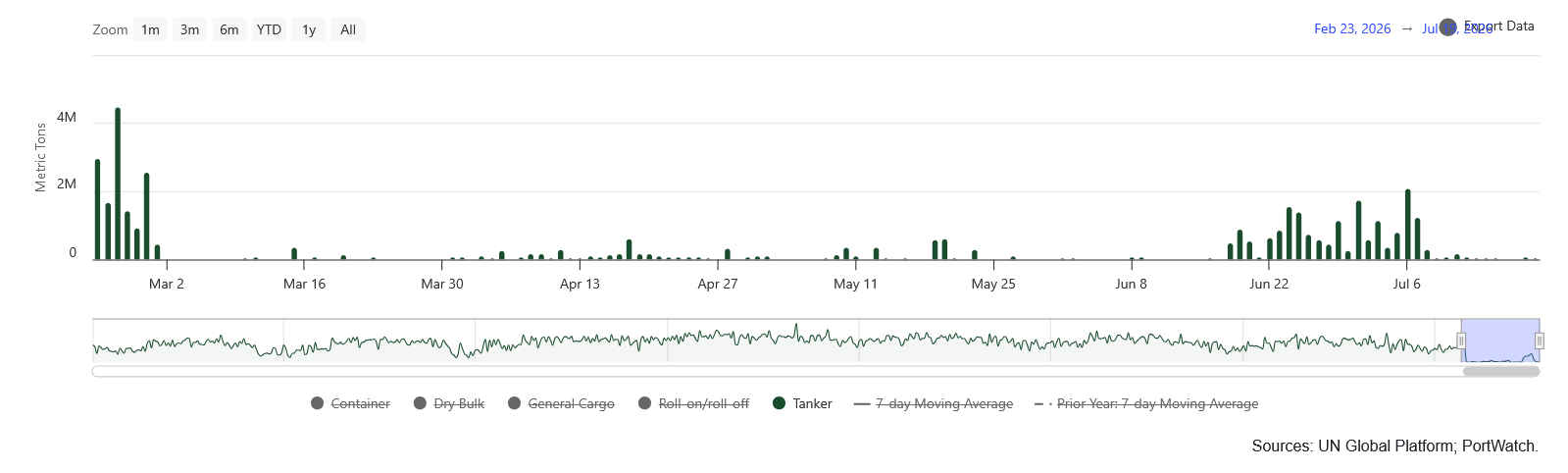
Oil is not flowing through the Strait of Hormuz, period. Not Saudi oil, not United Arab Emirates oil, not Iraqi oil, not Iranian oil. At present, no Persian Gulf oil is flowing.
The ramifications of the Strait’s closure are easily seen in oil production data from around the Persian Gulf.
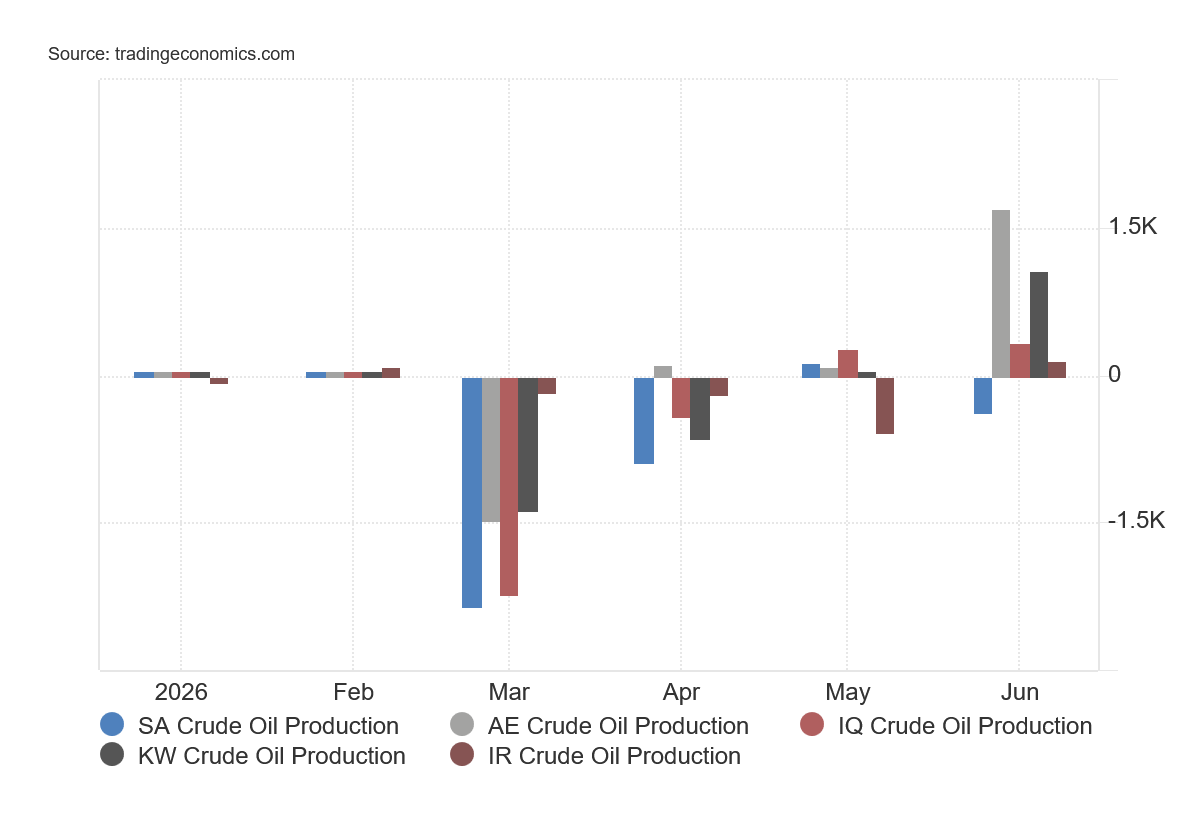
After the Strait’s initial closure, oil production fell around the Gulf, and continued falling through April. Some recovery was achieved in May, as the ceasefire talks gained traction. June, with the advent of the MoU and its brief ceasefire, saw substantial recovery in oil production volumes.
With the Strait effectively closed once more, June’s recovery will not be repeated in July. March’s production declines almost certainly will be repeated in July.
Energy Price Inflation Is Here
Oil prices are already reflecting this likely outcome, with both Brent Crude and West Texas Intermediate climbing steadily since the ceasefire broke down.
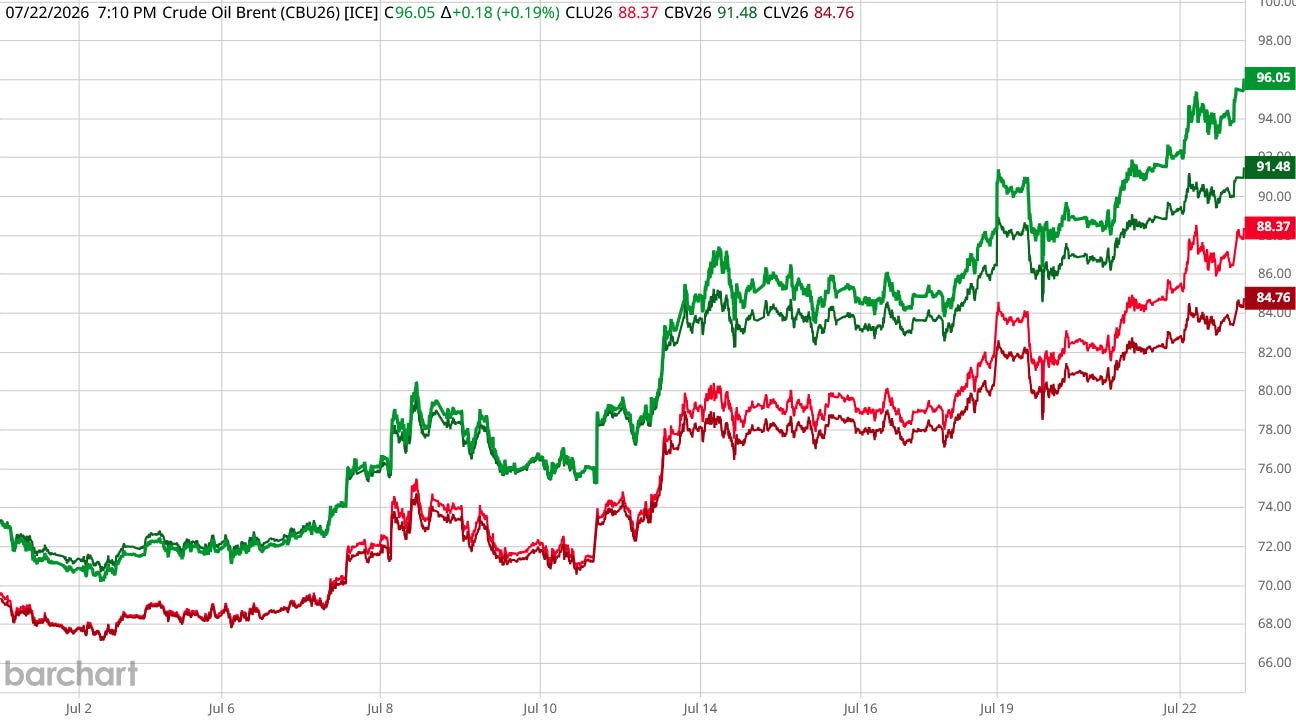
Tellingly, the spread between the September and October contracts, which had all but disappeared during the ceasefire, has widened dramatically, with the September Brent contract nearly $5/bbl more than the October contract, and West Texas Intermediate almost as bad. The market is pricing in a greater oil supply dislocation up front, with some mitigation later on.
There is little optimism to be found in oil prices. At $96/bbl for Brent (September Contract) as of this writing, it is only a matter of days before the $100/bbl threshold is breached. It might even happen before the weekend.
As the price of crude goes, so goes the price of oil’s refined products. Diesel prices are up by nearly a third since the start of July, with Asia and Europe enduring the greatest price increases thus far.
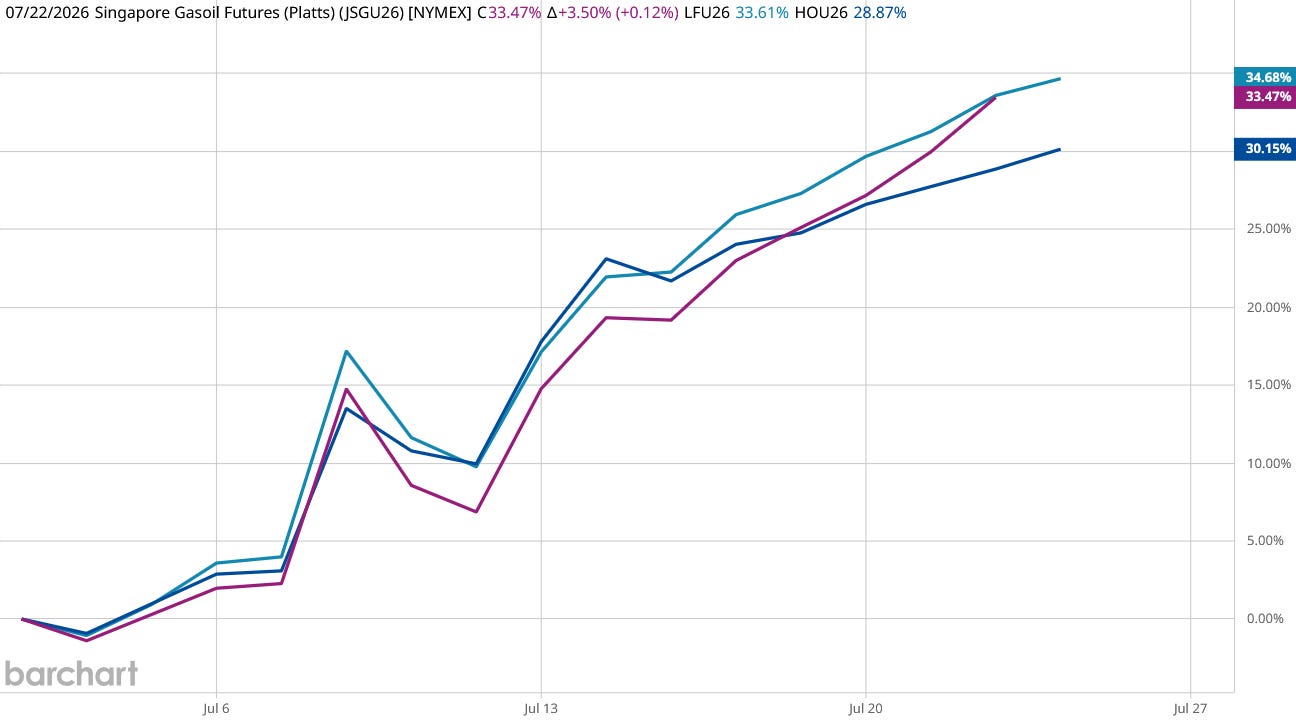
A vital trucking fuel is more expensive by nearly a third just since the start of July, with no discernible sign of reversing its upward trend. That is never going to end well for anyone.
Gasoline prices are up slightly less than diesel, with contract prices for reformulated gasoline “only” up 18% since the start of July.
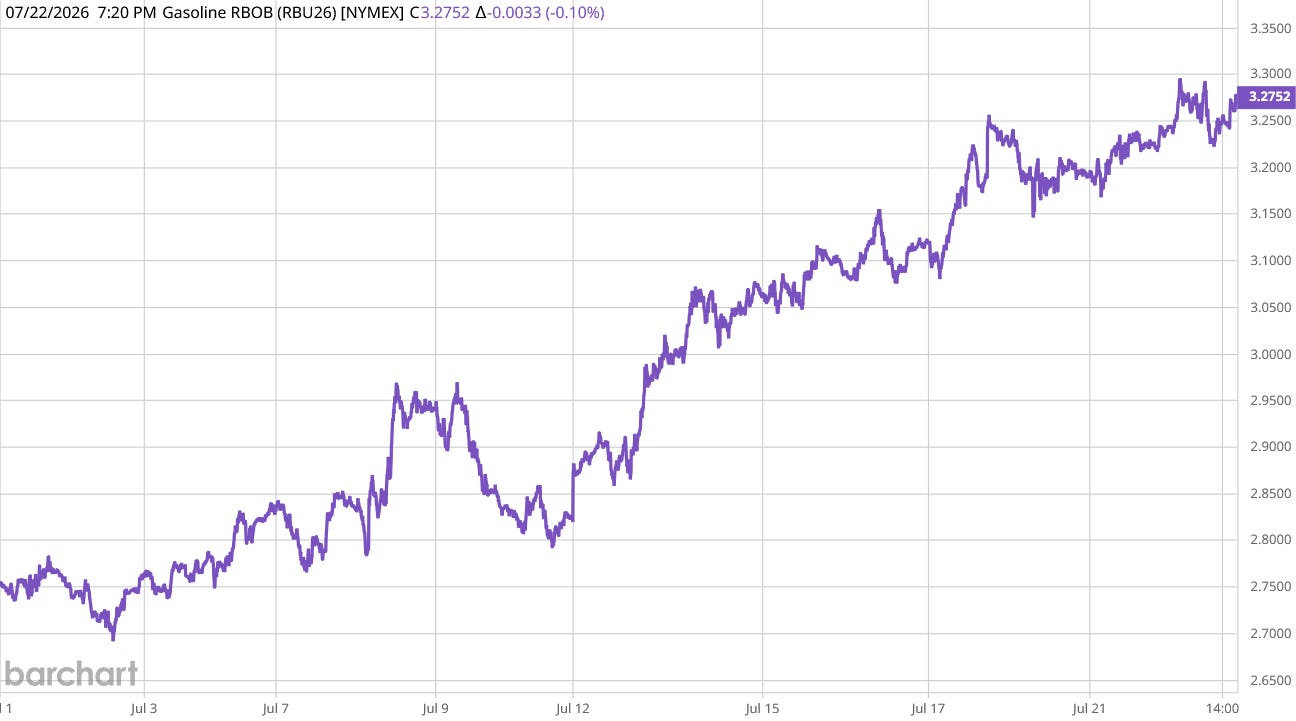
Fuel prices are already revealing where they will be felt the most. Bunker fuel prices have risen very nearly $100/metric ton in Asia, and approximately $70/metric ton in the US.
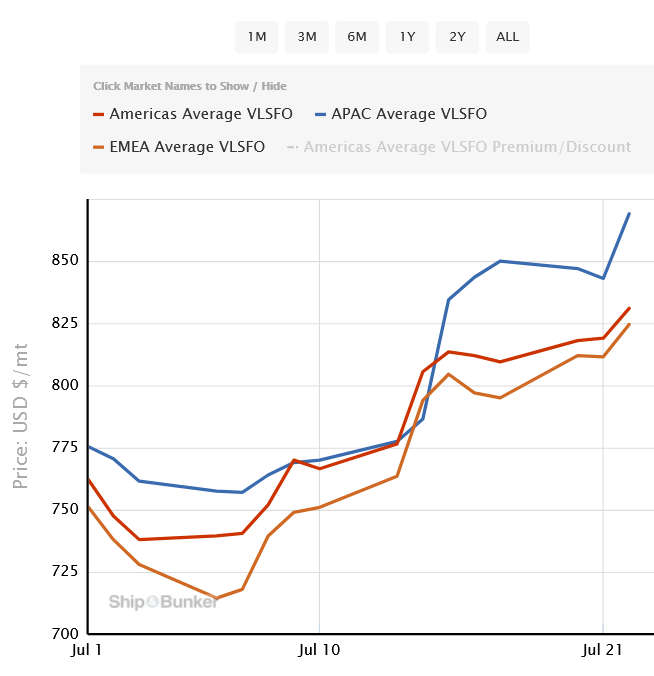
As was the case before, the economic impacts of the Strait’s closure hit Asia far more severely than America or even Europe. Energy price inflation in the form of increased maritime fuel prices is already hitting Asia.
These are not minor price fluctuations, these are price surges—and they are stark evidence that shipping costs are increasing rapidly. They are grim predictors that shipping costs will continue to increase over the near term at least.
Not Just Crude Oil
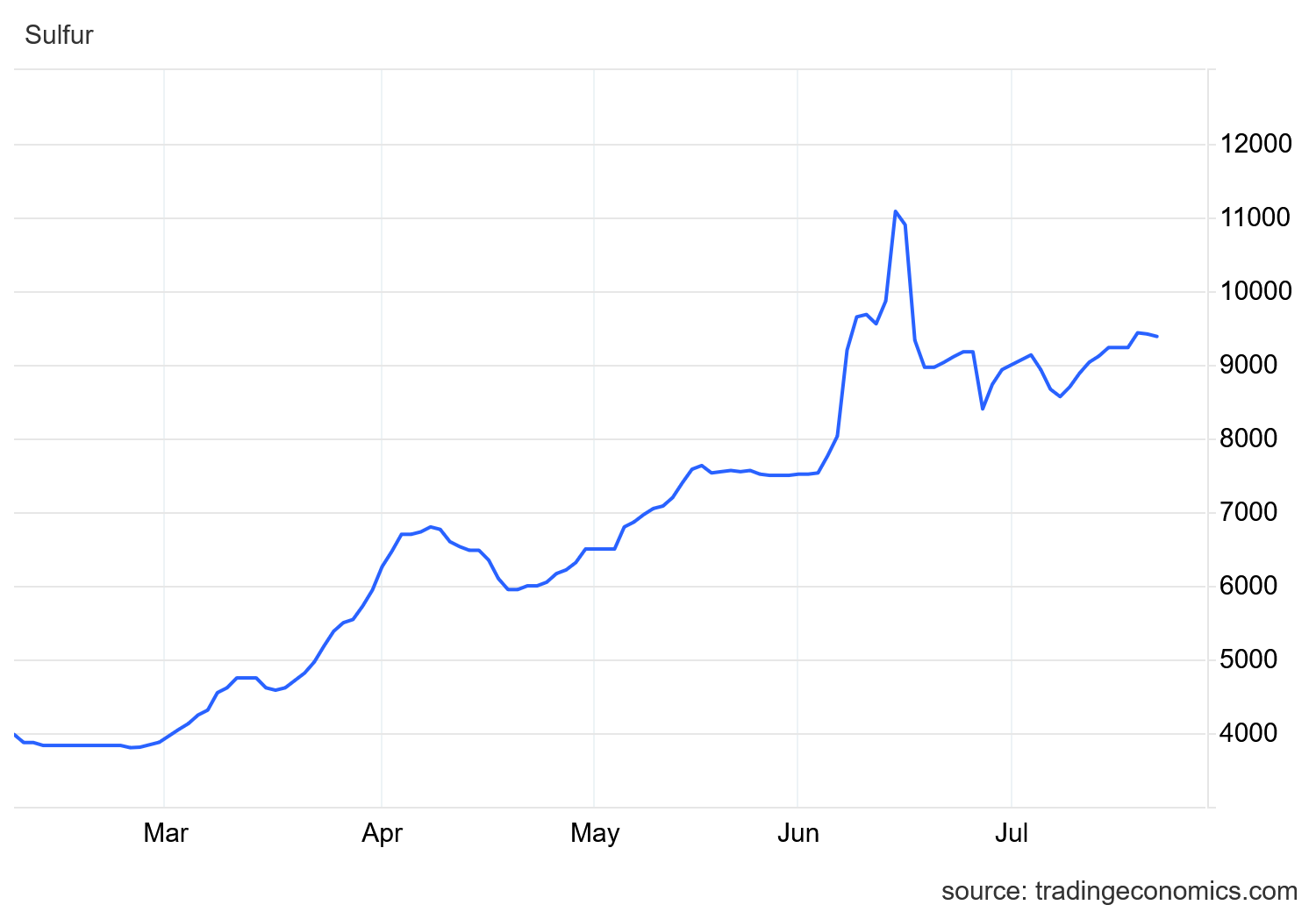
Other oil-related products are moving up in price as well. Sulfur prices, which had only partially retreated from their June highs, are heading back towards those highs.
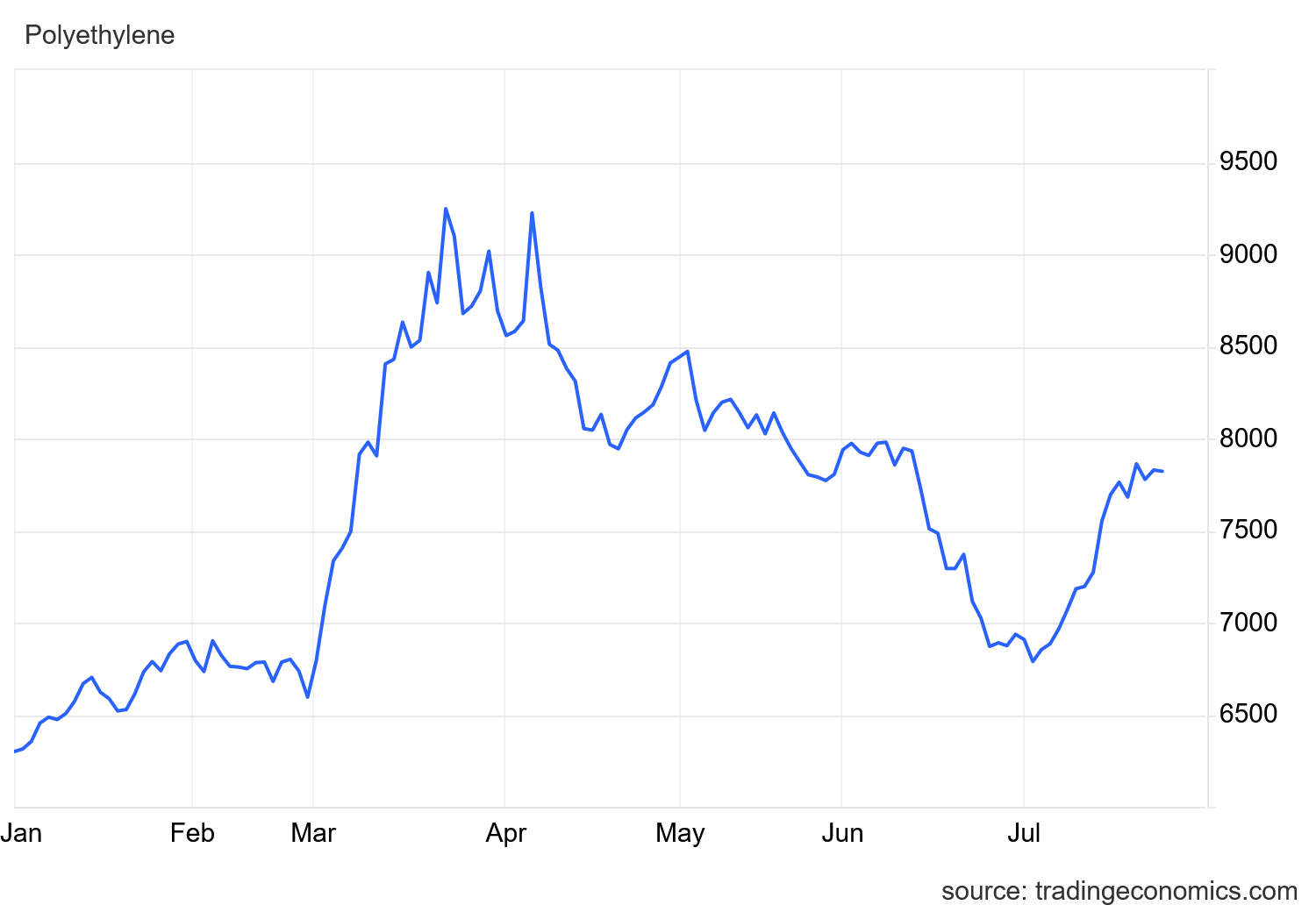
Polyethylene, which had almost returned to pre-war price levels, has surged in July.
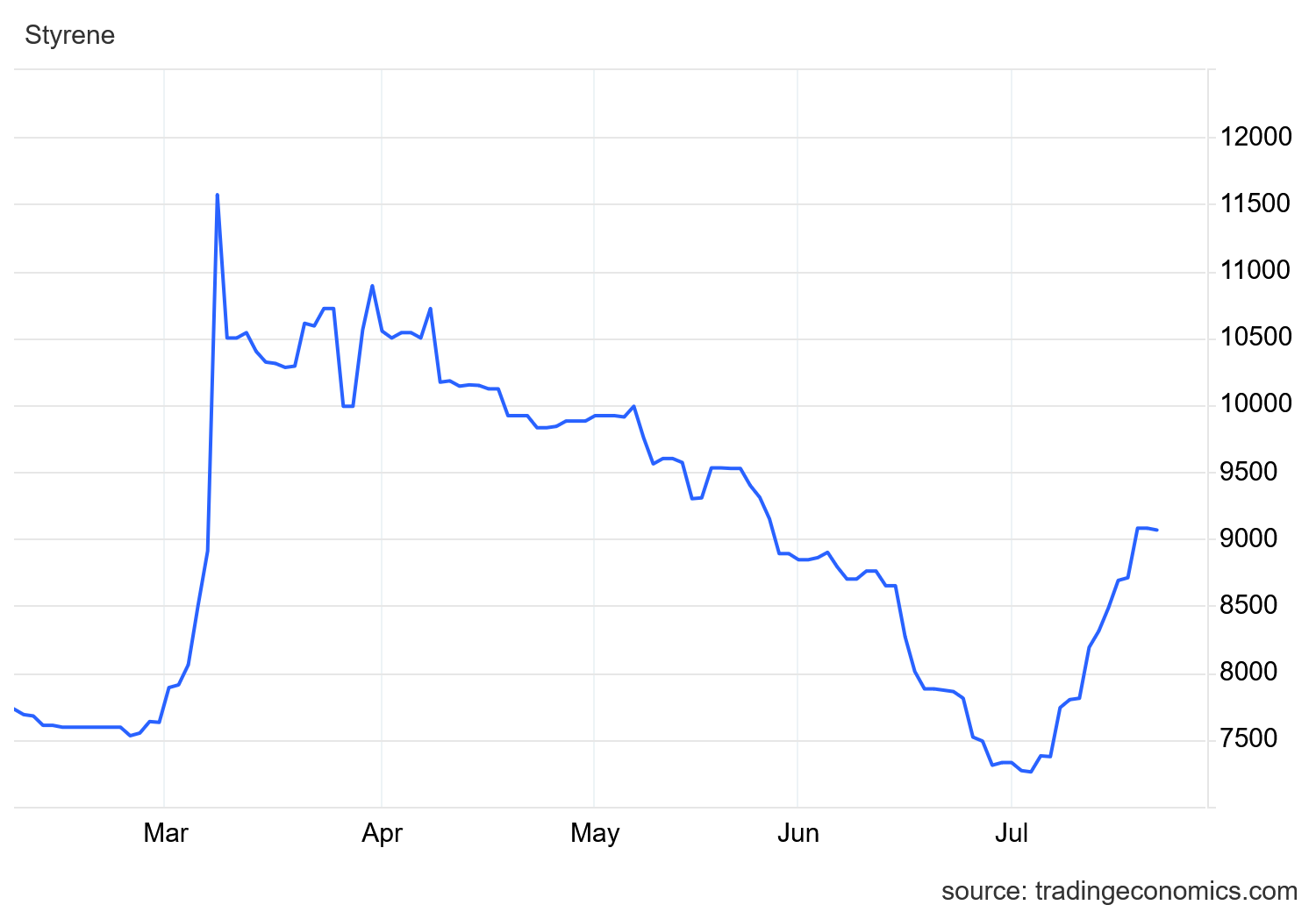
Styrene is showing similar price behaviors, having erased most of the recent declines.
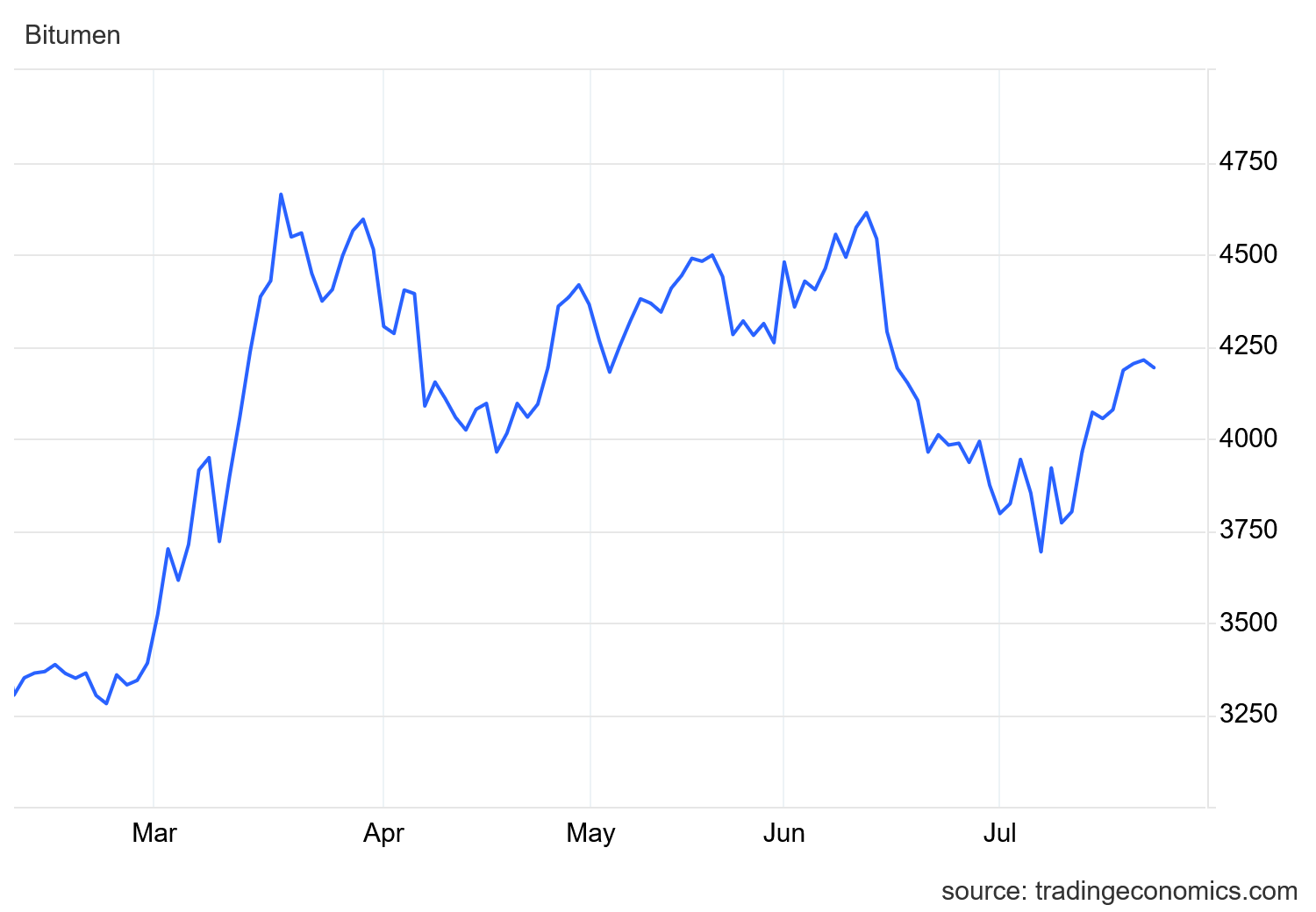
Bitumen is also surging in price.
As I discussed early on in the war, these commodities price surges greatly increase production costs around the world, and especially in China.
No More Buffer?
The situation is compounded by the risk that strategic reserve releases as a price buffer are at or near exhaustion. The US Strategic Petroleum Reserve has a statutory floor level of 252.4 million barrels, and at the current pace of releases it will reach that floor sooner rather than later.
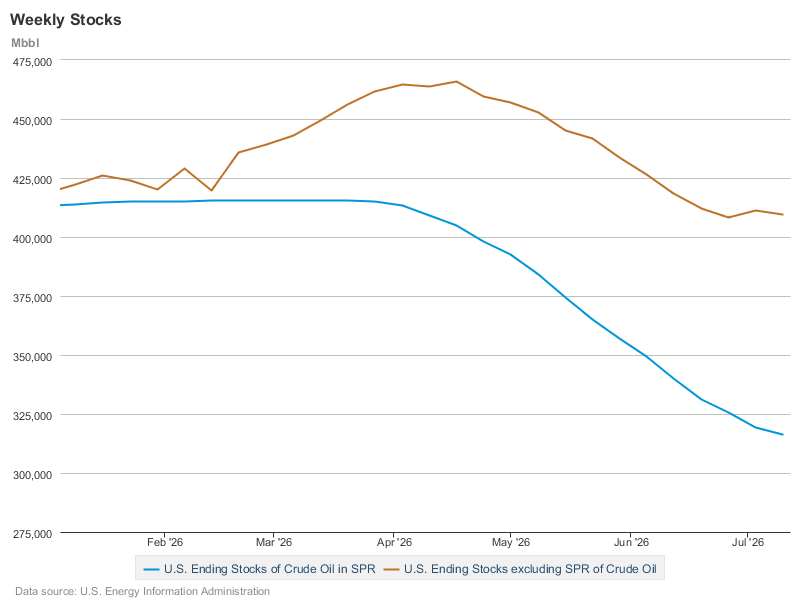
Without strategic reserve releases, the price impacts of the oil supply shock catalyzed by the Strait of Hormuz being closed again will be magnified relative to what they have been. Strategic reserve releases have kept effect oil supply greater than what it would be otherwise, mitigating some of the inflationary pressures from the Strait’s closure.
Without strategic reserve releases, an extended closure of the Strait of Hormuz constitutes a fresh oil supply shock soon to hit global oil markets.
This could be the stagflation the world had seemingly avoided with the ceasefire. It certainly is not going to help keep prices down anywhere.
This is the real threat posed by ongoing war in the Persian Gulf—the potential for extended and extreme economic disruptions from a series of primary and secondary price and supply shocks arising from the closure of the Strait of Hormuz. The ramifications of these disruptions have not changed from before, and these dislocations are very much a world problem, not just an American one.
If war continues, Persian Gulf oil does not flow. Without Persian Gulf oil, energy prices surge as global energy supply falls. There is no alternative scenario, no other possible outcome.
“Oilpocalypse”
This is the “oilpocalypse”—major global economic disruption catalyzed by surging oil prices and a fresh global oil supply shock.
China’s manufacturing costs are sure to rise in several industries. With China’s economy already struggling, the stagflation potentials from an oil supply shock are significant for the Middle Kingdom.
Freight costs are sure to increase, as bunker fuel prices continue to move up.
Energy price inflation is already a certainty.
How much inflation will we see? As the war drags on, quite a bit. Oil prices are already close to the $100/bbl threshold. Short of an outbreak of peace in the Middle East, we will not see oil prices retreat dramatically. We will see them rise dramatically. We cannot rule out oil prices surpassing the peaks reached in April.
Energy price inflation is already happening. What remains to be seen is how far beyond energy inflation will spread.
The reality of supply shocks is that they are by definition an abrupt reduction in overall supply. In order for price equilibrium to be restored, demand has to be reduced accordingly.
There is not a second outcome available. Whether that demand destruction is achieved through regulatory and monetary mechanisms (e.g., central bank interest rate hikes) or simply through letting inflation run rampant, the end result must be the same: demand falls until equilibrium with supply is restored.
For the United States, that would mean a return to either the stagflation of the 1970s or the induced deep recession of 1981-1982 from Fed Chairman Paul Volcker’s extreme interest rate hikes. If this war drags on long enough, if Iran remains intransigent and hostile long enough, that is the economic outlook for the United States. If this war drags on long enough, if Iran remains intransigent and hostile long enough, that is the economic outlook for the entire world.
Can this outcome be avoided? Easily—assuming a ceasefire is arranged before long, and sustained for at least some time. Yet even a ceasefire only delays the inevitable if it does not lead to a lasting peace arrangement. A ceasefire reopens the Strait of Hormuz and eases global oil prices, but as we are seeing right now, when a ceasefire collapses the Strait closes and global oil prices surge anew. Another failed ceasefire would only delay global economic crisis. A permanent peace is needed to avoid it.
Will there be a new ceasefire? Mediators are certainly working to make one happen. Whether they succeed and whether a new ceasefire lasts are questions that are inherently unanswerable until a ceasefire actually happens. Global economic prospects hinge on their successes or failures in this regard.
Welcome to Oilpocalypse Maybe.
Thank you again for a factual picture, Peter. I’ve been amazed at how little this war is being covered by corporate media. Even for them, it comes across as seriously lazy - and, as usual, manipulative.
I’d love to see updated data on a bunch of metrics. What’s the updated numbers for how much oil storage space does Iran have; how many drones left; how much foreign currency; and any other indicators of how long Iran can stay fighting? What are the updated estimates for how much longer China can keep from dramatic economic crisis? I’m sure you’re on the lookout for these kinds of numbers, and will be the first to give a meaningful analysis. You are so good at this!
Meanwhile, we also aren’t hearing much from corporate media regarding the spreading effect of this war in the gulf region. Is Iraq destabilizing as a result of lower oil sales? Is internal opposition to the Saudi regime increasing? Are military analysts worried about other Islamic countries, such as Pakistan, getting actively involved? There are so many possibilities within the context of a wider war. You, Peter, are one of the few analysts we can count on to stay factual, and not go off on wild extrapolation or narratives. Thank you for being you!
Dismal, but realistic assessment. The hardest kind to make. Thank you.